ECONOMICS COMMENTARY — 09 Oct, 2026
Global goods export growth accelerates to fastest in over five years

By Jingyi Pan
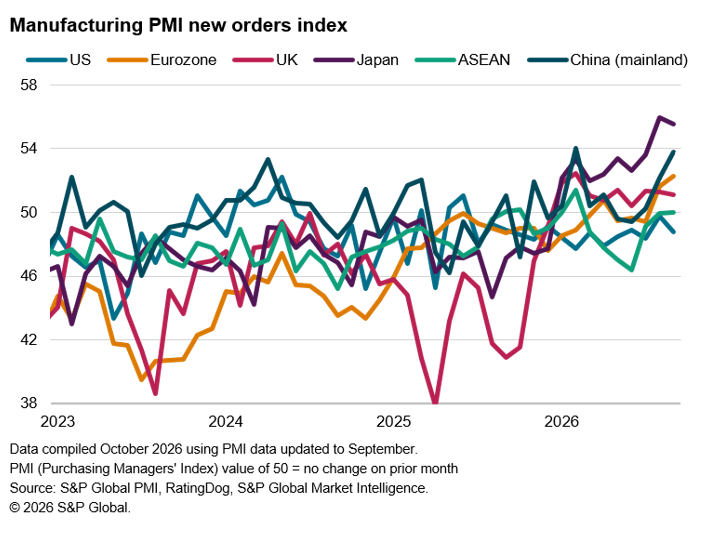
Global goods trade further picked up momentum at the end of the third quarter, with new export orders rising worldwide at the fastest pace since July 2021, according to the Purchasing Managers’ Index™ (PMI®) surveys. Growth was notably led by North Asian economies, including Taiwan, Japan and South Korea, while Germany and the Netherlands also showed especially strong growth.
The latest improvement in new export sales unfolded against a backdrop of an extended period of global production growth, providing early signs of a stabilisation in manufacturing trade into the second half of the year. That said, it remains to be seen whether the recovery will persist with factors including defence equipment expenditure, linked to the wars in Ukraine and the Middle East, and further AI-related equipment spending amid ongoing price increases potentially proving transient.
Broad-based improvement in trade in September
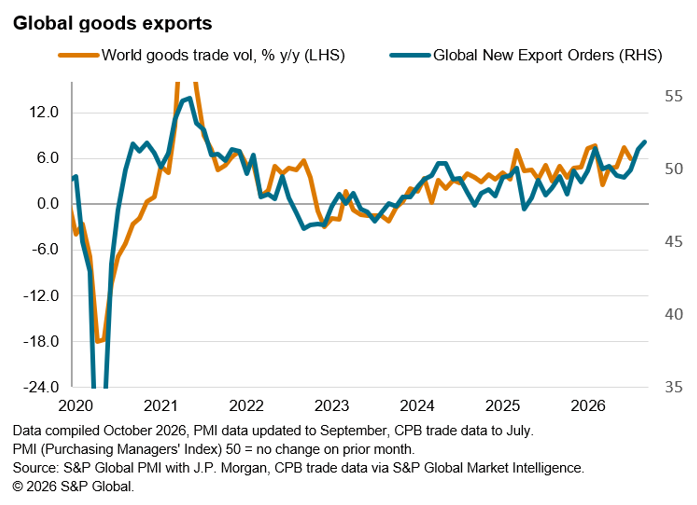
The seasonally adjusted Global Manufacturing PMI New Export Orders Index, sponsored by J.P. Morgan and compiled by S&P Global, posted above the 50.0 no-change mark for a second consecutive month in September. This indicated the first back-to-back expansion in new orders from abroad in over two years. At 51.9, the latest reading was the highest seen since July 2021 and is indicative of global merchandise trade growing at an annual rate of approximately 8% at the end of the third quarter.
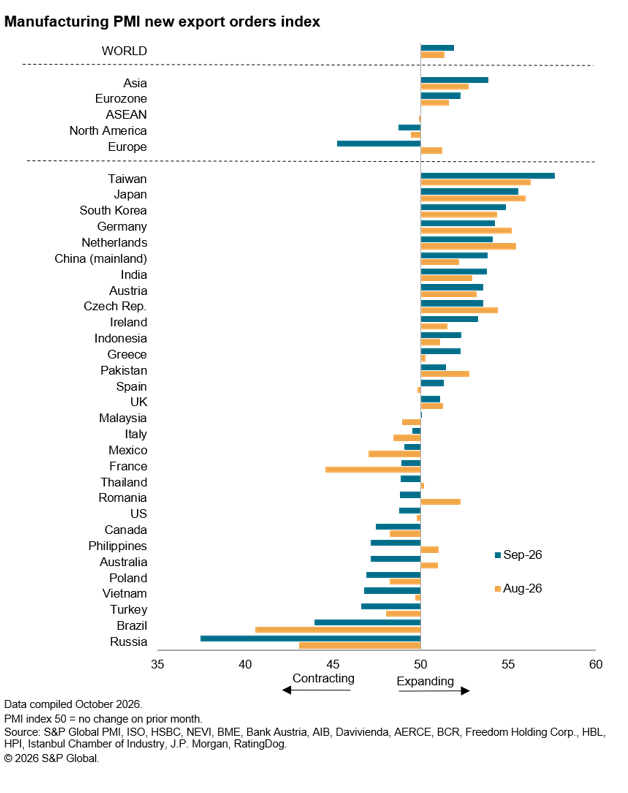
Encouragingly, growth was broad-based by region with both developed and emerging economies posting growth in new export orders. Trade from emerging markets in fact accelerated and overtook developed economies for the first time in seven months, posting the fastest rise in new export orders in the same period.
Beyond manufacturing, services new export business also rose for the second time in a row and at a quicker rate than in August amid a broad acceleration in service sector growth, altogether indicative of better overall trade performance at the end of the third quarter of 2026.
Taiwan and Japan post strongest rise in new export orders
Among the economies tracked by the PMI survey, Taiwan and Japan again emerged as the strongest performers in terms of growth in goods export orders.
Taiwan led worldwide manufacturing export growth for the fourth successive month, with the sharpest rise recorded since July 2021, thereby pointing to the strongest improvement in overseas demand for Taiwanese manufactured goods since the post-COVID-19 period.
Meanwhile, Japan saw the rate of new export orders expansion ease slightly from an over-eight-and-a-half year high in August, though the pace of growth remained the second-fastest over this period.
Joining Taiwan and Japan among the top performers was also South Korea, where the expansion of new export business was the most pronounced since March 2011. Anecdotal comments from South Korean manufacturers pointed to demand strengthening for semiconductors and automobiles in September.
On the other hand, the worst performers were Russia and Brazil in September. Russia faced the sharpest decline in export trade since mid-2022 with goods demand reportedly affected by rapidly rising prices and intense competition as well as ongoing sanctions.
Meanwhile, Brazil’s new export orders declined at a rate that was less pronounced than in August but nevertheless steep, as natural-resource-focused economies remained under pressure.
By broad region, Asia was the best performer in September owing to the improvements across various North Asian economies. Europe lagged, attributed mainly to the weakness in Turkey, as the eurozone and UK both saw new export business increase modestly in September.
Technology exports lead growth in export sales
Looking more closely at sector performance, the latest PMI survey showed that growth in new export orders was led by the technology sector, which overtook healthcare in September.
Following the wave of tariff-related front-loading activity, the AI-driven increase in global goods production has continued into the second half of 2026 so far. Signs of buffer stock building, attributed to concerns over supply bottlenecks and price increases associated with disruptions from the Middle East war, remained evident in September and further spurred the rise in trade for tech-focused economies. This was seen also with the surge in buying activity among technology equipment firms and with stocks of inputs increasing for the seventh consecutive month.
Additionally, there were once again indications of defence-related spending driving manufacturing activity growth into the end of the third quarter.
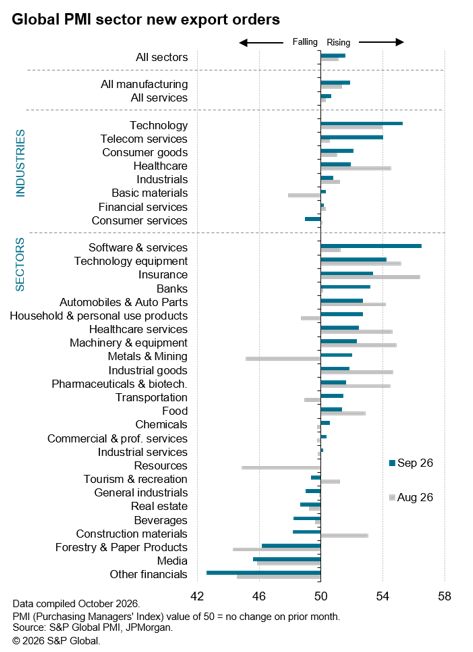
The positive news from September was the slight broadening out of the manufacturing upturn, with basic material companies notably now among the ones posting higher new export orders for the first time in five months. That said, with uncertainty continuing to shroud both the unrest in the Middle East and the degree to which input prices will continue to increase, the demand trend will need to be further monitored to assess the sustainability of the ongoing recovery in trade activity.
© 2026, S&P Global. All rights reserved. Reproduction in whole or in part without permission is prohibited.
Purchasing Managers' Index™ (PMI®) data are compiled by S&P Global for more than 40 economies worldwide. The monthly data are derived from surveys of senior executives at private sector companies, and are available only via subscription. The PMI dataset features a headline number, which indicates the overall health of an economy, and sub-indices, which provide insights into other key economic drivers such as GDP, inflation, exports, capacity utilization, employment and inventories. The PMI data are used by financial and corporate professionals to better understand where economies and markets are headed, and to uncover opportunities.
Read our latest PMI commentary here.
This article was published by S&P Global Market Intelligence and not by S&P Global Ratings, which is a separately managed division of S&P Global.
Theme
Location
Products & Offerings