ECONOMICS COMMENTARY — 12 Oct, 2026
Emerging markets growth lags developed economies in September

Output growth in emerging markets was outpaced by the rapid expansion seen in developed economies during September, with the rate of increase unchanged from August. An improving international environment should help drive stronger growth in emerging markets in the months ahead, however, and some more forward-looking indicators from the PMI surveys suggest that this will be the case.
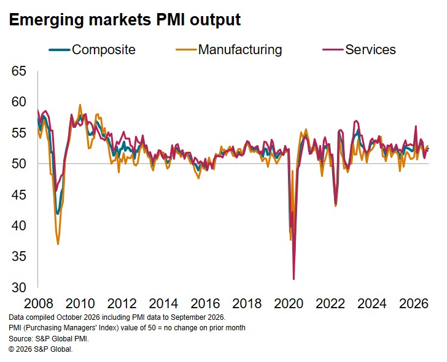
Emerging markets growth unchanged
Business activity across emerging economies increased solidly in September, extending the current sequence of rising output which stretches back to the start of 2023. That said, the rate of expansion was unchanged from August as a sharper rise in manufacturing production was countered by a fractionally slower increase in services business activity.
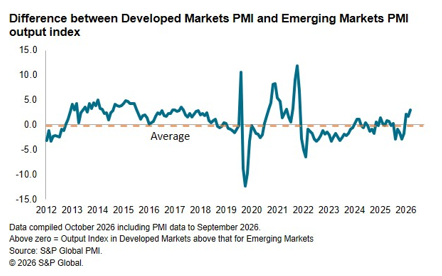
The stable pace of growth in emerging markets was in contrast to the picture in developed economies, where the rate of expansion accelerated for the fourth successive month to the steepest in almost four-and-a-half years.
In fact, the underperformance of the output PMI data among emerging markets relative to their developed markets counterparts was the most pronounced since May 2022.
Improvements in manufacturing production centred on Asian economies
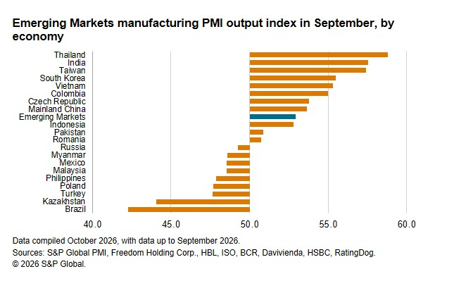
While overall emerging market business activity increased at the same pace as in August, the rate of expansion in manufacturing production quickened to a four-month high. On a geographic basis, the five fastest-growing manufacturing economies in September were in Asia as strong demand for electronics in particular drove growth in these economies. In fact, outside Asia only Colombia and the Czech Republic saw output rise more quickly than the emerging market average.
Manufacturing performance in emerging European and Latin American markets was generally more mixed than seen in Asia. Brazil reported the steepest downturn, posting a rapid fall in production amid demand weakness, competitive pressures, uncertainty in the run-up to the presidential elections, and higher cost burdens. Manufacturers in Kazakhstan also recorded sharply falling output as the demand environment there continued to deteriorate.
Signs of optimism for months ahead
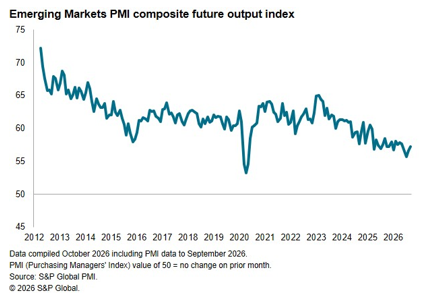
Although the expansion in business activity failed to gather pace in September, other indicators from the PMI surveys suggest that growth could pick up in the months ahead. Chief among these was increased success in securing new orders, which rose at the fastest pace since February. With output growth unable to keep up with that of new orders amid only marginal job creation, backlogs of work rose across the emerging markets for the first time in three months, albeit marginally. Companies will likely be looking to expand output more quickly in the months ahead in an attempt to catch up on outstanding business. Moreover, business sentiment also showed signs of revival, improving further from July’s six-year low to the highest since May.
Inflationary pressures remain under control
Another factor potentially helping to support growth in the months ahead is the relatively muted inflationary environment relative to the advanced economies. Input costs increased at a fractionally quicker pace in September, but one that was still broadly in line with the average seen post the COVID-19 pandemic and well below the historically elevated rates seen in the major advanced economies. Meanwhile, firms’ selling prices rose only modestly and at the slowest pace in 2026 so far.
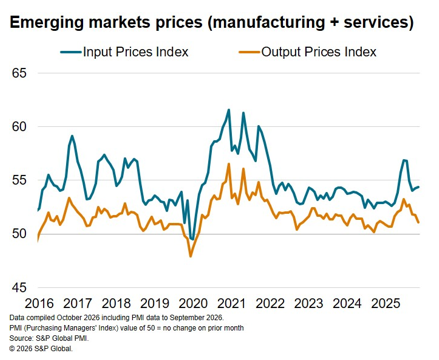
Overall, the latest PMI data show emerging markets struggling to keep pace with the growth seen in developed economies, but with the potential to see rates of expansion quicken in the months ahead.
© 2026, S&P Global. All rights reserved. Reproduction in whole or in part without permission is prohibited.
Purchasing Managers' Index™ (PMI®) data are compiled by S&P Global for more than 40 economies worldwide. The monthly data are derived from surveys of senior executives at private sector companies, and are available only via subscription. The PMI dataset features a headline number, which indicates the overall health of an economy, and sub-indices, which provide insights into other key economic drivers such as GDP, inflation, exports, capacity utilization, employment and inventories. The PMI data are used by financial and corporate professionals to better understand where economies and markets are headed, and to uncover opportunities.
Read our latest PMI commentary here.
This article was published by S&P Global Market Intelligence and not by S&P Global Ratings, which is a separately managed division of S&P Global.
Theme
Location
Products & Offerings