Research — September 22, 2026
Micron: A look at memory ahead of Q4 earnings

By Melissa Otto, CFA
Micron (NASDAQ: MU) is going to report its fiscal Q4 earnings on Wednesday, September 30, 2026. Here is a look at the key drivers for Micron’s outlook and the memory space.
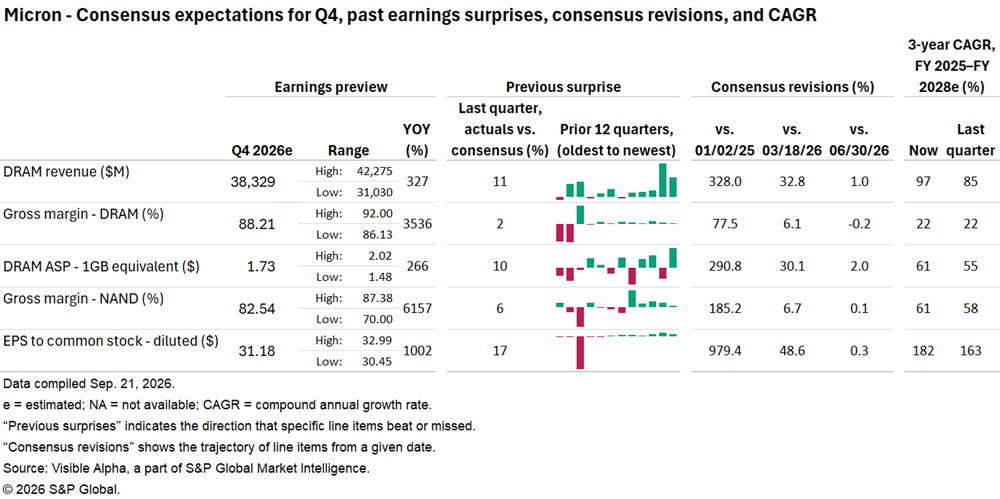
One of the most dramatic market moves around the AI story has been the recent move of memory stocks. Memory, especially High Bandwidth Memory (HBM), plays an important role in ensuring AI workloads run efficiently and fast, reducing latency. The strength of HBM is that it increases performance by stacking traditional Dynamic Random Access Memory (DRAM) layers vertically, while decreasing the amount of power consumed. As investment in data centers for AI has exploded, demand for memory has become a critical component of AI accelerators, like NVIDIA Corp.’s Blackwell GB200/B200. As a result of the surge in demand, memory prices have increased significantly, causing upward revisions to the potential earnings growth expectations for the space.
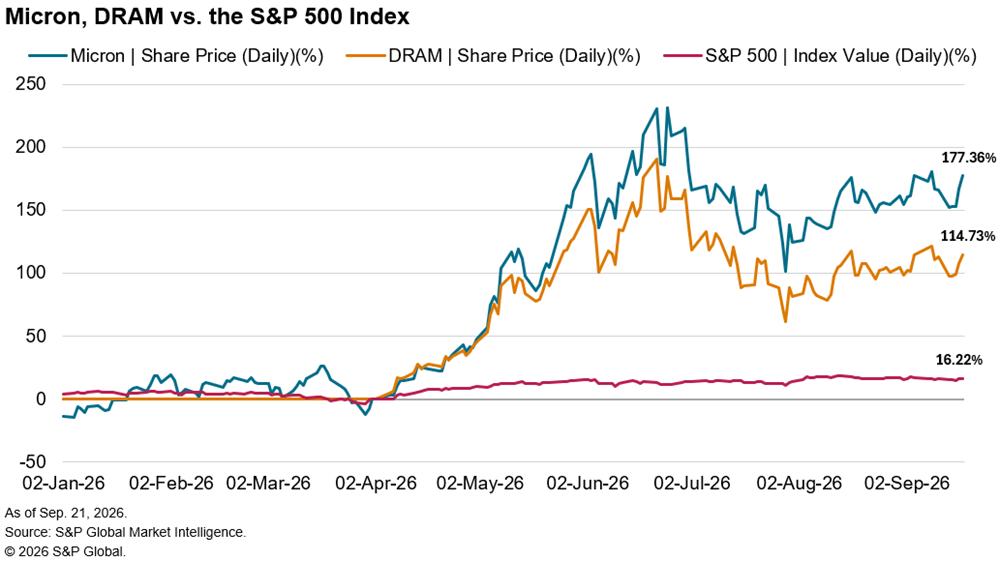
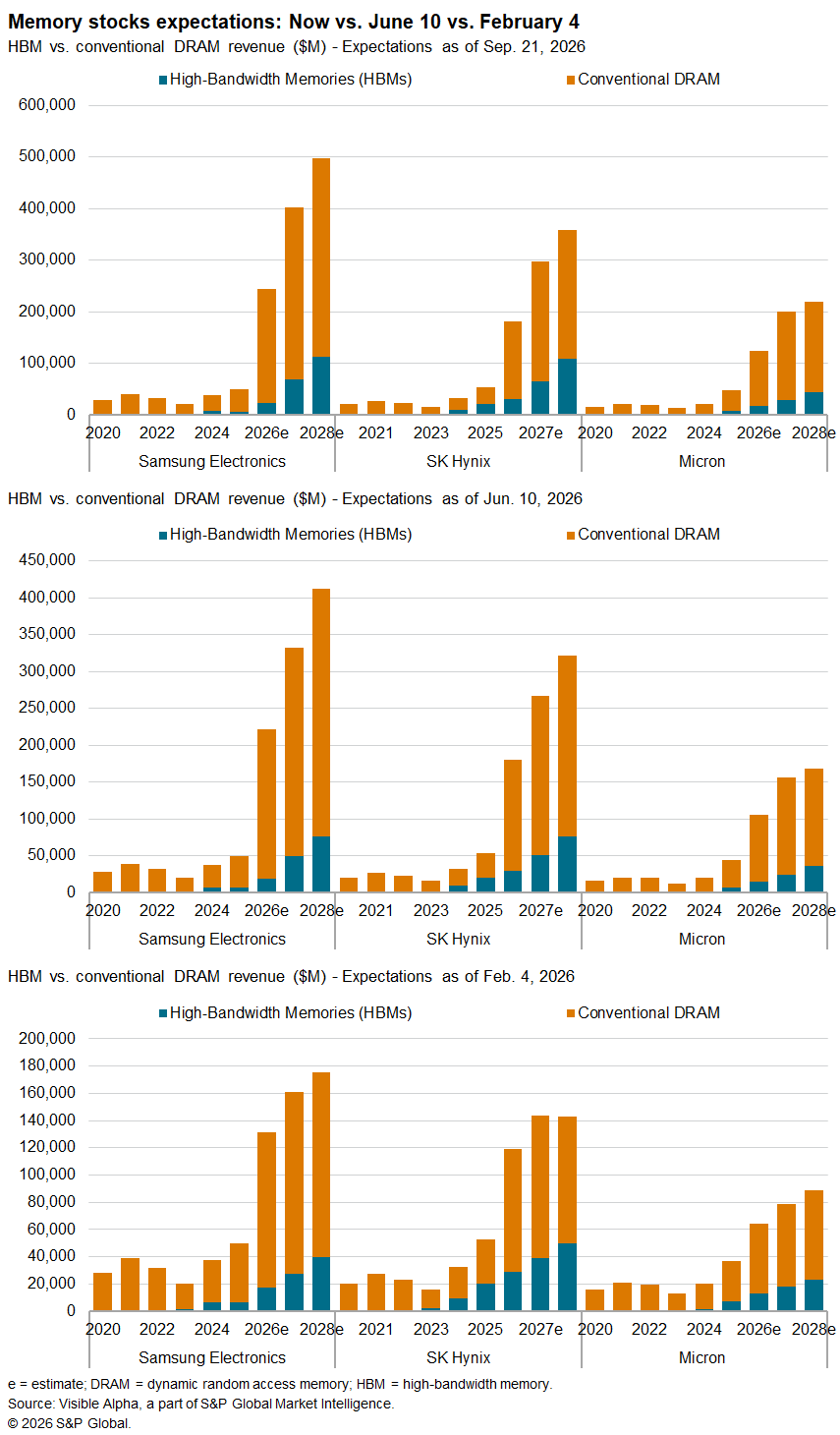
Micron’s quarterly estimates for both DRAM and NAND memory sales and gross profit have increased substantially since March, more than tripling since last year. Consenus projects $50.7 billion in total revenue this quarter, driven by $38.3 billion in DRAM revenue, up 22% quarter-over-quarter. More importantly, DRAM estimates are expected to generate $42.8 billion next quarter, up 12% quarter-over-quarter. Micron’s guidance this quarter will be a potentially important signal to the markets about the trajectory for memory. In addition, Management’s commentary about the durability of demand and how the company will handle pricing and contracts longer-term will be key issues in understanding the runway of longer-term earnings growth.
Micron’s DRAM revenues continue to grind higher for FY 2027. Gross profit consensus for DRAM has jumped 500bps this year and 700bps for next year, capturing the higher prices and driving FY 2027 EPS to now $156/share, up sharply from $90/share in March or a P/E of 6.8x.
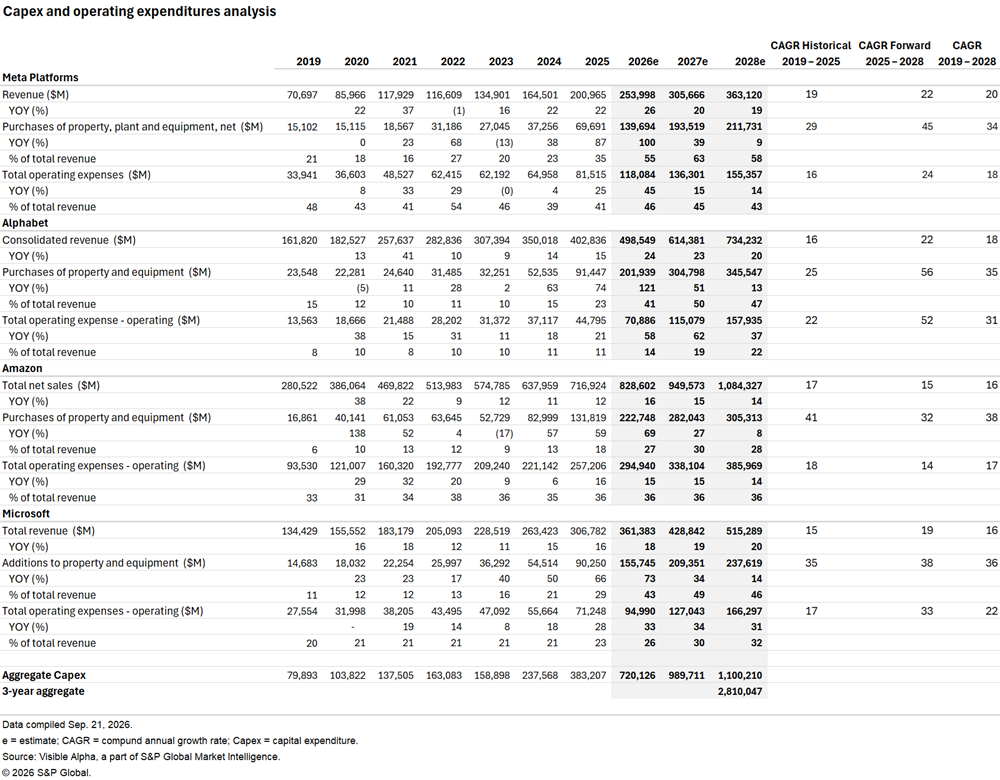
$2.8 trillion in expected AI capex spending by the hyperscalers
The pace of these upward revisions is moving in tandem with the capex spending of the hyperscalers. Only last year, the expected spending was projected to be ~$1.2 trillion this year and in 2027, is now expected to be $1.7 trillion, up 42% since last fall. In 2028, these four companies are expected to spend a further $1.1 trillion, totaling $2.8 trillion over the next three years.
With the hyperscalers continuing to increase their capex guidance, will memory demand and prices continue to exceed expectations?
Micron sees a longer and structurally different memory cycle
At the KeyBanc Capital Markets Technology Leadership Forum on August 10, 2026, Micron Chief Business Officer Sumit Sadana said customer demand had strengthened further since the company’s Q3 earnings, with demand continuing to outpace supply.
Micron's comments reinforce the case that the current memory upcycle could be more durable than previous cycles. Demand is broad-based, with Micron saying it can sometimes meet less than half of customer demand in data centers. Management expects industry conditions to remain tight beyond 2027, with 2027 potentially tighter than 2026.
AI is also changing the memory equation. As generative AI moves toward reasoning and agentic workloads, memory requirements are increasing. Micron sees DRAM as the primary infrastructure constraint, ahead of power, data-center capacity and logic wafers. HBM is adding to the pressure because it requires substantially more wafer capacity than conventional DRAM, with Micron citing an approximately 3:1 trade-off between HBM3E and DDR, potentially rising toward 4:1 with HBM4E.
The supply response will take time. Building leading-edge memory fabs is a multiyear process, and Micron said it does not yet have visibility on when industry supply will catch up with demand.
Micron is also securing greater visibility into future demand. The company has signed 16 Strategic Customer Agreements covering more than $22 billion of cash and cash-like commitments, including $18 billion in cash. Most agreements run for five years through 2030 and include binding, take-or-pay commitments, pricing mechanisms and no contractual outs. The agreements are intended to provide greater visibility into volumes and pricing while supporting investment in additional capacity.
Customer relationships are also becoming more strategic. Micron is increasingly co-engineering memory products with customers, particularly HBM, with technology road maps extending beyond 2030. The company expects custom HBM products to become possible from HBM4E onward, potentially making parts of the memory market more differentiated and less commoditized.
Supply constraints are also affecting server configurations. Micron said some customers are reducing DRAM density per server because they cannot secure enough supply, rather than simply because of higher prices. At the same time, increasingly complex AI workloads and longer context windows are raising DRAM requirements, while insufficient DRAM capacity can push KV cache into NAND, supporting demand for both memory and storage.
This article was published by Visible Alpha, part of S&P Global Market Intelligence and not by S&P Global Ratings, which is a separately managed division of S&P Global.
Content Type
Products & Offerings
Segment

