Research — Sep 25, 2026
Cutting the broadband cord – fixed wireless, satellite, mobile data or nothing

By Brian Bacon
Not only are consumers cutting the pay TV cord, but wired home internet service providers are also facing households that have never had home broadband service or are instead turning to fixed-wireless, satellite and mobile data alternatives. According to results from S&P Global Market Intelligence Kagan's MediaCensus online consumer survey, conducted in the first quarter of 2026, 16% of respondents indicated that they did not subscribe to a wired home broadband service. That 16% included fixed wireless at 9%, satellite home internet at 2%, and those who only use their smartphones for home internet or have no home internet at 2% and 3%, respectively.
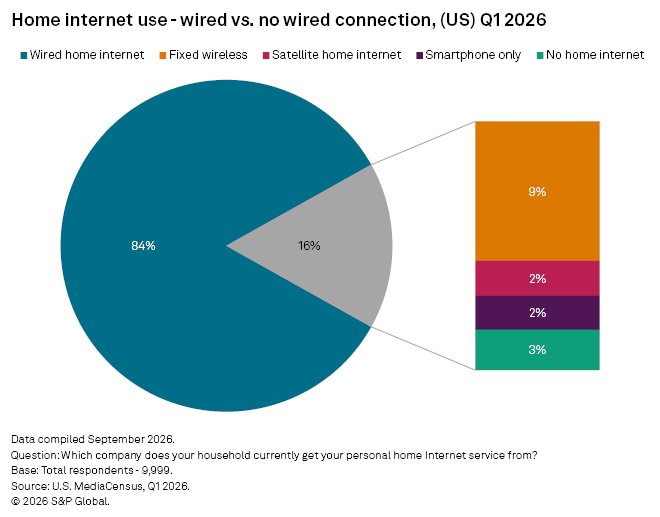

➤ Among those without a wired home internet connection, 28% indicated they had never subscribed.
➤ Forty-three percent of satellite internet subscribers cited living in a rural area without a wired option as the reason for not subscribing to a wired service.
➤ The age group with the largest share not subscribed to a wired internet service belonged to 18- to 24-year-olds at 23%.

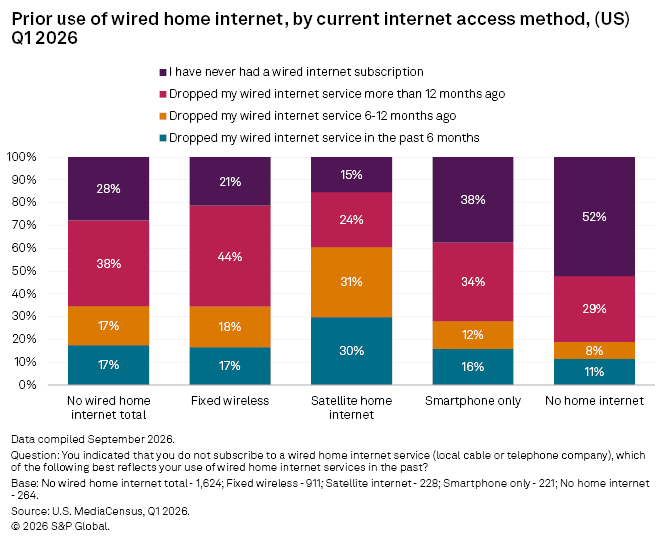
When we asked respondents without a wired connection about their previous use of wired home broadband services, most were not recent broadband cord cutters: 28% reported that they never had a wired service, while another 38% had dropped more than 12 months ago. Fixed wireless subscribers had the largest share indicating that they had dropped a service more than 12 months ago at 44%. Satellite subscribers were the most likely to be recent broadband cord cutters, with 30% having dropped in the past 6 months and another 31% having dropped 6 to 12 months ago. A notable difference between those who only use their smartphone for home internet and those who indicated they had no home internet service was the share who indicated they never had a wired service at 38% and 52%, respectively.
Access full tables in Excel format, including additional data, here.
When it came to reasons for no wired home broadband service, satellite internet subscribers were much more likely than fixed wireless subs to indicate it was because they live in a rural area with no wired options at 43%, compared to only 15% of fixed wireless subs. Fixed wireless subscribers are often presented an option for bundled deals with their wireless plan, which was the most selected reason among fixed wireless subs at 37%.
The overlap between those who indicated they only used their smartphone for home internet and those who don't have a home internet service is very apparent when looking at the reason for no wired internet service. Nearly a quarter (23%) of those without a home internet service indicated that they only used their smartphone, while another popular selection was an unlimited data plan (27%) and another 21% used their phone as a hotspot. Smartphone only respondents were especially likely to cite their unlimited data plan (52%) and using their phone as a hotspot (37%), but they were also more likely to claim that local providers were too expensive at 24%, compared to 14% of those claiming no home internet service.
When asked why they chose their current internet provider over another option, satellite subs were less likely to indicate they chose their operator because it was the best price for the service they needed at 7%, compared to wired home internet subscribers at 20%. However, fixed wireless subscribers were just as likely as wired subscribers to select "best price for the service I need," with the largest share among T-Mobile US Inc.'s 5G home internet subs at 29%.
The second most selected reason for subscribing to an operator was "most reliable internet service in my area," with the largest share among wired subscribers at 21%, while fixed wireless subs were the least likely at 12%. Similar to when asked about why they don't have a wired internet connection, satellite subscribers were the most likely to indicate it was because they live in a rural area without a wired option at 18%. For fixed wireless subs, 13% cited bundled deals with wireless service.
Examining broadband cord cutters by age shows that younger consumers are more willing to forego a wired connection, with 23% of those aged 18 to 24 indicating they don't subscribe to a cable or telco internet service. The share of broadband cord cutters/nevers decreases to 11% of those aged 65+.
Looking at broadband cord cutters/nevers' prior use of wired home internet by age shows that a larger share of those aged 45 or older indicated they dropped their wired service more than 12 months ago compared to younger age groups. Instead, younger age groups were more likely than older respondents to indicate they dropped within the past 12 months. As for broadband cord nevers, the 45 to 54 age group had the smallest share at 22%, while the 65+ age group had the largest share at 34%.
The breakdown of internet access by age shows that younger cord cutters/nevers were more likely to use satellite internet, from 24% of 18- to 24-year-olds to just 7% of 65+ broadband cord cutters. Instead, older broadband cord cutters/nevers were more likely to turn to fixed wireless or claim no household internet service.
Data presented in this article is from the general population sample of the MediaCensus survey conducted in the first quarter of 2026. This sample included 9,999 US internet adults matched by age and gender to the US Census. The survey results have a margin of error of +/-0.98 ppts at the 95% confidence level. Survey data should only be used to identify general market characteristics and directional trends.
For more information about the terms of access to the raw data underlying this survey, please contact support.mi@spglobal.com.
Consumer Insights is a regular feature from S&P Market Intelligence Kagan.
This article was published by S&P Global Market Intelligence and not by S&P Global Ratings, which is a separately managed division of S&P Global.
Content Type
Theme
Segment
Language