Research — Sep 25, 2026
Beyond Omnibus Accounts: The Operating Model Shift Behind Singapore's Custody Reform
The infrastructure may see fewer accounts, but the investors beneath them still need to be serviced. Singapore's custody modernization is as much about where responsibility sits as it is about how accounts are structured. For brokers and depository agents, this places greater emphasis on accurate client records, timely investor communications and scalable corporate-action and voting workflows.
For nearly 40 years, Singapore has operated a custody model distinct from global standards. Retail investors have been able to hold Singapore Exchange (SGX)-listed shares directly with the Central Depository (CDP), registered in their own names and recognized as members of the issuer. That degree of direct access is less common elsewhere, where investors more often hold through intermediaries under omnibus custody arrangements.
From July 2026, that starting point changes. Singapore Exchange Regulation (SGX RegCo) has removed the requirement for depository agents to hold each client's SGX securities in a separate, individually segregated sub-account, allowing client securities to be held in omnibus sub-accounts. The rule amendments take effect on July 15, 2026, with obligations relating to shareholder rights transitioning by December 2026 at the latest, subject to case-by-case extensions.[1]
Direct accounts have not been abolished. An investor who prefers to continue holding in their own name can do so; what has changed is that the market now offers a choice of structures. Consultation respondents pointed to potential benefits, such as faster account opening and consolidated views of local and foreign holdings through a single broker, although these remain anticipated rather than demonstrated.
The reform also sits within a broader evolution of market infrastructure. Across many markets, intermediary and omnibus structures are established features of securities custody, supporting cross-border investment and operational scale. Approaches differ by jurisdiction, but Singapore's move brings its custody framework closer to international market practice while retaining its own regulatory and investor-protection considerations.
The infrastructure sees one position; the intermediary sees many investors
Segregation did something quietly useful: it kept investor-level detail visible at the depository. When each client had their own sub-account, CDP's records and the underlying holder were closely aligned. Under an omnibus structure, CDP may hold a single aggregated position, while the details of who owns what within it are recorded on the depository agent's books.
The account is aggregated. The obligation to know each investor is not.
As per SGX RegCo's response to consultation paper comments, the depository agent's duty to maintain proper, complete and accurate client records is not new. Many of the requirements now incorporated into the CDP Rules mirror obligations that regulated intermediaries were already subject to under Singapore law. SGX has been explicit that codifying them would allow CDP to supervise and enforce them directly, rather than create wholly new duties. The shift is one of scale and consequence: as more investors sit inside omnibus accounts, the accuracy of the agent's underlying ledger becomes increasingly important. The rules capture this through an important distinction. Depository agents must reconcile their books against CDP records and notify CDP of discrepancies in aggregate omnibus holdings. However, the accuracy of the underlying client records remains the agent's responsibility.[2]
The infrastructure checks the total; the intermediary owns the detail.
This is therefore not simply an account migration exercise. It is a reform of custody account structures and the servicing that sits beneath them, rather than a change to core clearing and settlement processes.
What the investor gains, and what they come to rely on
Ownership is worth stating precisely because the rest of the argument depends on it. In a direct account, securities are registered in the investor's own name, and the investor exercises shareholder rights as a member of the issuer. In broker custody, the securities are deposited in the depository agent's name, and the agent holds them on trust for the client. The investor remains the beneficial owner but is no longer the member on record; the intermediary is, and shareholder rights are exercised through it.
That is a genuine trade-off. The potential benefits of omnibus custody, including convenience and consolidated portfolio views, come with greater reliance on the intermediary for information, corporate-action servicing, elections and voting. SGX has recognized this dependency by requiring depository agents to explain how assets will be held and what protections apply should the intermediary become insolvent.
The question, therefore, is not whether investors can move to broker custody, but what will influence that choice when direct holding remains available. Because both models continue to coexist, the transition is unlikely to follow a single path.
Where the model gets tested: shareholder rights
Corporate actions and shareholder votes are where the practical implications of an omnibus model become most visible.
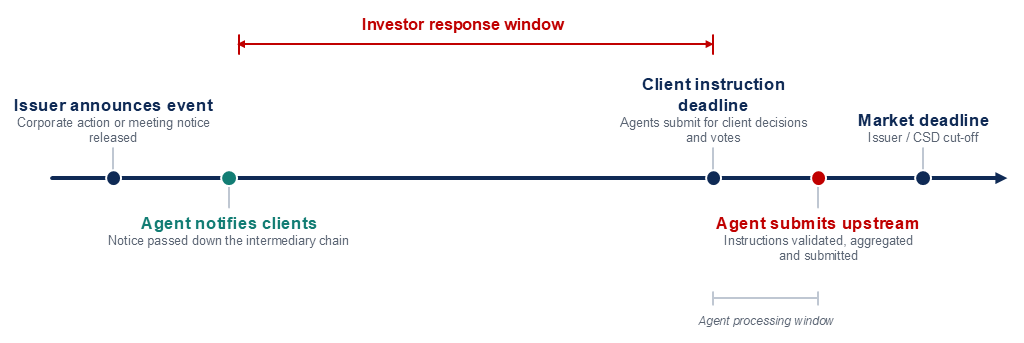
Investors behind a single aggregated position may have different election preferences, voting instructions and participation requirements. While CDP sees one position held by the depository agent, the intermediary must identify eligible investors, distribute information, collect and consolidate instructions, submit them upstream, allocate outcomes correctly and retain evidence of what occurred.
SGX has established a baseline for these activities. Relevant depository agents and trading members must pass on notices, appoint clients as proxies where required, submit voting instructions and corporate action elections, and provide investors with sufficient time to respond.
Many of these activities have traditionally sat in the background of the custody chain. Under an omnibus model, they become increasingly visible operational responsibilities for intermediaries.
SGX is explicit that investors acting through intermediaries will generally have less time to respond than direct holders, because information must move down the custody chain and instructions must move back up. The remaining time must nevertheless be sufficient, making intermediary efficiency and communication processes increasingly important in time-sensitive corporate action and proxy voting events.
Figure 1: Information flow between investors, intermediaries and the market
A common reform, uneven starting points
Global custodians already operating omnibus structures elsewhere are on familiar territory, although Singapore's specific rules and market practices still need to be incorporated into existing operating models.
Local brokers and intermediaries whose operating models are built around segregated CDP accounts may face greater adaptation requirements, particularly in investor servicing, communications, elections, voting and shareholder-rights facilitation.
Institutional investors may focus less on account structures and more on whether greater alignment with global custody models reduces operational complexity or simply shifts it into the intermediary service model.
Readiness will therefore vary across the market, making operational preparedness and service quality important competitive differentiators.
The open question
Singapore has given its market a more flexible and internationally familiar custody structure. But the account structure is only the starting point. The success of an omnibus arrangement depends on what happens beneath it: whether records remain accurate, communications arrive in time, and investors can elect, vote and receive what they are owed.
The reform also leaves some questions open. While SGX has defined responsibilities, it remains largely technology-neutral on how they will be delivered in practice. Singapore's market has already demonstrated the benefits of structured corporate action information and standardized data exchange in parts of its post-trade infrastructure. Whether similar levels of standardization emerge across shareholder-rights communications, elections, voting workflows and broader omnibus servicing remains to be seen.
As participants adapt to the new model, questions about interoperability, workflow efficiency and operating model design are likely to become increasingly important.
Whether service quality becomes a meaningful point of competition, rather than simply the availability of an omnibus account, is a question the reform opens rather than settles. The answer will depend on implementation, market practice and how investors respond. The visible change is the account structure. The lasting significance lies in where investor-level responsibility sits and how effectively it is discharged.
S&P Global Market Intelligence and its affiliates do not provide tax, legal or accounting advice. This material has been prepared for informational purposes only and is not intended to provide and should not be relied on for tax, legal or accounting advice. Consult your own tax, legal or accounting advisors before engaging in any transaction.
[1] Singapore Exchange Regulation (SGX RegCo), Responses to Comments on Consultation Paper: Modernisation of Singapore's post-trade custody model, July 1, 2026.
[2] Singapore Exchange Regulation (SGX RegCo), Responses to Comments on Consultation Paper: Modernisation of Singapore's post-trade custody model, 1 July 2026, pp. 8-9, paras. 32, 35-36.