Research — AUGUST 5, 2026
Samsung postQ: AI memory strength drives earnings beat, raises expectations

By Harshvardhan Kyal
Samsung Electronics Co. Ltd. (KRX: 005930) delivered a strong second quarter, beating Visible Alpha consensus expectations across revenue, earnings and free cash flow as robust AI-driven memory demand lifted results. Strong performance in DRAM and HBM, together with solid execution across the broader business, reinforced Samsung's improving position in the AI infrastructure cycle.
The Device Solutions division remained the key growth engine, led by better-than-expected DRAM and HBM performance, while the Device eXperience segment also exceeded expectations on stronger mobile, display and automotive electronics sales. Following the results, analysts raised forecasts for Samsung's memory business, particularly HBM, reflecting growing confidence in the company's AI-driven growth trajectory.
Looking at earnings summaries compiled by S&P Global Pronto NLP, together with Visible Alpha pre-quarter consensus expectations and revised outlook, here are the key takeaways.
Key takeaways
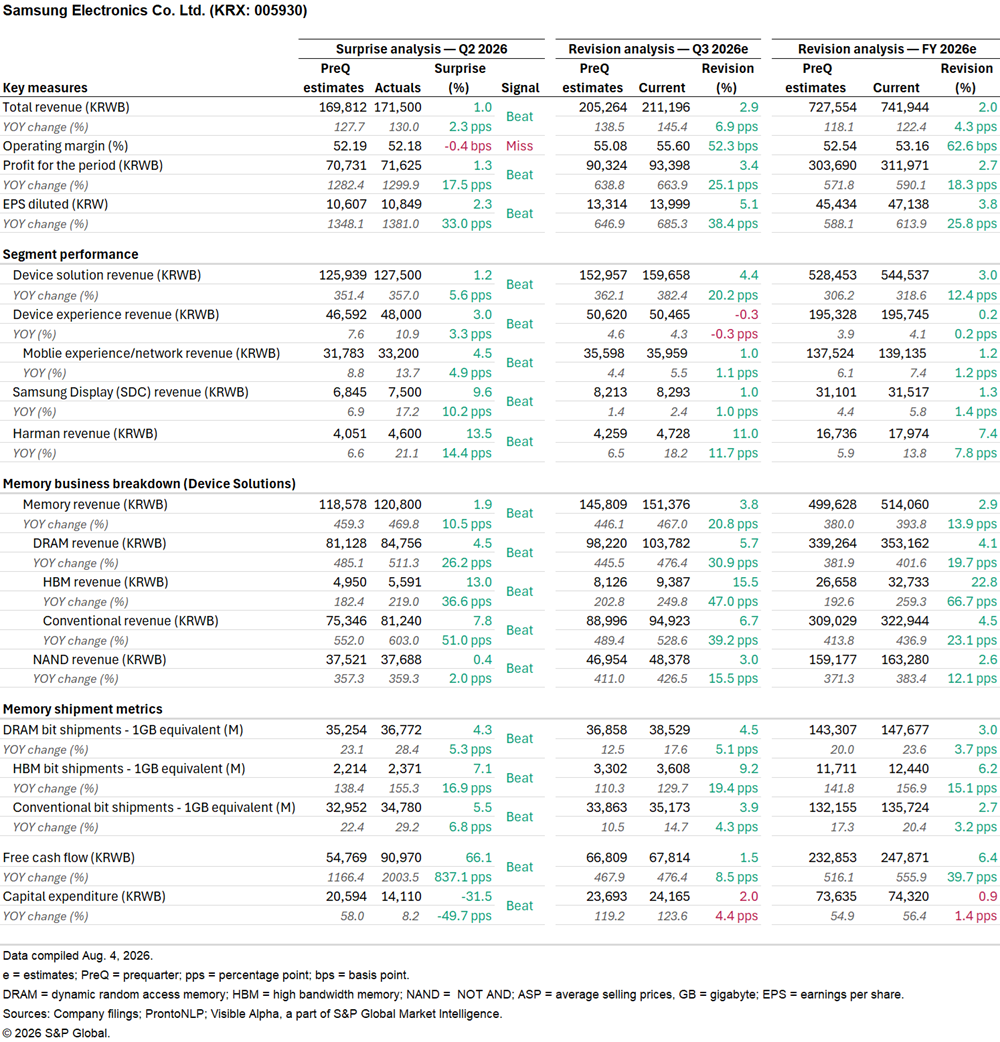
Samsung reported Q2 revenue of KRW 171.5 trillion, 1% above Visible Alpha consensus expectations, while diluted EPS of KRW 10,849 exceeded expectations by 2.3%. Profit for the period reached KRW 71.6 trillion, 1.3% above consensus, while operating margin of 52.2% was broadly in line with expectations.
The Device Solutions (DS) division generated revenue of KRW 127.5 trillion, beating consensus by 1.2% and rising 357% year-over-year, driven by continued AI-related memory demand.
Within DS:
- Memory remained the primary growth driver. Memory revenue increased 469.8% year-over-year to KRW 120.8 trillion, exceeding consensus by 1.9%.
- DRAM revenue rose 511.3% to KRW 84.8 trillion, beating expectations by 4.5%.
- HBM revenue delivered the strongest upside-surprise, rising 219.0% year-over-year to KRW 5.6 trillion, 13% above consensus.
- NAND revenue grew 359.3% to KRW 37.7 trillion, broadly matching expectations.
Strength extended beyond memory. The Device eXperience (DX) segment generated revenue of KRW 48 trillion, 3% above consensus. Mobile eXperience & Networks revenue exceeded expectations by 4.5%, while Samsung Display Co., Ltd. and Harman International Industries Inc. delivered the largest upside surprises outside the semiconductor business, beating consensus by 9.6% and 13.5%, respectively.
AI demand continued to support shipment growth and cash generation. Free cash flow reached KRW 91.0 trillion, 66.1% above consensus expectations, while capital expenditure of KRW 14.1 trillion came in 31.5% below expectations.
Guidance
Management expects AI-related demand to remain the primary growth driver in the third quarter.
HBM4 sales are projected to triple sequentially, while DRAM bit shipments are expected to increase by a mid-single-digit percentage quarter over quarter and NAND bit shipments by a high-single-digit percentage, pointing to continued improvement across the memory portfolio.
Consensus revisions
Following the results, analysts have become more constructive on Samsung's semiconductor outlook, particularly its AI memory business.
For Q3 2026, revenue expectations are now up 2.9% to KRW 211 trillion, while full-year 2026 revenue estimates are up 2% to KRW 742 trillion. Most of the upgrades are concentrated in the Device Solutions division, where revenue estimates are up 4.4% for Q3 and 3% for the full year.
HBM has seen the largest revisions. Analysts have increased Q3 HBM revenue estimates by 15.5% and FY2026 forecasts by 22.8%, reflecting greater confidence in Samsung's AI memory roadmap. DRAM revenue estimates are up 5.7% for Q3 and 4.1% for the full year, while overall memory revenue forecasts have increased 3.8% and 2.9%, respectively. Expectations for the Device eXperience business were largely unchanged.
The stronger revenue outlook has also translated into higher profitability expectations. Analysts have raised Q3 operating margin forecasts to 56.1%, while FY2026 operating margin estimates increased to 53.5%. Full-year diluted EPS estimates are up 3.8% to KRW 47,138. Capital expenditure estimates have increased only 0.9%, suggesting analysts expect stronger earnings without a material acceleration in investment spending.
Share price reaction
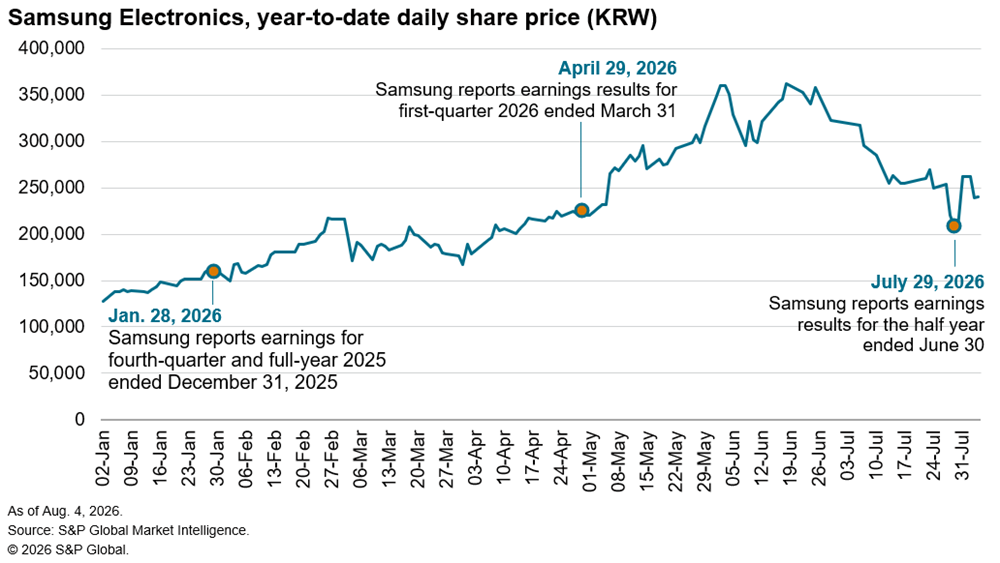
Samsung shares traded flat to slightly lower following record Q2 2026 earnings as investors remained cautious about the sustainability of elevated AI memory margins despite management's constructive long-term outlook. The stock later gained alongside a broader rally in US technology shares after strong earnings from Amazon.com Inc. and Microsoft Corp. renewed investor confidence in sustained AI infrastructure spending.
This article was published by Visible Alpha, part of S&P Global Market Intelligence and not by S&P Global Ratings, which is a separately managed division of S&P Global.
Content Type
Theme
Products & Offerings
Segment
