Research — August 25, 2026
Moderna builds post-Covid case on flu and cancer vaccines
By Raghav Jhawar and Shaily Jain
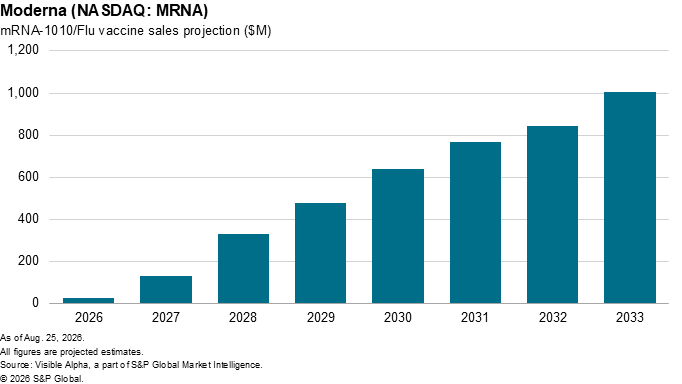
Moderna Inc. (NASDAQ: MRNA) has won U.S. Food and Drug Administration approval for mFLUSIVA (mRNA-1010), the first mRNA-based influenza vaccine, opening a new commercial opportunity as the biotech seeks to reduce its dependence on declining Covid-19 vaccine sales. The FDA approved the vaccine for adults aged 50 and older, with traditional approval for those aged 50–64 and accelerated approval for those aged 65 and above. Moderna expects mFLUSIVA to be available in the US for the 2026–27 flu season.
The near-term revenue contribution is modest relative to Moderna’s overall business. Visible Alpha consensus forecasts show mRNA-1010 revenue of about $30 million in 2026 and $135 million in 2027, its first full year on the market. The longer-term opportunity is more significant, with analyst expecting sales of around $1 billion by 2036. The approval also strengthens the case for Moderna’s broader respiratory portfolio, including a potential flu-Covid combination vaccine. Moderna expects its flu vaccine to expand into Europe, Canada and Australia as regulatory reviews progress.
For Moderna, the timing is important. The company generated $1.9 billion of revenue in 2025, down sharply from its pandemic-era peak and down 40% year-on-year. Analysts, however, expect 2026 to mark a return to revenue growth, with revenue growth of 9% to $2.1 billion.
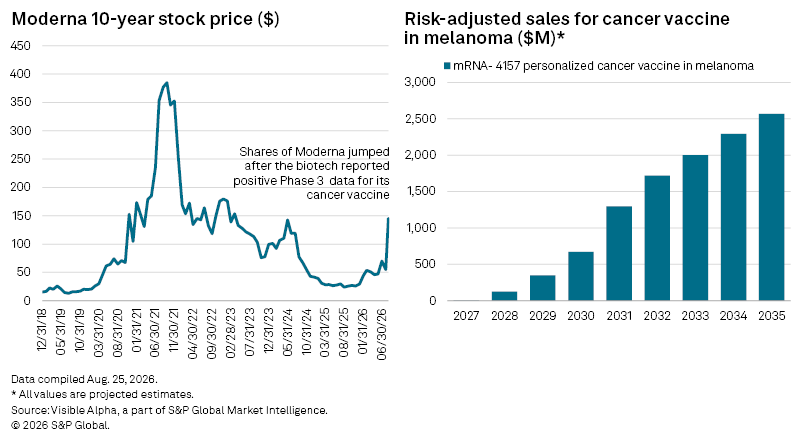
Beyond respiratory vaccines, Moderna’s shares surged 177% on August 19 after the company and Merck & Co. Inc. (NYSE: MRK) reported positive Phase 3 results for intismeran autogene (mRNA-4157) in melanoma.
The result has materially altered the investment case for Moderna, shifting the narrative from replacing lost Covid revenue to building a broader mRNA medicines platform. Visible Alpha’s risk-adjusted estimates point to a potentially much larger opportunity from mRNA-4157. Analysts currently assign a 78.33% probability of success rate to mRNA-4157 in melanoma.
This article was published by Visible Alpha, part of S&P Global Market Intelligence and not by S&P Global Ratings, which is a separately managed division of S&P Global.
Content Type
Products & Offerings
Segment
