Research — August 6, 2026
Microsoft postQ: Azure $100B milestone as AI demand lifts earnings and outlook
By Sourav Kataria and Harshvardhan Kyal
Microsoft Corp. (NASDAQ: MSFT) delivered a strong FY2026, with revenue, operating income, net income, and diluted EPS all modestly exceeding Visible Alpha consensus expectations, driven by continued momentum in Azure, cloud infrastructure, and enterprise AI adoption.
Azure surpassed $100 billion in annual revenue for the first time, highlighting accelerating demand for AI workloads and Microsoft's expanding infrastructure footprint. Management expects another year of double-digit revenue and operating income growth in FY2027, while maintaining a disciplined approach to AI-related capital investments.
Looking at earnings summaries compiled by S&P Global Pronto NLP, together with Visible Alpha pre-quarter consensus expectations and revised outlook, here are the key takeaways.
Key takeaways
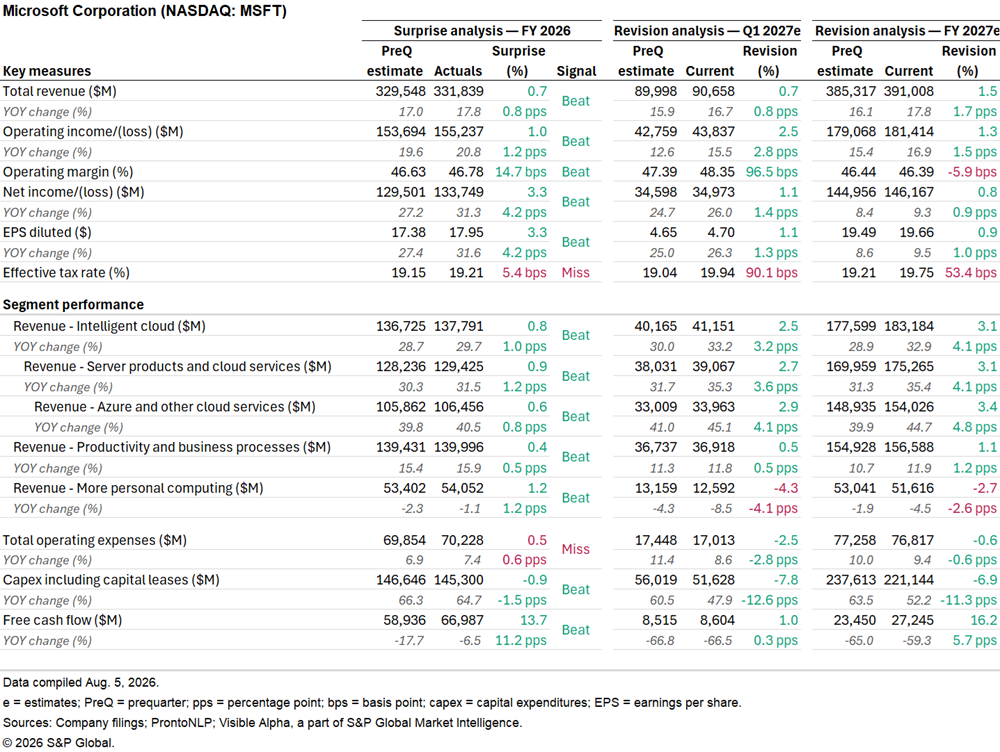
FY2026 revenue increased 17.8% year-over-year to $331.8 billion, exceeding Visible Alpha consensus expectations by 0.7%. Intelligent Cloud revenue rose 29.7% to $137.8 billion, also ahead of consensus expectations, driven by Server Products and Cloud Services revenue growth of 31.5% and Azure and other cloud services growth of 40.6% to $106.5 billion.
Core businesses remained resilient. Productivity and Business Processes revenue increased 15.9% year-over-year to $140 billion, slightly above consensus expectations, supported by enterprise software demand. More Personal Computing revenue declined 1.1% to $54.1 billion, but exceeded expectations despite continued PC market weakness.
Profitability remained strong despite AI spending. Operating income rose 20.8% year-over-year to $155.2 billion, while net income increased 31.3% to $133.7 billion and diluted EPS rose 31.6% to $17.95, ahead of consensus. Higher AI-related expenses were offset by strong revenue growth and operating leverage.
Cash flow remained robust. Capital expenditure, including capital leases, totaled $145.3 billion, slightly below consensus, while free cash flow reached $67.0 billion, 13.7% above expectations, despite Microsoft's continued investment in cloud and AI infrastructure.
Guidance
Microsoft expects another year of double-digit growth. For FY2027, management expects revenue and operating income growth in the double digits, with operating margin declining less than one percentage point as AI investments continue.
Q1 FY2027 revenue guidance of $89.85 billion-$90.95 billion was broadly in line with Visible Alpha preQ consensus of $89.9 billion.
Intelligent Cloud revenue guidance of $40.95 billion-$41.25 billion exceeded consensus, supported by approximately 45% constant-currency Azure growth.
Productivity and Business Processes guidance was broadly in line with expectations.
More Personal Computing guidance came below consensus, reflecting continued PC softness.
Management expects Q1 capital expenditures to exceed $50 billion. FY2027 capital spending is expected to increase year-over-year in line with customer demand, while free cash flow remains positive.
Consensus revisions
Analysts have raised cloud forecasts following stronger Azure momentum. Visible Alpha consensus shows analysts now expect Q1 FY2027 revenue of $90.7 billion, up 0.7% from preQ estimates, while FY2027 revenue expectations increased by 1.5% to $391 billion.
Intelligent Cloud leads the revisions trend, where estimates are now up 2.5% for Q1 FY2027 and 3.1% for FY2027, driven by higher expectations for Azure and Server Products and Cloud Services.
Profitability expectations have also improved. Analysts have raised FY2027 operating income, net income, and diluted EPS estimates to $181.4 billion, $146.2 billion, and $19.66, respectively.
Capital expenditure expectations are down 6.9%, while free cash flow estimates have increased by16.2% to $27.2 billion.
Share price reaction
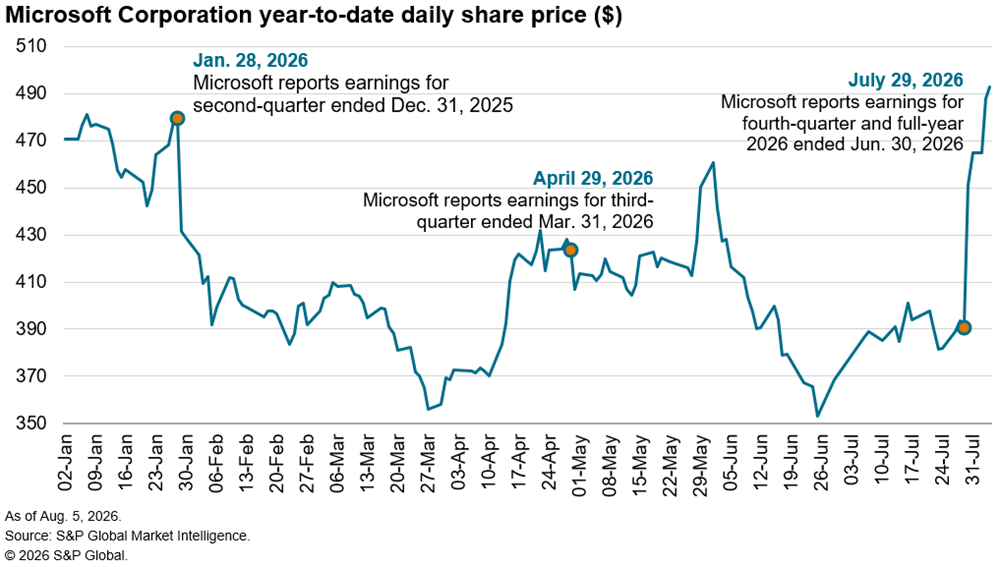
Microsoft shares rose following the earnings release as investors responded positively to accelerating Azure growth, strong profitability, and confidence that AI investments are translating into commercial returns.
This article was published by S&P Global Market Intelligence and not by S&P Global Ratings, which is a separately managed division of S&P Global.
Content Type
Products & Offerings
Segment
