Research — August 6, 2026
Johnson & Johnson postQ: Innovative Medicine lifts outlook; MedTech weak
By Disha Rajawat
Johnson & Johnson (NYSE: JNJ) delivered a stronger-than-expected second quarter, with robust growth in its Innovative Medicine segment offsetting weaker-than-anticipated MedTech performance.
The company raised its full-year guidance following better-than-expected first-half results, while Visible Alpha consensus revisions point to modestly higher revenue expectations for 2026. However, investor focus remained on execution challenges in parts of the MedTech portfolio, particularly within Interventional Solutions.
Looking at earnings summaries compiled by S&P Global Pronto NLP, along with Visible Alpha pre-quarter consensus expectations and revised outlook, here are some key takeaways.
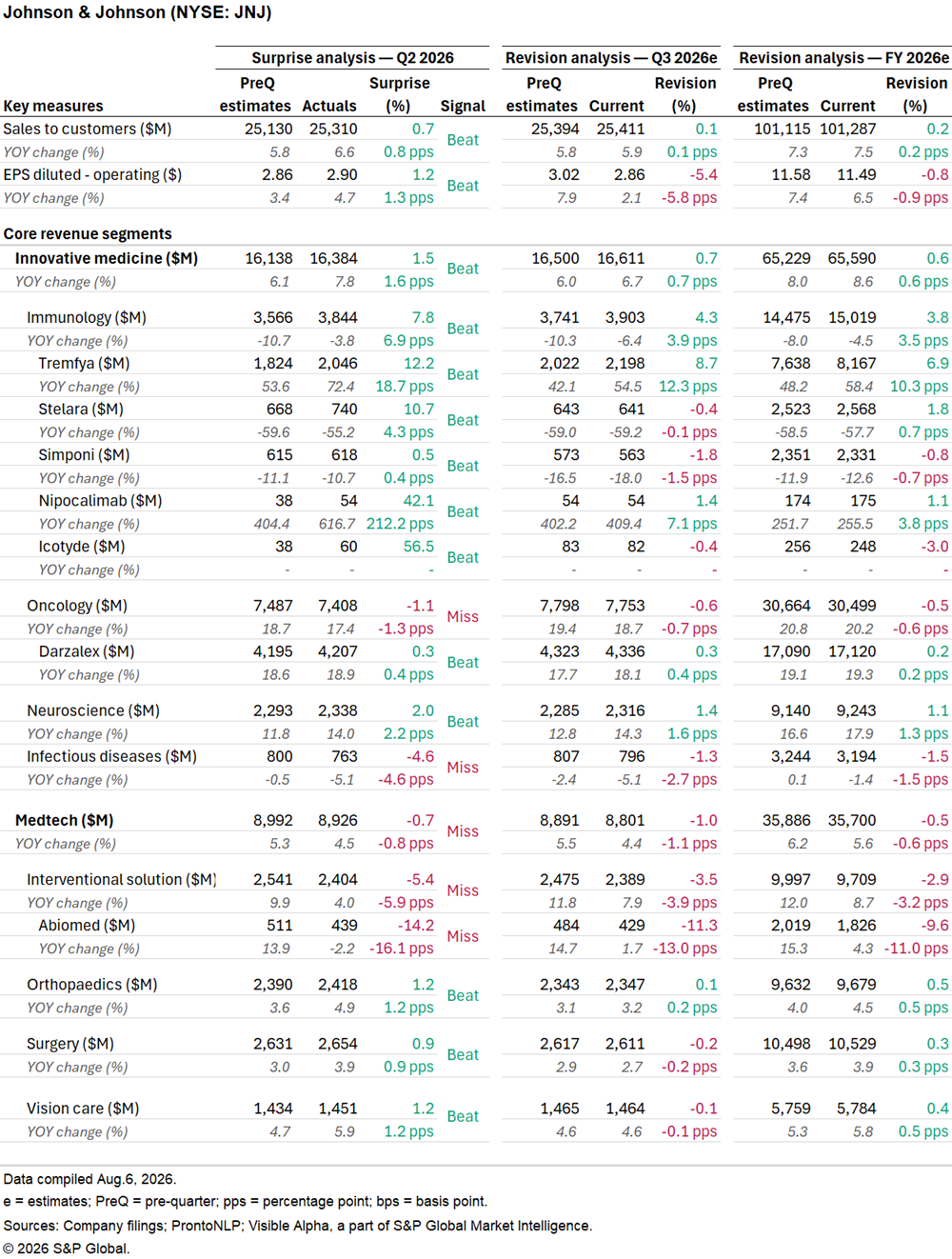
Key takeaways
Johnson & Johnson reported Q2 revenue of $25.3 billion, up 6.6% year-over-year and slightly ahead of Visible Alpha consensus expectations. Adjusted diluted EPS of $2.90 exceeded analyst expectations by 1.2%, driven by stronger margins and better-than-expected performance in Innovative Medicine.
Within Innovative Medicine, Tremfya was the standout performer, with revenue 12.2% above consensus and up 72.4% year-over-year, supported by strong demand across psoriasis and inflammatory bowel disease indications. Expectations for newer pipeline assets also improved, with Nipocalimab, an investigational FcRn inhibitor being developed for autoimmune diseases, and Icotyde, an investigational oral IL-23 receptor antagonist being developed for immune-mediated diseases such as psoriasis and psoriatic arthritis, seeing revenues exceeding consensus estimates by 42.1% and 56.5%, respectively, although both remain relatively small contributors to overall sales.
Stelara, Johnson & Johnson’s established immunology therapy, also outperformed expectations.
Neuroscience revenue also surpassed expectations, helping offset softer results in Oncology and Infectious Diseases.
MedTech revenue increased 4.5% year-over-year to $8.9 billion but modestly missed consensus. The shortfall was primarily driven by Interventional Solutions, where Abiomed, the manufacturer of heart recovery technologies including the Impella heart pump used during cardiac procedures, reported revenue 14.2% below consensus expectations.
Performance across Orthopedics, Surgery and Vision Care was more resilient, partially offsetting weakness in cardiovascular-related businesses. Management maintained that procedure volumes remain stable and expect growth to improve in the second half of the year, but investors remain cautious around the pace of recovery.
Guidance
Following a strong first half, Johnson & Johnson raised its full-year outlook.
- Revenue: $100.8 billion-$101.4 billion, compared with previous guidance of $100.5 billion-$101.1 billion
- Adjusted diluted EPS: $11.60-$11.75, compared with prior guidance of $11.45-$11.65
Consensus revisions
Analysts have increased Q3 2026 revenue estimates by 0.1% to $25.4 billion and raised full-year revenue forecasts by 0.2% to $101.3 billion. Adjusted diluted EPS expectations however, been revised down 4% for Q3 to $2.90 and 0.4% for the full year to $11.54.
Upward revisions were concentrated in Innovative Medicine, where analysts increased revenue forecasts by 0.7% for Q3 and 0.6% for FY2026.
Analysts have become more cautious with MedTech, lowering revenue estimates by 1% for Q3 and 0.5% for FY2026.
Share price reaction
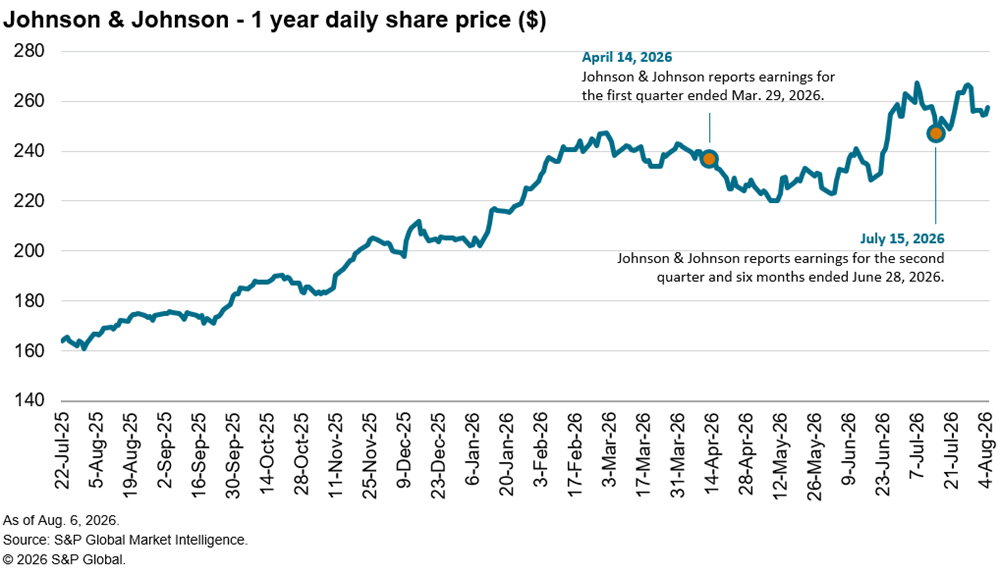
Johnson & Johnson shares declined following the second-quarter earnings release as investors focused on weaker-than-expected MedTech results, particularly within Interventional Solutions.
This article was published by Visible Alpha, part of S&P Global Market Intelligence and not by S&P Global Ratings, which is a separately managed division of S&P Global.
Content Type
Products & Offerings
Segment
