ECONOMICS COMMENTARY — 03 Aug, 2026
Global PMI data point to sustained manufacturing growth spurt in July, but momentum slows amid high prices, uncertainty and reduced stock building

Global manufacturing output continued to expand solidly in July, according to PMI® survey data, supported by rising new orders and precautionary stock building. However, growth momentum cooled for a second month as input buying slowed, inventory accumulation eased and business confidence remained relatively weak. Supply delays and cost pressures moderated, but geopolitical and economic uncertainty, including concerns over tariffs, conflicts and energy prices, continued to weigh on demand and raised downside risks for factory production in the months ahead.
Global factory production rises in July but growth momentum cools
The Global Manufacturing Purchasing Managers’ Index™ (PMI) survey, sponsored by J.P. Morgan and compiled by S&P Global Market Intelligence, indicated a further solid rise in worldwide factory production in July. Although the rate of growth cooled slightly for a second successive month, down to the lowest since March, it remained among the highest seen over the past five years.
The rate of increase in July was only slightly below that seen over the second quarter, which had posted the largest quarterly gain since the second quarter of 2021, during the worldwide scramble for products during the COVID-19 pandemic.
Comparisons with official data suggest that the PMI is broadly indicative of manufacturing production rising worldwide at an annual rate of around 3%. That compares with a long-run average of around 2%.
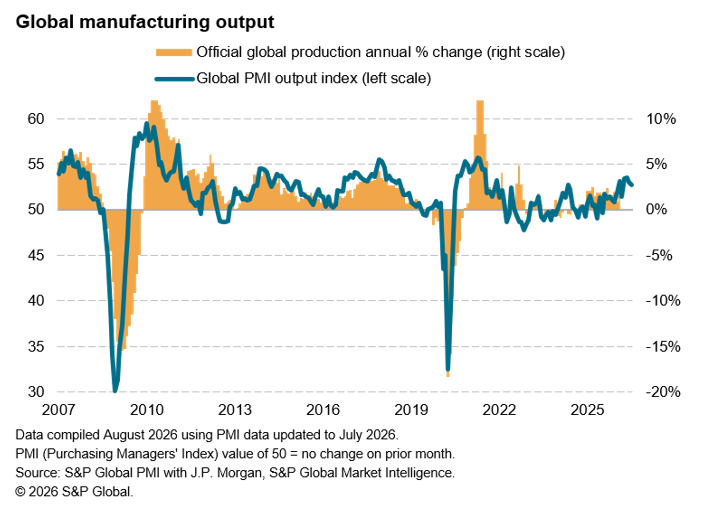
Production was buoyed by a further rise in new orders, though here the rate of increase likewise slowed to the weakest since March, down for a third successive month.
Manufacturing buffer stock building starts to temper
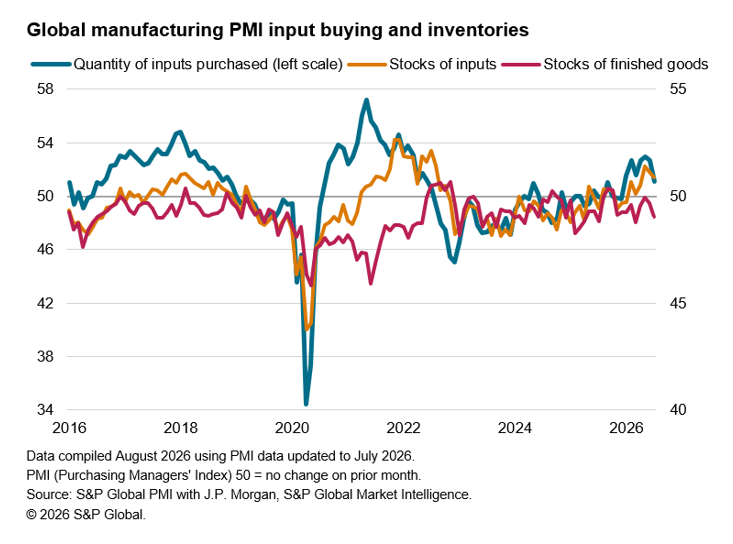
Precautionary stock building, which has been one of the key drivers of growth over recent months, showed signs of cooling in July. The proportion of manufacturers globally buying more inputs for safety stock considerations has fallen from a peak in April to a five-month low. The number of customers reportedly making higher inventory purchases has meanwhile also fallen, down to its lowest since January, having peaked in May.
Global input buying consequently grew in July at the slowest rate seen so far this year, rising more slowly than both order books and production to reflect the reduced safety stock build. Inventories of purchases, while still rising at a historically marked rate, showed the smallest increase since April, while stocks of finished goods were allowed to fall at an increased rate.
In summary, safety stock building continued to help support robust global production growth, but its impact lessened in July.
Supply disruption and price pressures ease for manufacturers
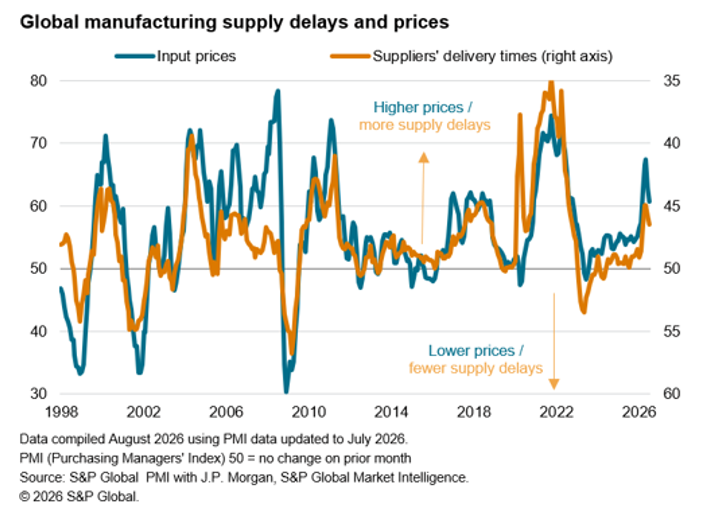
The reduced buffer stock building reflects a combination of sufficient inventory levels at some firms alongside reduced worries over future price and supply conditions. Both input cost inflation and supplier delays moderated in July, down to their lowest since February and March respectively, though both nevertheless remain elevated by historical standards due to the ongoing disruptions to shipping and energy markets caused by the situation in the Middle East.
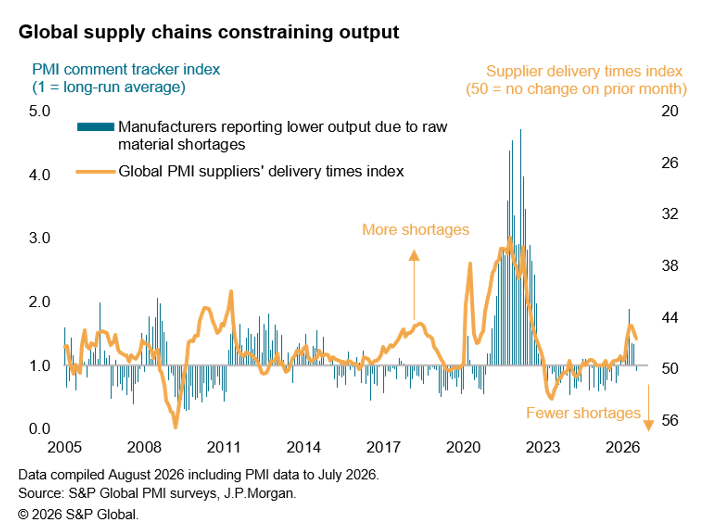
The reduction in supply worries was also reflected in a drop in the number of manufacturers worldwide reporting constrained output due to a lack of raw materials, which has fallen below its long-run average for the first time since last November.
Meanwhile, the number of manufacturers globally reporting lower orders due to high prices fell to its lowest since March. However, the demand-sapping effect of higher prices clearly remained somewhat elevated due to ongoing inflationary pressures during the month, principally linked to energy prices.
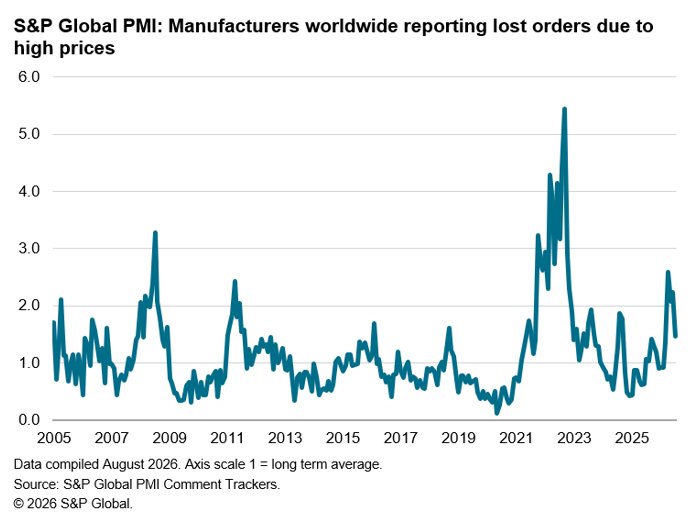
These data therefore suggest that supply disruptions are less of a drag on output than in prior months and that, while high prices are still deterring demand, the loss of orders due to high prices has become less widely reported.
Geopolitical and economic uncertainty weighs on manufacturing outlook
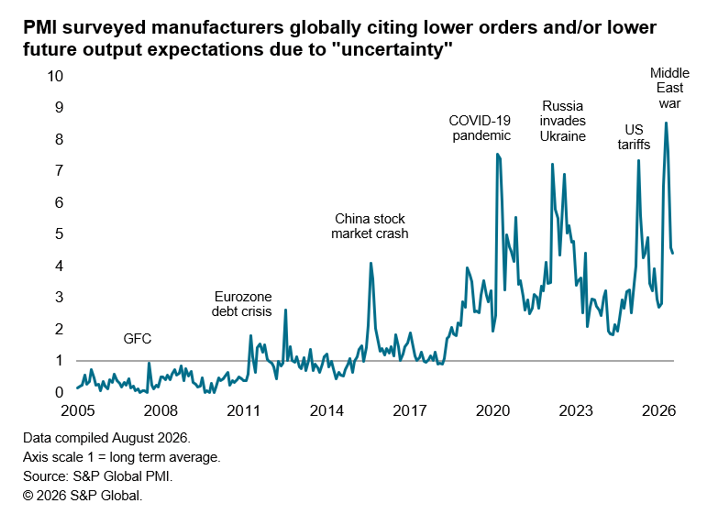
A further key factor shaping demand for manufactured goods worldwide in recent months has been uncertainty. While encouraging buffer stock building, uncertainty about the geopolitical and economic outlook has been widely cited as a demand dampener in recent months.
Reports of “uncertainty” causing lost orders or a loss of business optimism in fact hit an all-time survey high in April, as the war in the Middle East compounded existing concerns over US tariffs, political change, central bank policy, the war in Ukraine and disruption from AI. Although this uncertainty moderated in July to its lowest since the outbreak of the war in the Middle East, it is still running at more than four times the long-run average, indicating sustained downward pressure on manufacturing growth.
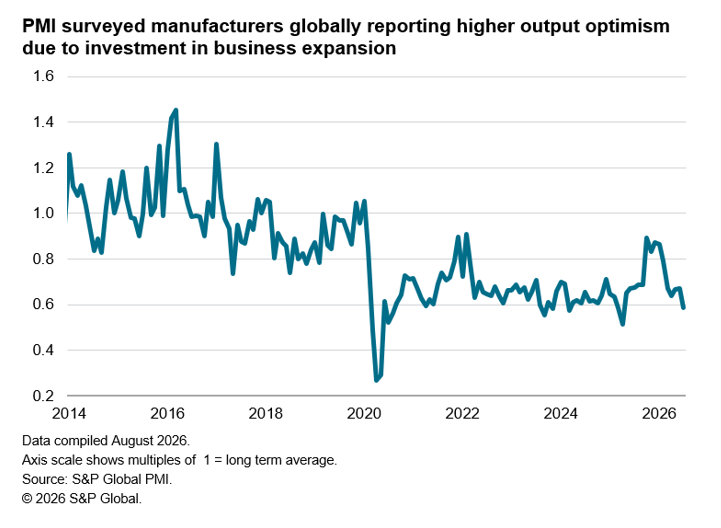
In the same vein, the proportion of manufacturers reporting optimism about higher production in the months ahead due to expansion plans is at one of the lowest levels recorded by the global PMI surveys. In the same vein, the proportion of manufacturers reporting optimism about higher production in the months ahead due to expansion plans is at one of the lowest levels recorded by the global PMI surveys.
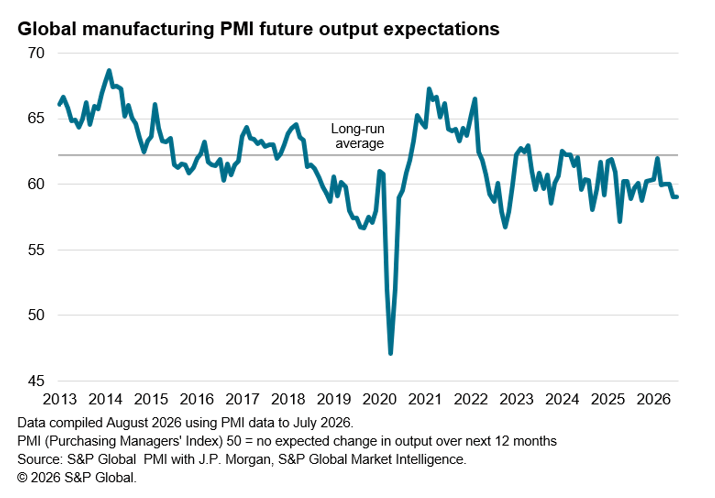
In this environment, it is not surprising to see manufacturing output expectations continuing to run well below their long-run average, hinting at downside risks to production in the coming months.
Access the latest global PMI press release here.
© 2026, S&P Global. All rights reserved. Reproduction in whole or in part without permission is prohibited.
Purchasing Managers' Index™ (PMI®) data are compiled by S&P Global for more than 40 economies worldwide. The monthly data are derived from surveys of senior executives at private sector companies, and are available only via subscription. The PMI dataset features a headline number, which indicates the overall health of an economy, and sub-indices, which provide insights into other key economic drivers such as GDP, inflation, exports, capacity utilization, employment and inventories. The PMI data are used by financial and corporate professionals to better understand where economies and markets are headed, and to uncover opportunities.
Read our latest PMI commentary here.
This article was published by S&P Global Market Intelligence and not by S&P Global Ratings, which is a separately managed division of S&P Global.
Theme
Location
Products & Offerings