Research — Aug 06, 2026
From environmental liability to economic asset: A case for tailings reprocessing

The mining industry is facing a rising demand for metals, particularly those critical to the energy transition, while the quality of primary ore bodies is in long-term decline. As head grades fall, operations must move and process more material to produce the same quantity of metal, generating even larger volumes of waste.
However, within this massive amount of waste material lies a potential solution. Tailings, the finely ground residual material left after mineral processing, can still contain significant quantities of valuable metals. Material that was uneconomic to recover decades ago may now be viable given today's commodity prices, improved processing technologies and the industry's increasing focus on sustainability and circular resource management.
This article examines the scale and distribution of global tailings inventories, identifies where the greatest concentrations of contained metal reside and assesses factors that are making reprocessing an increasingly attractive proposition, while noting that the ultimate opportunity still depends on the technical and economical recoverability of these materials. Drawing on S&P Global Mine Economics data and metallurgical mass balance techniques, we quantify the opportunity available.

➤ An estimated 131 billion metric tons of tailings was produced globally from 1991 to 2025.
➤ Countries from Latin America and the Caribbean hold 36% of the world's contained metal in tailings.
➤ Tailings reprocessing would bypass comminution, one of mining's most energy-intensive steps.
➤ Declining primary ore grades, rising commodity prices and advances in processing technology are converging to make reprocessing viable.
➤ Challenges such as material heterogeneity, environmental liabilities and regulatory complexity remain.

What are tailings?
Tailings are the waste material produced by mining operations after ore has passed through mineral processing systems to generate a concentrate. Historically considered to have negligible value or grades falling below the economic cutoff, these materials typically consist of finely ground rock, water and residual chemicals used during extraction.
The management of tailings is a critical aspect of mining operations. The 2019 Brumadinho tailings dam collapse in Brazil remains a stark reminder of the dangers posed by inadequate tailings stewardship, not only to the surrounding environment but also as a direct threat to human and animal life. As a result of the disaster, 11.7 million cubic meters of material broke out of the dam, taking the lives of 272 people, burying nearby villages and depositing approximately 2.8 MMcm of iron- and manganese-rich mud into the nearby Paraopeba River.
The volume of tailings generated globally is substantial and with lowering ore grades, it is expected to keep increasing. This creates a dual imperative: To manage tailings safely and responsibly; and explore whether these vast inventories might represent an untapped economic opportunity.
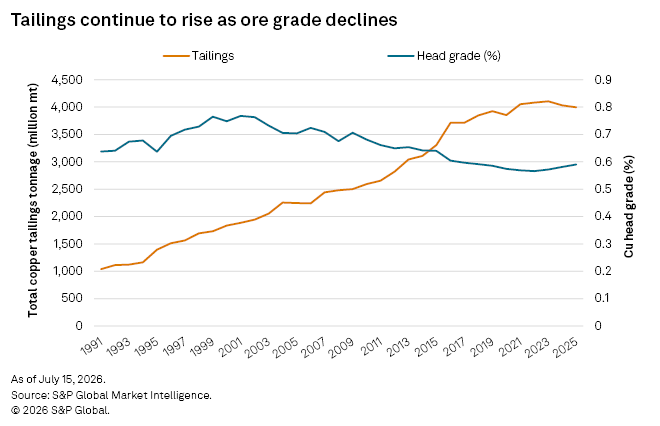
Global tailings output reaches 131 billion mt
Data from S&P Global Mine Economics coverage indicates that an estimated 131 billion mt of tailings was produced from 1991 to 2025. This tonnage is calculated using metallurgical balance and does not account whether this material has already been used as backfill or reprocessed and assumed stored in tailings storage facilities.
To provide some context for this volume, an average tailings density of 1.5 grams per cubic centimeter is assumed (for comparison, water has a density of 1.0 g/cm³). Depending on the tailings' composition, the actual density could be higher or lower. This translates to approximately 87.3 cubic kilometers, which is very close to Lake Geneva at 88.9 km³, one of the largest lakes in Europe.
Regional distribution of tailings
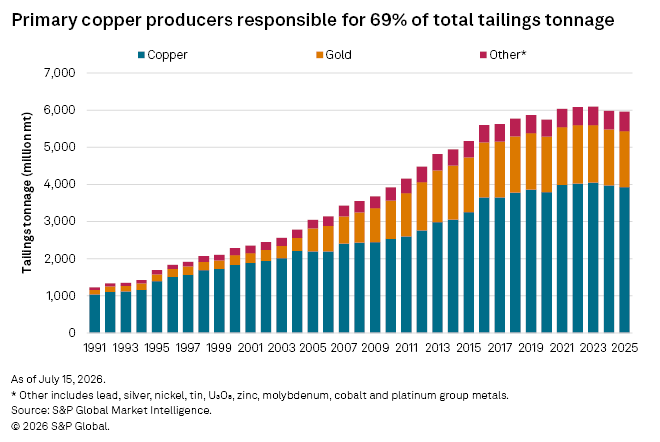
Looking at the tonnage of the tailings alone, the US has produced the largest volume of tailings for the last 30 years, followed by Chile, Peru and Mexico. Primary copper mines produce the highest volume of tailings at approximately 69% of total tailings tonnage, while 23% are attributed to primary gold producers.
However, it differs when examining contained metal, which is calculated by applying the grade of each commodity to the tonnage of tailings produced at each operation. Countries from Latin America and the Caribbean hold 36% of total contained metal in global tailings inventories — the largest share held by any region. Chile possesses the single highest concentration of contained metal in tailings in any country.
By commodity, copper accounts for 55% of contained metal in tailings globally, followed by zinc at 26% and lead at 11%. Available data from over three decades shows that copper averages 69% recovery, explaining the large share of unrecovered copper in the tails. However, it is important to note that these figures reflect total contained metal inventories rather than contained metal per metric ton of tailings where large-volume commodities naturally will dominate the comparison.
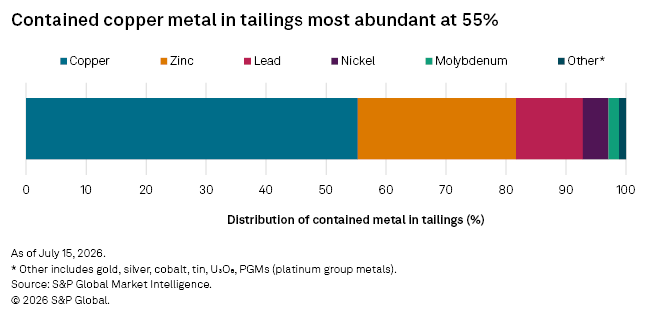
Looking at tailings tonnage and commodity dominance, the distribution reflects historical dominance of the countries from Latin America and the Caribbean in copper production and the cumulative effect of decades of processing at scale, often with recovery rates that, by today's standards, left significant value behind.
Why do tailings' grades vary?
Tailings grades vary by site and commodity because of differences in processing, ore chemistry and geology. Older operations often use less advanced recovery methods, leaving higher residual metal grades in tailings. Some metals are also harder to extract economically, especially when they occur as byproducts in polymetallic ores, requiring specialized processing. This also brings up geological complexity, as complex mineralogy can result in valuable metals remaining locked in mineral structures that conventional processing cannot efficiently liberate.
Tailings are inherently nonuniform, as metal grade, mineralogy, particle size distribution and chemical composition can change substantially, even within the same storage facility. However, as primary ore grades decline over time, the relative grade differential between fresh ore and historical tailings is narrowing, enhancing the attractiveness of reprocessing.
The comminution advantage
Tailings have already undergone comminution, which are the crushing and grinding processes that reduce ore to fine particle sizes to liberate valuable minerals. Comminution is one of the most energy-intensive steps in the entire mining value chain, typically accounting for up to 60% of a mine's total electrical power consumption and approximately 35% of an operation's greenhouse gas emissions.
Because tailings are already usually finely ground, reprocessing may allow the bypassing of this costly and carbon-intensive stage, which offers a dual advantage. First, it lessens operating costs, which reduces energy consumption and associated costs by eliminating or significantly reducing comminution requirements. Second, it lowers emissions intensity due to metal produced from reprocessed tailings with a substantially smaller carbon footprint instead of through conventional primary processing.
For mining companies under pressure to decarbonize and for downstream consumers seeking lower-embodied-carbon metals, tailings-derived production offers a differentiated value proposition.
Converging enablers
Several structural trends are converging to make tailings reprocessing more viable than before.
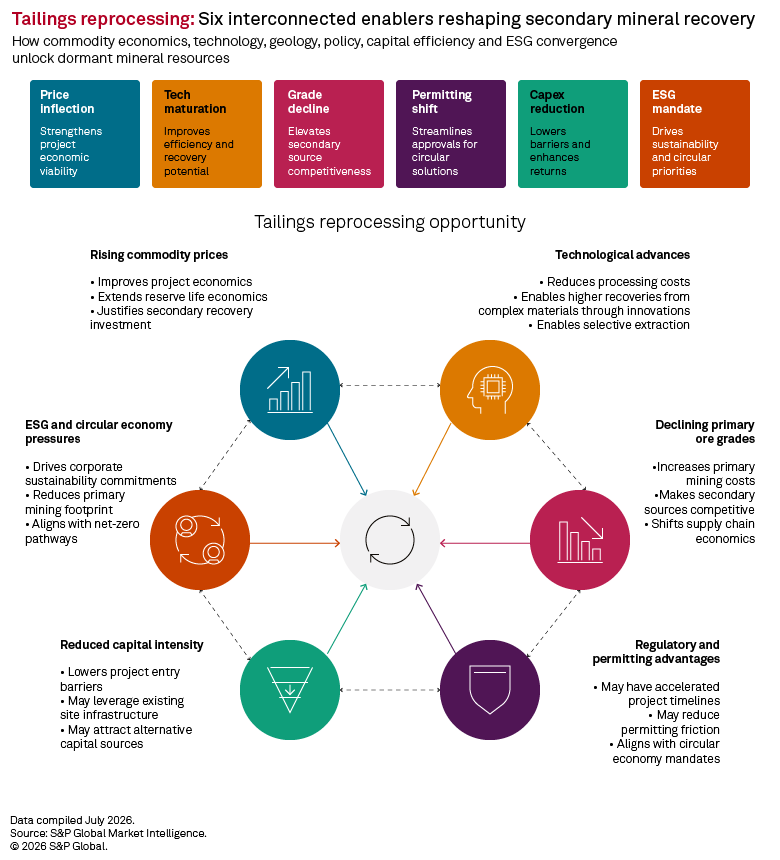
The alignment of technical, economic and policy drivers suggest that tailings reprocessing is becoming more strategically relevant to future metal supply. Operating projects demonstrate what is achievable. Parral Tailings, a heap leaching facility in Mexico, works on historical tailings from the Mina la Prieta mine, successfully retrieving gold and silver that was otherwise left as waste. Western Limb Tailings in South Africa treats tailings to recover platinum group elements and associated base and precious metals. Different institutions are also continuously showing interest in the potential of tailings, as evidenced in the investment of the EU's CRITERIA project and Geoscience Australia's Atlas of Australian Re-mining Potential.
Challenges and considerations
Despite the growing case for reprocessing, major hurdles persist. Tailings are highly heterogeneous, making process design, economic modeling and scale-up less reliable. Tailings being mixed with harmful elements and reagent residues may require additional treatment or limit viable processing routes. Reprocessing also creates water-balance issues and environmental liabilities, requiring careful mitigation. Legal and regulatory complexity, especially in case of historical or orphaned sites, can further slow down progress. Finally, robust geochemical, mineralogical and metallurgical testing is essential to confirm feasibility, driving substantial upfront characterization costs.
These challenges are real but not insurmountable and underscore the need for rigorous, data-driven assessment of individual tailings inventories before investment decisions are made.
This article was published by S&P Global Market Intelligence and not by S&P Global Ratings, which is a separately managed division of S&P Global.