Research — Aug 28, 2026
Commission staff supports a fraction of Wisconsin Public Service's rate request

By Dan Lowrey
Staff of the Public Service Commission of Wisconsin filed testimony on Aug. 14 in a rate case for WEC Energy Group Inc. subsidiary Wisconsin Public Service Corp. Staff supports increases in electric rates of $24.7 million over 2027 and 2028 and increases in gas rates of $6.1 million, representing about one-fifth of WPSC's requested rate increases.
A commission decision in the case is anticipated before the end of the year.

➤ The staff of the Public Service Commission of Wisconsin (PSC) is supporting combined Wisconsin Public Service Corp. (WPSC) rate increases of $24.7 million for electric and $6.1 million for natural gas operations over 2027 and 2028, compared to WPSC's original $132.7 million electric and $28.6 million gas rate increase requests. Primary drivers of the difference between the recommendation and request are staff's lower proposed return and adjustments that reduced average plant-in-service balances, and the temporary removal of pending cost overruns related to the Paris and Darien solar-and-storage projects.
➤ Staff recommends reducing WPSC's return on equity to 9.50% from its currently authorized 9.80% ROE. The utility is seeking a 9.90% in this case. The staff's proposed ROE falls below national averages, which hovered around 9.71% for electric utilities in the first quarter of 2026. Staff supports a more conservative common equity ratio of approximately 54.22% for 2027, rejecting the utility's requested equity component of about 56.25%.
➤ Typical of the constructive regulatory climate in Wisconsin, the filings rely on forward-looking test years. State statutes support the use of settlements between parties in rate cases to expedite the conclusion of such proceedings, and several major rate cases have been resolved via settlements in the last couple of years. However, the past two rate cases for WEC Energy have been fully litigated.

For WPSC, staff recommends a $7.6 million electric rate reduction in 2027 and a $32.3 million increase in 2028. Staff supports a $1.1 million increase in WEPCO gas rates in 2027, followed by a $5.0 million increase in 2028.
The recommended rate changes are premised on a 9.50% return on equity (54.22% of capital structure in 2027 and 54.04% of capital structure in 2028) for WPSC. The utility is currently authorized a 9.80% ROE, and is requesting a 9.90% ROE in this proceeding.
The recommended ROE is below national averages tracked by RRA. The overall average authorized ROE for electric utilities was 9.71% in rate cases decided in the first quarter of 2026, below the 9.84% average for full year 2025.
WEC requests that the common equity component established for ratemaking purposes be set at 56.25% for WPSC in the test year ending Dec. 31, 2027. For 2028, the company requests a 56.06% equity ratio for WPSC.
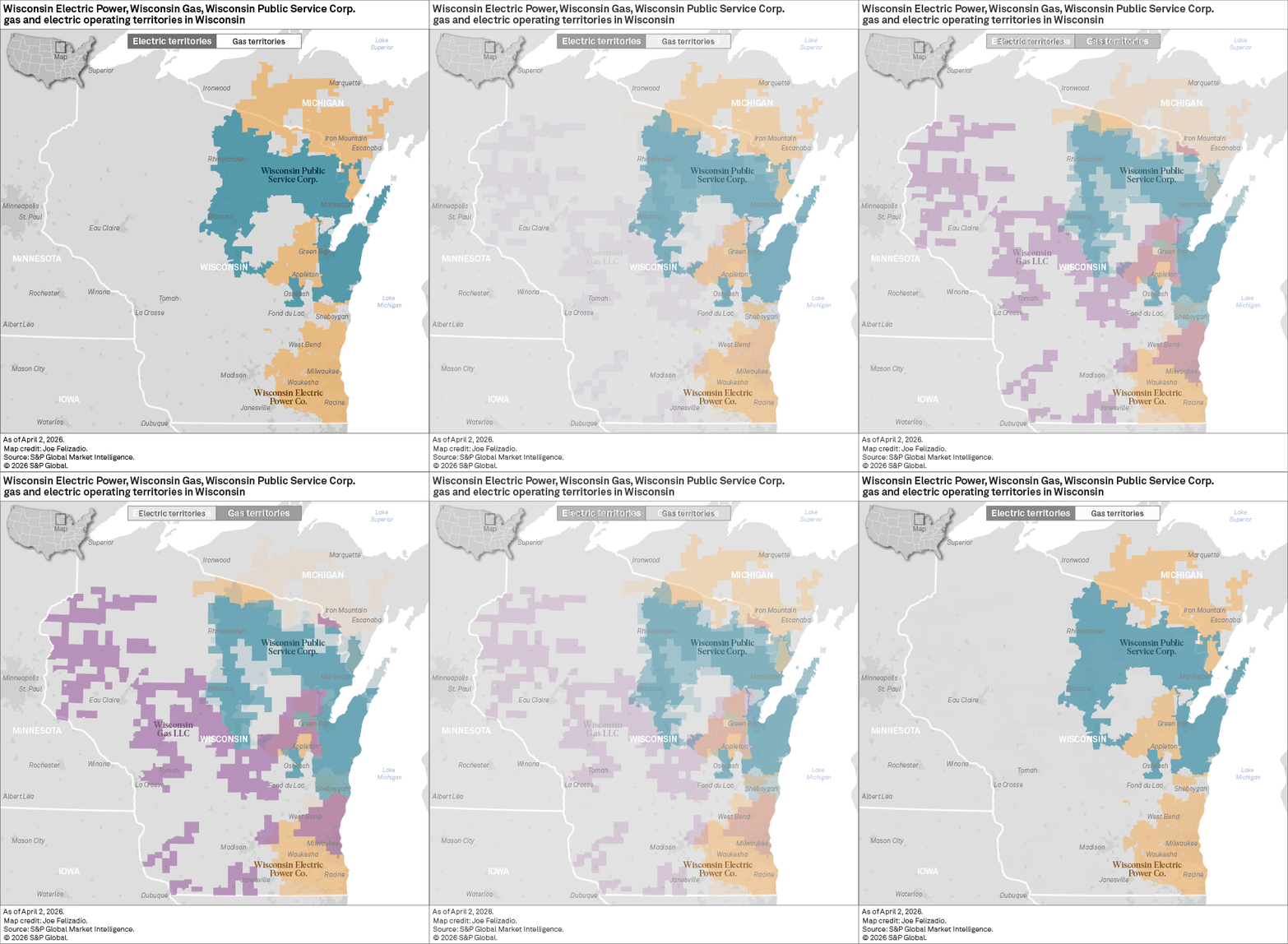
Staff supports a 7.56% overall return on a rate base of $4.05 billion for a test year ending Dec. 31, 2027, and a 7.53% overall return on a rate base of $4.45 billion for a test year ending Dec. 31, 2028, for WPSC's electric operations. For the utility's gas operations, staff supports an 7.50% overall return on a rate base of $965.5 million for a test year ending Dec. 31, 2027, and a 7.48% overall return on rate base of $1.00 billion for a test year ending Dec. 31, 2028.
Staff's testimony detailed its evaluation of the WPSC's proposed revenue requirements, resulting in several key adjustments to the estimated income statement, average net investment rate base, and revenue requirements for the 2027 and 2028 test years. A primary area of adjustment involved the sales forecasts for both electric and natural gas operations, which reduced the revenue requirement. For electric revenue, staff proposed a $14.1 million increase for 2027 and $14.0 million for 2028, largely driven by revised forecasting methodologies for customer growth rates and usage per customer across various rate classes. In natural gas, the staff's adjustments increased the sales forecast by 22,894,305 therms for 2027 and 28,105,962 therms for 2028.
Staff also recommends reducing the total company average plant in service for electric operations by $138.3 million for 2027 and $182.0 million for 2028, and for natural gas operations by $18.2 million for 2027 and $30.5 million for 2028. These reductions are primarily based on using actual 2025 year-end balances rather than estimates and applying historical spending patterns (budget-to-actual percentages) to future capital expenditures, as the WPSC's forecasts had historically exceeded actual construction costs, according to staff.
Staff also recommends several adjustments to payroll and benefits, including reducing regular full-time equivalent positions by 63 for 2027 and 58 for 2028 based on a three-year linear trend, resulting in a decrease of $1.6 million and $1.2 million, respectively, to the revenue requirement. Further adjustments were applied to part-time/seasonal employee expenses, overtime hours, and wage increases for non-represented employees, aligning them with historical averages or inflation rates.
Staff decreased electric operating and maintenance (O&M) expenses related to plant maintenance by $4.2 million in 2027 and $3.6 million in 2028, using a budget-to-actual adjustment reflecting past underspending compared to authorized budgets. A 50% reduction was proposed for board-of-director fees due to insufficient detailed justification demonstrating customer benefits. Similarly, industry association dues were adjusted lower to reflect only the portion of activities deemed beneficial to customers, and expenses for promotional advertising, institutional advertising, and economic development were entirely disallowed.
Staff also removed from the revenue requirement the amount of cost overruns associated with the Paris Solar and BESS (Battery Energy Storage System) project and Darien Solar and BESS project from the test years pending commission authorization.
Staff shared several reports on affordability as part of its testimony, including on a commission investigation concerning utility bill affordability for low-income customers served by WEC utilities. "Many of these reports indicate that households say they do not have sufficient resources to make ends meet and that wages have not kept pace with inflation," staff testified.
Rate case background
WEC's utility subsidiaries — WPSC, Wisconsin Electric Power Co. and Wisconsin Gas LLC — filed applications with the commission on April 1 to collectively increase electric and gas base rates by more than $640.1 million over two years while increasing their authorized returns on equity by 10 basis points.
The applicable dockets are Docket No. 5-UR-112 (Elec); Docket No. 5-UR-112 (Gas); Docket No. 5-UR-112; Docket No. 6690-UR-129 (Elec); and Docket No. 6690-UR-129 (Gas).
WPSC is seeking an increase in Wisconsin jurisdictional electric rates of $84.1 million in 2027 and an incremental $48.6 million increase in 2028. WPSC is seeking a $21.7 million increase in gas rates in 2027 and an incremental $6.9 million increase in 2028.
For the 2027 test year, WPSC's request is premised on a 9.90% return on equity (56.25% of regulatory capital structure), an 8.00% overall return on a Wisconsin jurisdictional electric rate base of $4.13 billion and an 7.92% overall return on a gas rate base of $973.5 million. For the 2028 test year, WPSC's request is premised on a 9.90% return on equity (56.06% of regulatory capital structure), an 8.01% overall return on an electric rate base of $4.49 billion and an 7.94% overall return on a gas rate base of $1.01 billion.
WPSC indicates a significant share of the electric revenue deficiency is tied to ongoing investment in new generation — especially renewable and battery storage projects — plus associated working capital and construction work in progress, alongside a new depreciation study that increases annual cost recovery. WPSC also points to a large increase in O&M costs, which it links to several years of high inflation and higher interest rates, as well as higher cost of capital and transmission expense.
On the natural gas side, WPSC says its requested increases are driven mainly by additional capital spending on reliability projects, inflation-driven O&M increases and higher financing costs, with an updated depreciation study contributing to the revenue requirement. As with electric, slightly lower forecast gas sales (net of the cost of gas) are cited as an added headwind.
WPSC proposes to continue the same earnings sharing mechanism (ESM) for earnings in excess of its authorized ROE approved by the commission in its last rate case. Staff took no issue with the ESM.
To soften bill impacts across its gas and electric operations, the WEC utilities highlight a set of voluntary mitigation steps, including not seeking recovery of incentive compensation, adjustments intended to reduce non–data center customers' exposure to transmission costs tied to data centers, and efforts to accelerate tax credit benefits back to customers.
RRA view of Wisc. regulation
RRA considers Wisconsin regulation to be constructive from an investor perspective. Energy utilities are regulated under a traditional framework, and the most recently authorized equity returns have been above the prevailing national averages when established. The use of forecast test periods and other constructive financial practices, such as the reliance on comparatively equity-rich capital structures for rate-setting purposes and authorization of a cash return on 50% of construction work in progress, has provided the state's investor-owned utilities a reasonable opportunity to maintain solid credit quality metrics and to earn their authorized equity returns.
To expedite the resolution of rate cases, legislation was enacted in 2018 authorizing the PSC to approve settlements between parties. Prior to 2018, rate cases were rarely settled. Since the enactment of the legislation, most rate cases completed for an investor-owned utility have included a settlement.
The PSC also allows periodic adjustments to reflect expected changes in electric fuel costs outside a variance range. The commission has taken an active role in integrated resource planning; thus, before constructing a generating facility, a utility must obtain a determination of need from the PSC, which includes an estimate of the facility's costs. While certain impediments to the construction of new nuclear facilities have been removed, none of the state's electric utilities have plans to develop nuclear generation.
Recent mergers involving the state's major energy utilities have been approved without onerous conditions. In the gas industry, gas-cost recovery mechanisms are in place for local distribution companies, and gas retail choice is effectively available only for large-volume customers. State statutes support the use of settlements between parties in rate cases to expedite the conclusion of such proceedings.
RRA accords Wisconsin energy regulation an Above Average/3 ranking, indicating it is constructive from an investor standpoint. For more information, visit the Wisconsin commission profile page.
Regulatory Research Associates is a group within S&P Global Energy.
S&P Global Energy produces content for distribution on Capital IQ Pro.
For a full listing of past and pending rate cases, rate case statistics and upcoming events, visit the S&P Capital IQ Pro Energy Research Home Page.
For a complete, searchable listing of RRA's in-depth research and analysis, please go to the S&P Capital IQ Pro Energy Research Library.
This article was published by S&P Global Market Intelligence and not by S&P Global Ratings, which is a separately managed division of S&P Global.