Research — Aug 12, 2026
China leads the charge in GenAI adoption in Asia-Pacific

By Seth Shafer
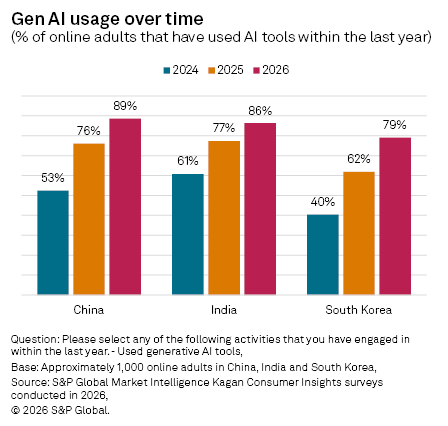
Recent S&P Global Market Intelligence Kagan surveys in China, India and South Korea show that generative AI usage has become the norm in representative Asia-Pacific markets, led by China where nearly 90% of online adults reported using AI tools in the last year.

➤ The vast majority of online adults in China and India surveyed in 2026 said they use AI tools at 89% and 86%, respectively, with South Korea not far behind at 79%. Usage in China and South Korea has nearly doubled since Kagan began surveying for AI usage in 2024.
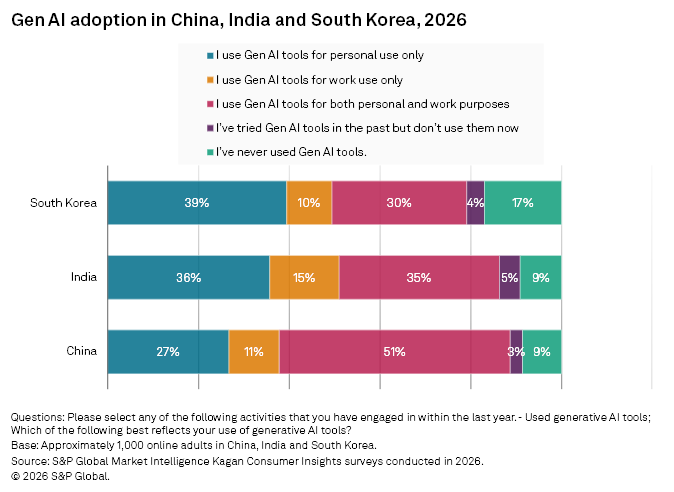
➤Use cases for AI varied across markets, with respondents in China who use AI the most likely to say they use it for both personal and work use at 51%, while South Korea had the largest share of users who only use AI for personal use at 39%. Just 10% to 15% of AI users in all three markets said that they use AI for work purposes only.
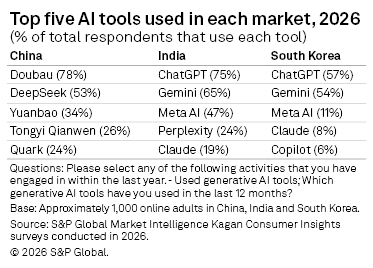
➤ Respondents in China were most likely to use Doubao and Hangzhou DeepSeek Artificial Intelligence Co. Ltd., while ChatGPT and Gemini were the top two AI tools used in India and South Korea. While domestic AI tools are available in South Korea and India, usage is dominated by global offerings from the likes of OpenAI LLC, Anthropic PBC, Alphabet Inc. and Meta Platforms Inc.

Kagan’s surveys of online adults in China, India and South Korea showed rapid and steady adoption of AI tools in each market, an unsurprising result given how quickly AI use cases have spread to workplaces, schools and homes alike.
To further explore AI adoption trends, every survey respondent was asked to select how they primarily use AI tools, with non-users able to select from “I’ve tried GenAI tools in the past but don’t use them now” and “I’ve never used GenAI tools.” Usage for work purposes only was consistent across the three markets at 10% to 15% of total respondents, while the mix of “personal use only” and “both personal and work purposes” varied depending on the market.
Among non-users, it was rare for respondents to have tried AI tools in the past but not currently use them; most non-users fell into the “never tried” category.
Access data discussed here in Excel for China, India and South Korea.
Use of individual AI tools has coalesced around two clear market leaders in each market, although a longer tail of usage was also evident in China and India. In the China market, where usage of global tools such as ChatGPT, Gemini and others is not allowed, Doubau and DeepSeek are the early leaders. Four more AI services (Yuanbao, Tongyi Qianwen, Quark and ERNIE Bot) were used by 20% or more of respondents that use AI.
While ChatGPT and Gemini were #1 and #2 in both India and South Korea, the usage of other services varied widely between the two markets. India saw a wider range of tools in use by about 20% or more of total respondents, whereas usage fell off dramatically in South Korea outside of ChatGPT and Gemini.
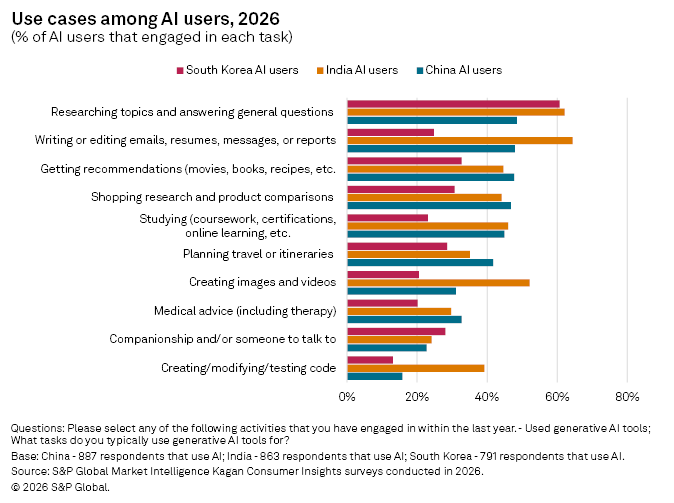
While the tools used in some markets may look similar, use cases varied significantly. When asked about how AI users engage with AI tools, respondents in India reported the highest usage rate for writing or editing emails, resumes and reports, at 64%. Users in South Korea and China identified researching topics and answering general questions as their most common AI activity, with engagement rates of 61% and 49%, respectively. Although India's top use case was reserved for emails and reports, 62% of AI users leverage their tools for research and general inquiries which exceeded the corresponding rates in both China and South Korea.
A notable difference between the countries is the use of AI for writing and editing emails or resumes. In South Korea, only 25% of AI users reported using AI for those tasks, with rates much higher in China (48%) and India (64%). This may reflect the perception among some South Korean employers that resumes created with AI are viewed negatively during the hiring process.
Another area of divergence is code creation and testing. While 39% of AI users in India reported using AI for coding-related tasks, this was the least common AI activity among users in both China and South Korea, with engagement rates of just 16% and 13%, respectively. Users in India may be adopting AI more readily for technical and software development purposes than the other countries surveyed.
India also demonstrated higher engagement in using AI tools to create images and videos. Among Indian AI users, 52% reported using AI for these creative activities compared with 31% in China and 21% in South Korea. What was particularly interesting and perhaps unexpected was the use of AI as a source of companionship, where usage hovered around 25% for each country surveyed.
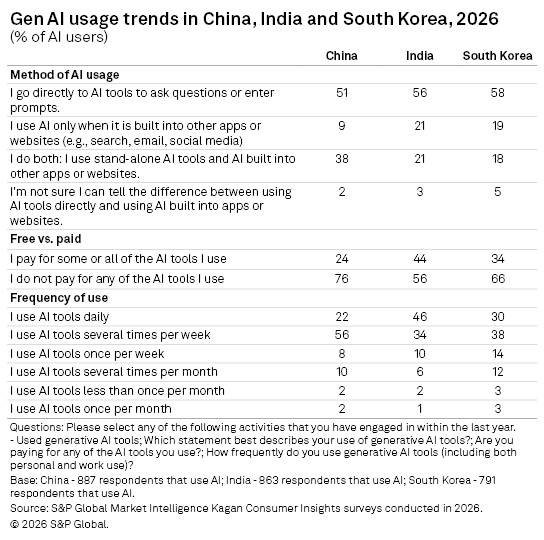
Among AI users surveyed in India, 44% pay for at least one AI tool that they use, compared to lower percentages in South Korea at 34% and China at 24%. Across the markets we surveyed, a solid majority of AI users reported using AI tools at least several times a week, including 46% of respondents in India indicating daily use. Overall, most AI users engage with these tools frequently, while only a small percentage use them once a month or less.
India and South Korea showed the most similar patterns of AI usage across the methods measured. More than 50% of AI users in China, India, and South Korea reported going directly to AI tools when seeking answers to questions. AI users in China reported the highest percentage of respondents who utilize both the standalone tools as well as embedded AI tools at 38%, India and South Korea both trailed at 18% and 21% respectively.
Consumer Insights is a regular feature from S&P Global Market Intelligence Kagan.
This article was published by S&P Global Market Intelligence and not by S&P Global Ratings, which is a separately managed division of S&P Global.
Content Type
Theme
Segment
Language