Research — Aug 28, 2026
BBC 2026 – funding and editorial concerns are challenges for new leadership

2025/26 has been another year of both challenges and successes for the British Broadcasting Corp. The organization has appointed a new Director-General, Matt Brittin, who replaced Tim Davie. Commercial revenue has remained stable, while EBITDA has shown signs of improvement, supported by stronger performance from BritBox. However, BBC funding continues to be a significant challenge. The corporation has reported financial deficits despite a period of rationalization, and the number of households paying the license fee, the BBC's main source of revenue, is declining once again. Combined with several editorial issues, this means the BBC must take steps to secure its future ahead of the renewal of its Royal Charter in 2028.

➤ License fee revenue continues to be a challenge for the BBC; only an estimated 82% of UK households pay the fee.
➤ BBC Commercial is producing stable year over year revenue.
➤ The BBC continues to have a favorable reputation in the UK and globally, but Netflix is a slightly more popular choice for respondents to a recent survey conducted by Ofcom.
➤ Securing viewing from younger audiences continues to be a challenge according to the Ofcom survey.

BBC license fee and future funding
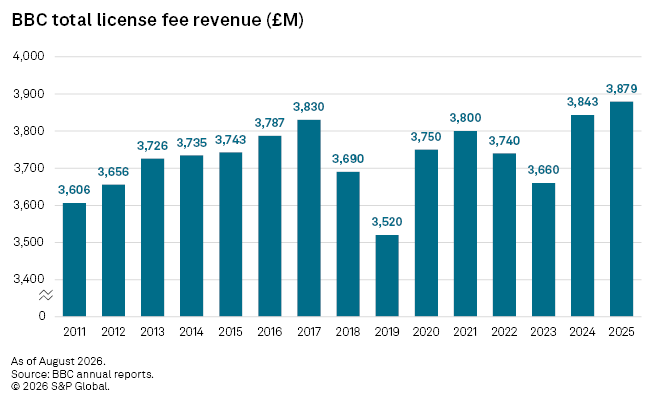
The license fee remains the BBC's primary source of revenue and helps fund its content and services. However, the corporation continues to face significant financial challenges. The BBC Group reported a deficit of £121 million this year, compared with a deficit of £112 million in the previous year. This indicates that, despite delivering efficiencies across the Group and maintaining stable commercial performance, license fee income remains insufficient to support the BBC and fulfill its public service remit.
The annual license fee increased to £169.50 in April 2024 from £159, following a two-year freeze. It rose again to £174.50 in April 2025 in line with inflation. However, the number of people paying the license fee continues to decline as consumers choose not to use BBC services. The BBC's latest annual report states that there are now 23.3 million television licenses in force in the UK, a decrease of 539,000 compared with the previous year. This represents a significantly larger decline than the reduction of 300,000 license fee payers recorded a year earlier. According to the Office for National Statistics, there were 28.4 million households in the UK in 2024, implying that only about 82% of households paid the license fee. The BBC has stated that, under the current funding model, it may not be able to fully support and deliver the public service remit and editorial standards that it is required to maintain.
The BBC's future funding arrangements are closely linked to the renewal of its Royal Charter, which is due to commence in January 2028. The government has already published a discussion paper examining a range of options for the BBC's future funding model. These include the introduction of advertising, subscription-based services, or a hybrid approach featuring a premium "top-up" subscription offering access to additional content. Culture Secretary Lisa Nandy has stated that the government is "keeping all options open" regarding the BBC's future funding, although it has ruled out funding through general taxation.
BBC editorial challenges
The BBC prides itself on its editorial standards and its reputation as a leading force in journalism, committed to reporting the truth accurately and impartially. However, its reputation continues to be affected by editorial mistakes and missteps, including the racial comments that were mistakenly broadcast during the 2026 BAFTA Awards ceremony and the ongoing fallout from edits made to President Trump's speech in the 2024 Panorama program, Trump: A Second Chance. Issues such as these weaken the BBC's claim to be the "north star" of broadcasting standards, a position it seeks to maintain within the global media industry. Nevertheless, the BBC remains a highly influential broadcaster, with 72% of UK adults using its news services each week, and it continues to rank as the UK's leading provider of fact-checked, accurate reporting and trusted content.
BBC Commercial performance
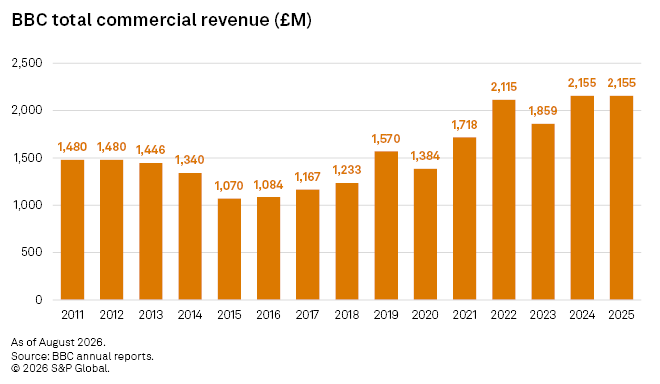
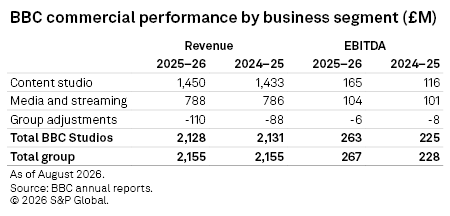
BBC Commercial delivered a stable performance in 2025, matching the record revenue levels achieved in 2024. Growth in certain areas of the business was offset by declines in others, as well as by group-wide adjustments. The BBC reported that revenue was supported by the continued growth of its direct-to-consumer services, including BritBox and BBC Select, alongside strong performance from its consumer products division, particularly the pre-school brand Bluey.
Although BBC Studios reported consistent revenue year on year, EBITDA, BBC Commercial's preferred measure of profitability, increased by 17% year on year to £263 million. This improvement was driven by a combination of factors, including a more favorable revenue mix weighted toward higher-margin sales, cost savings, and favorable foreign exchange movements.
The BBC reported that its most successful titles during the year included "The Americas," narrated by Tom Hanks; "Prehistoric Planet: Ice Age," produced for Apple TV+ and narrated by Tom Hiddleston; "Aileen: Queen of Serial Killers" for Netflix Inc.; "Death Valley," starring Timothy Spall; and "Dancing with the Stars US" for NBC TV Network and Media Works and Disney+.
Looking ahead, however, BBC Commercial warned of continued challenges, including a reduction in program commissions from traditional broadcasters, further consolidation among global media companies, and the ongoing shift in viewing habits from linear television to on-demand services.
BBC Content spend
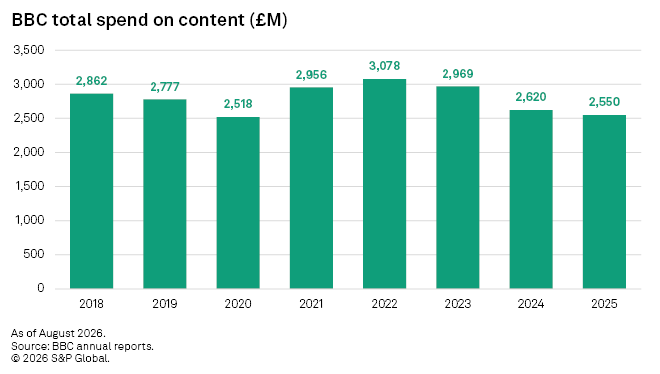
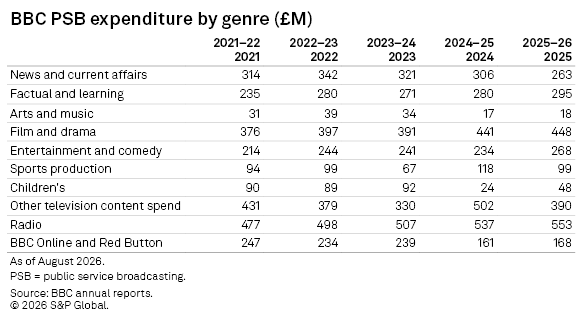
The BBC's content spending declined by 2.7% year on year in 2025/26. While sports production costs remained substantial, they were lower than in the previous year due to the absence of major events such as the Paris Olympics and the UEFA Men's European Championship. In 2025/26, the BBC's sports coverage focused on women's events, including the UEFA Women's European Championship and the Rugby World Cup.
The BBC has already implemented cost reductions across its news operations in recent years, with further cuts expected in the future. Increased investment in comedy and drama was supported by the success of "Death Valley," which was sold to more than 100 international markets.
BBC audiences
The BBC annual report provides examples of how the corporation continues to play an important role in UK life:
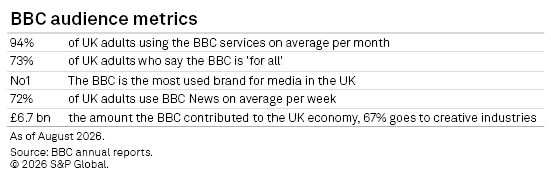
Outside the UK, the BBC continues to attract a substantial global audience. Content from BBC News and BBC Studios reaches 502 million people each week, representing a 12% year-on-year increase.
Conversely, UK media regulator Ofcom's annual Media Nations report paints a more challenging picture in the domestic market. Its survey of people aged 16 and over found that, when deciding what to watch, 26% of respondents turned first to Netflix, compared with 25% who chose the BBC. Among younger audiences aged 16 to 24, the gap was more pronounced: 30% selected Netflix as their first choice, 23% chose YouTube, and only 14% chose BBC services.
Economics of Networks is a regular feature from Kagan, a part of S&P Global Market Intelligence.
This article was published by S&P Global Market Intelligence and not by S&P Global Ratings, which is a separately managed division of S&P Global.
Content Type
Theme
Segment
Language