Research — April 23, 2026
Surging energy demand puts US utility capex forecast near $1.3T in 2026–30
By Jason Lehmann, Dan Lowrey, and Heike Doerr
US investor-owned utilities are planning significant capital expenditures over the next five years, focusing on infrastructure modernization, reliability and new generation capacity to meet heightened energy demand from new large-load customers, particularly data centers.

➤ RRA forecasts approximately $1.3 trillion of aggregate capital expenditures for US energy utilities between 2026 and 2030 as companies seek to modernize infrastructure and add generation capacity in response to heightened energy demand from large-load customers, particularly data centers that support AI, digital services and cloud infrastructure. Data centers, along with other large industrial loads such as new manufacturing facilities, are fueling the need for new power supplies through 2035, adding 374 TWh of energy demand and over 45 GW of peak load, according to analysts at S&P Global Energy CERA.
➤ RRA's updated 2026 capex forecast represents an approximate 29% increase from roughly $200 billion spent in 2025. Aggregate energy utility investments are now projected at $259.122 billion in 2026, $275.592 billion in 2027 and $276.921 billion in 2028 — an approximately 9% increase over 2026–28 forecast spending levels in RRA's December 2025 capex forecast. Within the smaller investor-owned water utility sector, total capex is projected to grow approximately 16% in 2026 to $6.947 billion, from $6.003 billion in 2025, continuing a trend of double-digit annual capex growth rates.
➤ The elevated pace of capital expenditures over the next several years will require a commensurate level of regulatory engagement to secure timely cost recovery; as such, Regulatory Research Associates anticipates ongoing elevated rate case activity across the sector, with a focus on balancing the need for significant infrastructure investment against customer affordability considerations. Successful regulatory outcomes will be central to translating capital spending into rate base and earnings growth.

Energy utilities continue to ramp up infrastructure investments
US electric and gas utilities are significantly ramping up planned infrastructure investments for the 2026–2030 period, driven by a forecast surge in energy demand from the rapid expansion of data centers, and from residential, commercial and industrial customer expansion. Capex programs are targeted at infrastructure modernization to enhance grid reliability and resiliency, alongside a significant build-out of new generation and transmission capacity to meet continuing data center growth and the need to connect to new resources.
For the 2026–2030 period, aggregate energy utility spending for 46 companies tracked by Regulatory Research Associates is forecast at a record $1.295 trillion, versus $1.169 trillion in our December 2025 forecast (now excluding Allete Inc., which last traded as a public company on Dec. 15, 2025).
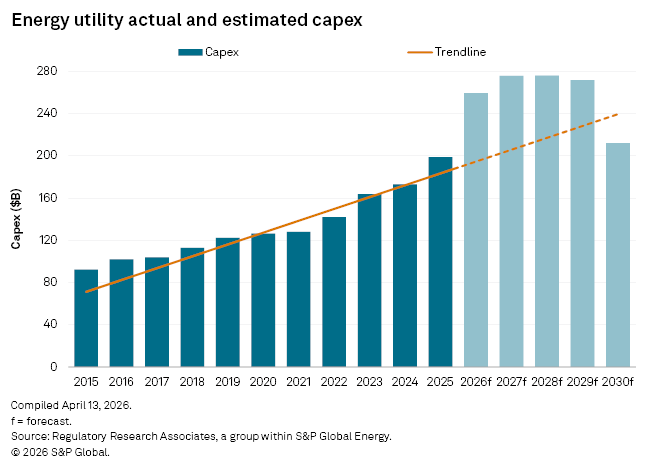
The overall spending forecast for the 2026–2030 period exceeds RRA's prior five-year forecasts, fueled by a diverse mix of investments across the electric and gas sectors. Forecast capex for the RRA Financial Focus electric utility group is expected to grow to $112.457 billion forecast in 2028, from $108.436 billion in 2026, and from $80.547 billion reported for 2025. Infrastructure investment strategies are centered on grid modernization and resiliency, expanding generation and transmission capacity to meet surging demand, and investments in clean energy transition, including renewables and battery storage. In particular, the projected rapid expansion of data centers in the US will necessitate significant new generation capacity due to high, constant power demands, which will in turn require ongoing upgrades and expansions to US transmission and distribution networks, including new high-voltage lines and substations.
Entergy Corp. forecasts $35.235 billion of capital investments for its utilities between 2026 and 2028, up from a forecast of $30.745 billion in December 2025. Just under half of the company's updated budget is slated for new generation projects as the company seeks to serve growing industrial electric loads. Entergy expects approximately 60% of the growth among its large industrial customers through 2029 will be data center-related. The company has nearly 9 GW approved and under construction toward its planned 13 GW of new capacity through 2029.
American Electric Power Co. Inc.American Electric Power Co. Inc. has a $72 billion base capital plan for 2026–2030, or more than $14 billion annually. Since last fall, the company has doubled its firm incremental contracted load additions to 56 GW, including with a large aluminum smelting customer, large industrial customers, hyperscalers and large data center developers.
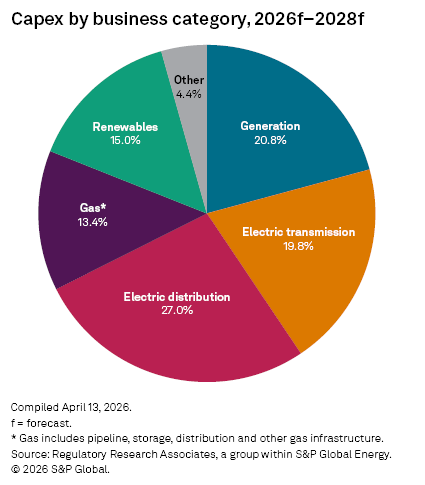
Forecast capex for the RRA Financial Focus multi-utility group is expected to grow to $153.302 billion by 2028, from an estimated $139.575 billion in 2026 and $110.872 billion reported for 2025.
Data centers and other large-load energy users are among the primary factors driving utility capital expenditure plans into the next decade. Southern Co. now expects to spend more than $51 billion between 2026 and 2028 — up 34% from $35.6 billion in our December 2025 forecast — primarily on new electric generation, transmission and distribution projects to meet rising energy demand projections from contracted large loads, and increased usage from existing and new large-load data center customers.
Sempra's 2026–2028 capital expenditures are forecast at $44.852 billion, versus $33.6 billion forecast in RRA's December 2025 outlook, and expenditures through 2030 could exceed $74 billion, driven by strong demand for new transmission and distribution, particularly in Texas, where power is needed for expanding data center and oil and gas operations in the Permian Basin.
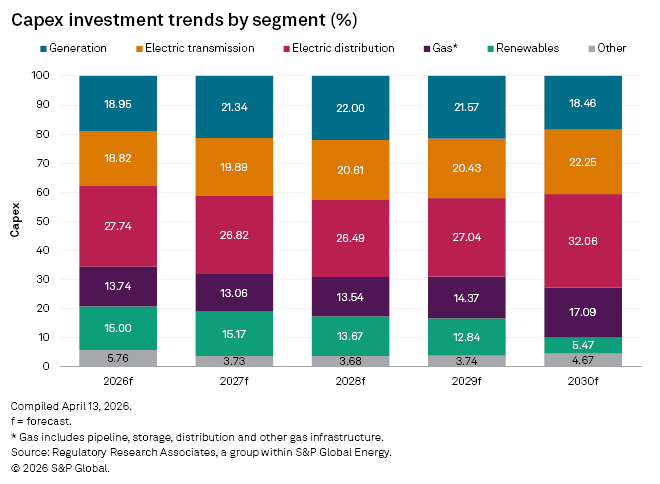
Within the smaller gas utility sector, Atmos Energy Corp. plans $13.771 billion of capital expenditures between 2026 and 2028, the same as in RRA's December 2025 forecast. More than 80% of the company's budget is allocated to safety and reliability investments, including system modernization and monitoring projects and gas storage.
To meet new customer growth and comply with environmental and water quality regulations, water utility capex programs typically include infrastructure renewal programs to replace mains, services, meters, hydrants and valves, as well as larger capital projects such as water and wastewater treatment and delivery facilities. Capex for the small Financial Focus water group is expected to grow marginally from $6.25 billion in 2026 to $6.34 billion in 2028.
Looking ahead
As previously noted by RRA, affordability remains a key issue shaping the US power and utility sector, moving from a background concern to a binding constraint on what utilities can earn and build. The shift is driven by mounting pressure at state and federal levels, with energy prices having risen much faster than inflation, and customer dissatisfaction at historic highs. Utilities' multibillion-dollar capital expenditure programs may put further upward pressure on bills unless offset by new strategies. The upcoming election cycle and federal policy discussions are amplifying the focus on affordability, with industry groups and utility executives highlighting the need to moderate rate growth and maintain customer trust. Regulatory Research Associates is watching closely how affordability concerns could reshape regulatory and market dynamics. For additional information, see the April 7 RRA Financial Focus report, "2025 US electricity price growth accelerates after 2-year moderation trend."
Download the H1 2026 capex databook.
This report is designed to identify capital expenditure trends in the US utility sector, drawing data from a range of sources, including corporate investor presentations, annual reports and other sources. While S&P Global Energy strives to ensure the accuracy of the included underlying data, the sources vary in terms of depth, quality and timeliness. Actual company-specific capital expenditure information should be acquired from filings with the US Securities and Exchange Commission. To access the most recent previous capex analyses, refer to Energy utility capex forecast nears $1.2 trillion in 2025–29; US utility capex forecast nudges higher on increased generation spending plans; and Energy utility capex predicted to top $1 trillion from 2025 through 2029
|
Regulatory Research Associates is a group within S&P Global Energy.
For a complete, searchable listing of RRA's in-depth research and analysis, visit the S&P Capital IQ Pro Energy Research Library.
This article was published by S&P Global Market Intelligence and not by S&P Global Ratings, which is a separately managed division of S&P Global.