BLOG — Dec. 21, 2025
5G take-up lags in Europe
By Georgia Jordan and Julija Jurkevic
Article Highlights
- In 11 of the 14 European markets with available data, less than 40% of mobile subscribers used 5G in 2024.
- Slow 5G take-up in Europe contrasts with the popularity of 4G services when they first launched in the mid-2010s.
- Spectrum limitations may also delay service expansion, as many mobile carriers in Europe launched their 5G networks before regulators held spectrum auctions for higher-capacity frequencies.
Six years after the first commercial launches of 5G services across Europe, the adoption of 5G among consumers remains low in many markets, according to regulator-reported data. In 11 of the 14 European markets with available data, less than 40% of mobile subscribers, excluding machine-to-machine lines, used 5G services by year-end 2024.
Europe's 5G journey is a mosaic of differing national strategies, regulatory timetables, investment profiles, spectrum policies and operator technology choices that have produced a fragmented landscape for rollouts.
Europe 5G launch timeline

Already a client? Click here to access S&P Global Market Intelligence Kagan's full report on European 5G networks, including all 5G launched per operator in Excel format.
Early access to high-capacity spectrum (3.4 GHz-3.8 GHz), aggressive capital expenditure deployment strategies, and a pivot toward 5G standalone (SA) cores and enterprise monetization are driving leadership in the Nordics and Germany, while "fast-follower" markets in France, Spain and the United Kingdom are now cautiously accelerating SA. In contrast, many Eastern and Southern European markets continue to face delayed auctions, lower investment intensity, and uneven economic conditions that dampen 5G penetration and stall SA monetization.
Slow 5G adoption in the region also reflects the stagnation in smartphone shipments, which declined in four of the last six years. This is largely due to high market saturation, which is more pronounced in developed economies — smartphone penetration between 2019 and 2024 grew from 86.6% to 91.2% in Western Europe and from 79.8% to 86.5% in Eastern Europe — and longer replacement cycles delaying new smartphone purchases for consumers.
Low smartphone sales in the period were also aggravated by the effects of COVID-19: Adverse macroeconomic conditions and disrupted supply chains, coupled with stay-at-home mandates and work-from-home trends driving consumers to prioritize Wi-Fi upgrades over mobile. 5G-enabled smartphones would only become widely available in 2021, with Samsung launching its first device in Europe in mid-2019 and Apple in October 2020.
5G adoption in Europe
Baltic country Lithuania had the lowest 5G adoption rate in 2024, at 11.0% of total mobile subscribers, having only recently launched 5G services in January 2022. Romania, the first market in Eastern Europe to launch a 5G network in May 2019, has still not experienced much adoption of 5G, with only 16.2% of mobile subscribers using the network.
Meanwhile, Denmark registered the highest 5G adoption rate at 81.6% of total mobile subscribers. This is despite being a comparative latecomer — at least in relation to other Western European markets — with the first commercial 5G service launched by incumbent telco TDC in September 2020.
Slow 5G take-up in Europe contrasts with the popularity of 4G services when they first launched in the mid-2010s. Of the 14 European markets for which regulators reported 4G data, 11 had over 80% of mobile subscribers using either 4G or 5G by year-end 2024. Of the five markets with historical data available for comparison, France and Spain saw 4G adoption reach around 60% of total mobile subscribers in four years, compared to around 30% in four years since 5G services were first launched.
Belgium was the only one of the five markets where the 5G take-up rate has mirrored that of 4G eight years prior, with both generations being used by around a third of mobile subscribers within four years of the networks being launched. Belgian mobile carrier Telenet, for instance, reported that 30% of smartphones on its network were 5G compatible by March 2023, 15 months since the company first launched 5G services in December 2021, up from 22% a year earlier.
Sweden, on the other hand, saw 5G adoption grow much faster than 4G, reaching 28.6% in four years compared to 10.7% for 4G services over the same period. It is worth noting that Sweden was one of the first in the world to launch a 4G network back in 2010, when smartphones were still a novelty.
Spectrum limitations
Market conditions have stymied early movers' ability to drive adoption. Initial 5G launches tend to be limited to a small number of major cities, expanding coverage over several months, and frequently, years. Spectrum limitations may also delay service expansion, as many mobile carriers in Europe launched their 5G networks before regulators held spectrum auctions for higher-capacity frequencies, such as the 3.5 GHz band, which forced reliance on low-band spectrum, affecting throughput and delaying 5G SA commercialization.
In Western Europe, Portugal was the last country to hold a 5G spectrum auction, in November 2021, when the first services were also launched. Yet the regulator reported 31.2% of mobile subscribers used 5G at year-end 2024, close to the 34.2% adoption rate in Germany, which first launched services in July 2019, and ahead of Austria's 24.0%, almost six years after 5G first became available in March 2019.
Ireland was one of the first countries in Europe to auction the 3.5 GHz (in May 2017) and 26 GHz (in June 2018) frequencies, two years before operators launched services in August 2019. Ireland's 5G adoption remains low at 19.3% of total mobile subscribers as of 2024. The regulator data, however, includes M2M in its total mobile subscriber numbers, which skews the data somewhat, as the majority of machine connections use 2G and 3G networks.
In Eastern Europe, major markets such as Russia and Serbia are yet to launch 5G services or hold spectrum auctions. In Poland, for instance, all mobile network operators (MNOs) had launched 5G services by year-end 2020, relying on repurposed 3G spectrum in the 2100 MHz frequency band initially, as regulator Urzad Komunikacji Elektronicznej / Office of Electronic Communications (UKE) had postponed the auction for the 3.5 GHz band planned for that year due to the COVID-19 pandemic. Poland auctioned 5G frequencies in October 2023, followed, in June 2025, by a second auction for low-band 5G frequencies (700 MHz and 800 MHz).
Spectrum refarming, or the freeing up of frequencies, is also inconsistent across European markets. Only a handful of operators have switched off 3G networks, while 2G is expected to remain in operation until 2030 to provide network coverage for M2M services. With most European countries planning to switch off 3G networks entirely by the end of 2025, S&P Global Market Intelligence Kagan expects that new spectrum availability in the low and mid-band ranges will allow MNOs to expand 5G coverage more rapidly in the next few years, as lower frequencies provide wider coverage areas. Regulators in Europe have stepped up on mmWave spectrum allocation, especially in the 26 GHz band, which allows for greater capacity in dense urban areas.
The UK auctioned 5.4 GHz of spectrum in the 26 GHz and 40 GHz frequencies for a total of £39 million in October 2025, significantly increasing bandwidth. Prior to the auction, the market's three MNOs had a total of 1.1 GHz of spectrum combined.
Spectrum availability has also enabled more operators to launch 5G SA services, which offer a significant improvement over 4G, compared to early 5G networks that often depended on sharing spectrum, as well as network cores, with the still heavily used 4G network.
5G standalone
Operators initially favored non-standalone (NSA) 5G anchored to 4G cores for speed-to-market, cost control, and device availability. Dynamic spectrum sharing (DSS) on FDD bands (2.1 GHz, 1.8 GHz) plus 700 MHz enabled broad coverage quickly, ahead of 5G spectrum auctions. This drove subscriber penetration but delivered only incremental performance improvements compared to 4G in many scenarios and limited exposure to standalone-only features, including true network slicing, ultra-reliable low-latency Communications (URLLC), and deterministic latency. On the other hand, 5G SA requires a 5G core and broader device support, as well as higher capex and opex due to the need for core modernization and cloud-native transformation. Despite SA performance advantages, ecosystem maturity and monetization models remain uneven.
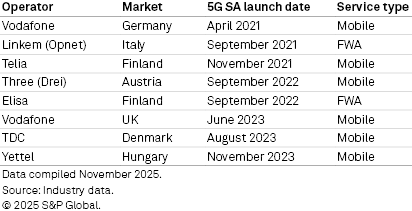
5G SA deployments have accelerated in the last two years, with launches in Czechia, France, Germany, Hungary, Kazakhstan, Latvia, Lithuania, Portugal, Romania, Slovakia, Spain and Sweden. Early SA launches in Europe reveal strategies such as fixed-wireless-first SA, enterprise-first SA, and consumer SA for latency branding (5G+).
Early 5G standalone launches in Europe
Mobile Investor is a regular feature from S&P Global Market Intelligence Kagan.