RESEARCH — Nov. 20, 2025
451 IT Insider October: A roundup for IT decision-makers

In a world where technological advancements dictate the pace of progress, the AI revolution challenges industries to adapt or be left behind. As businesses grapple with the complexities of integrating cutting-edge AI solutions, the stakes have never been higher. This report cuts through the noise, offering a critical examination of the AI landscape, where innovation meets reality, and the path to sustainable growth is paved with both opportunities and obstacles.

Global markets have reached a critical inflection point, where the rapid evolution of AI demands not only robust investment in infrastructure and talent but also a strategic recalibration of risk management practices. As adoption accelerates across businesses of all sizes, companies must balance innovation with pragmatic operational improvements to safeguard long-term value. The fundamental challenge lies in navigating a landscape marked by disruptive opportunities alongside complex integration and security hurdles.

AI in focus: Generative AI software market revenue trajectories and the bubble question
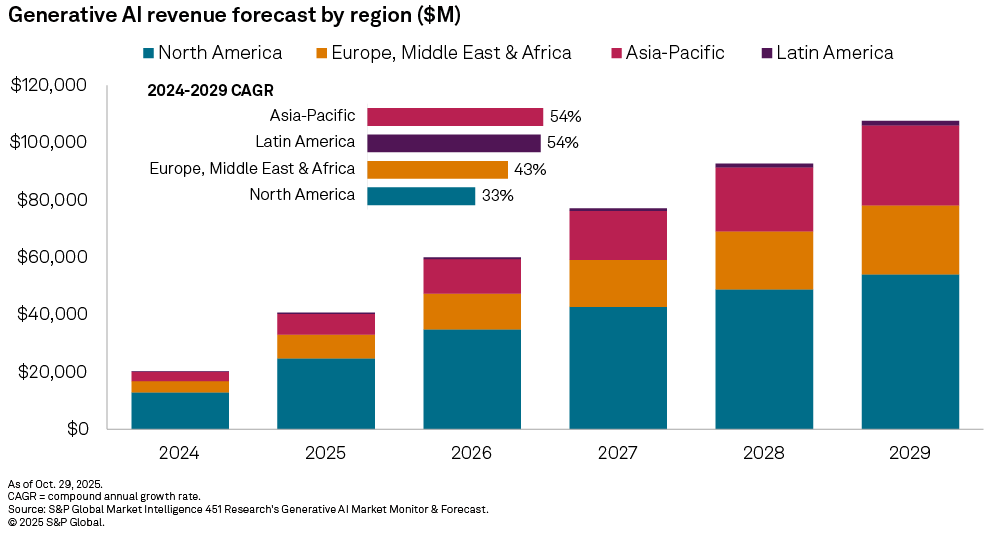
All eyes are on the AI market, with significant attention on what some view as a growing AI "bubble." The market is entering a period of intense scrutiny, which brings us to a central question: Can AI vendors build a revenue trajectory robust enough to justify AI infrastructure investments and sustain their high rates of cash burn? The October 2025 Generative AI Market Monitor & Forecast provides an opportunity to examine this question. It tracks 483 GenAI model and software vendors — specifically, companies whose core value proposition centers on GenAI capabilities, rather than those that simply incorporate GenAI features into broader products. It provides insight into vendors that offer general-purpose AI capabilities to address a wide array of use cases and customer segments, and that are already generating revenue or have an active client pipeline. The GenAI industry will likely be unable to meet its proposed infrastructure investments without a significantly accelerated revenue trajectory. Aggregate revenue in the GenAI software market is projected to reach $103 billion by 2029 — a 39.3% compound annual growth rate from 2024 to 2029. However, these figures seem out of sync with studies that suggest trillions of dollars in annual revenue will be needed to fund the computing power required to meet anticipated AI demand by 2030.
Enterprise AI demand drives tech spending amid uncertainty
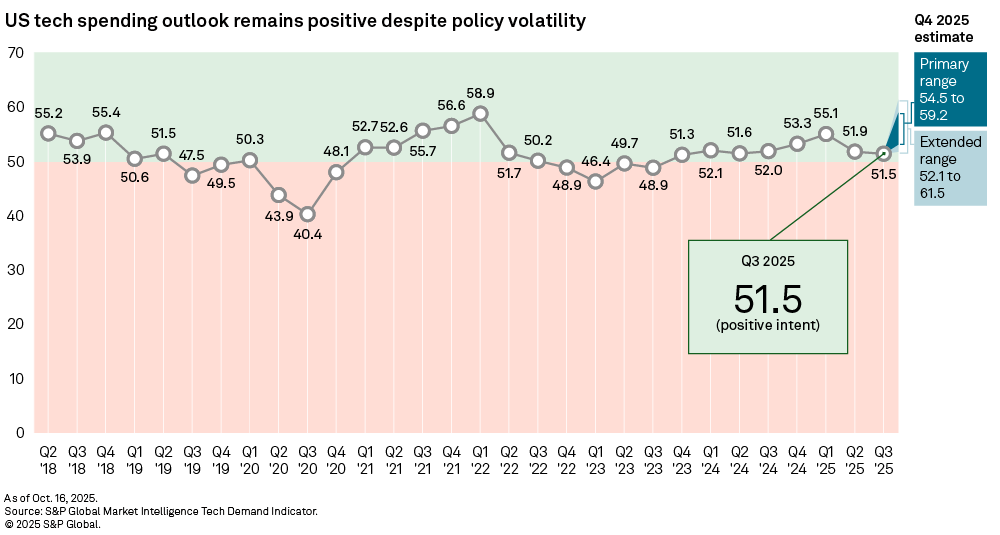
Intent to spend on technology among US businesses and consumers flattened during the third quarter of 2025, showing signs of recovery after a significant decline from the first quarter to the second quarter, according to 451 Research's US Tech Demand Indicator, a survey-backed composite of intent to spend on technology. US trade policy continues to affect the global economy and, by extension, organizations' IT spending plans. While the impact differs by technology category and region, we expect its influence to continue well into 2026. According to 451 Research's Macroeconomic Outlook, SME Tech Trends, AI Adoption 2025 survey, global tech spending is looking up, likely driven by multiple factors including tariffs, renewals and AI disruption. Global IT spending is expected to show a bullish outlook for early 2026, although this optimism varies significantly by region. US organizations remain notably more cautious than their international counterparts, with only 18% expecting budget increases, compared with 43% of non-US respondents. This divergence appears to be linked to tariff impacts, particularly affecting hardware-centric segments such as IT infrastructure, employee devices and the internet of things.
AI adoption continues to gain momentum across organization sizes, with 53% of small and medium-sized enterprises and 61% of large enterprises reporting usage or proof-of-concept initiatives. SMEs, on average, plan to allocate 18% of their total IT budget to AI-related spending in the next 12 months, while large enterprises project an average of 26%, indicating a substantial commitment to these technologies. The broad interest in advanced capabilities, such as GenAI and agentic AI, and the expected benefits across various use cases and departments, suggests that organizations view these tools as important drivers of productivity and operational efficiency. However, implementation challenges around cost, skills and security remain significant barriers.
SMEs with an established digital transformation strategy appear better positioned to navigate market pressures, showing stronger spending intent and higher AI adoption rates. This suggests that strategic digital planning may help organizations balance external economic pressures with technology investment priorities.
Emerging tech: Exploring the adoption of a data science platform for agentic AI
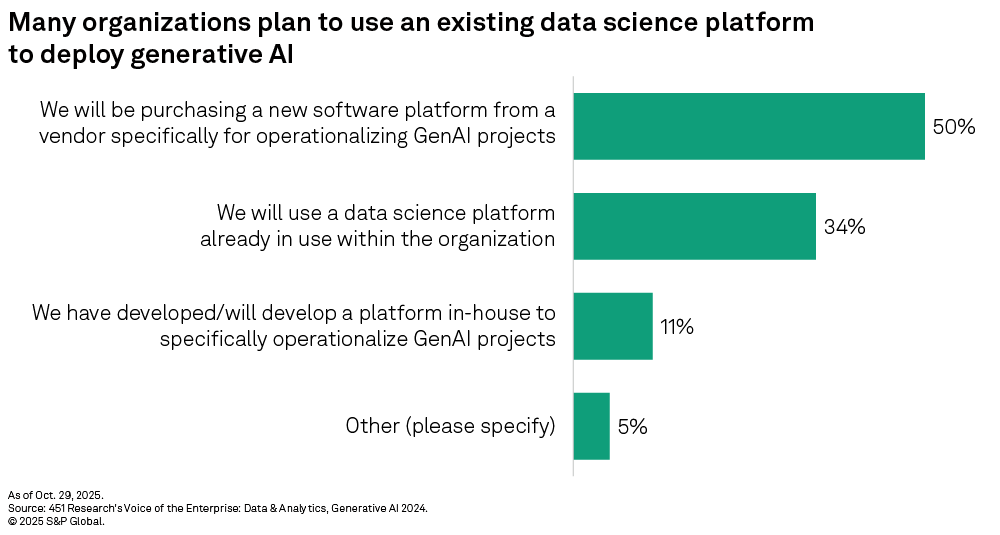
Increasingly, data science platform providers seek to enable generative and predictive AI development, deployment and management in a single environment, and enterprises recognize the appeal of this approach. Slightly more than one-third (34%) of responding organizations plan to use an existing data science platform to implement generative AI in production, according to 451 Research's Voice of the Enterprise (VotE): Data Analytics, Generative AI 2024 survey. We examine the critical functionality required to effectively use a data platform as an environment for AI agent creation, deployment and management.
Agentic AI gives data science platforms fresh relevance and a stake in a high-growth market. The requisite functionality is quite expansive because it must address all phases of AI agent development, deployment and management. Data scientists and developers are familiar with data science platforms, and with this familiarity comes expectations that the same level of functionality will be available for agentic AI. Fulfilling this expectation can be hard for some players because agentic AI is outside of their core competency in data science. Organizations considering using their existing data science platform for AI agent development, deployment and management need the benefits to outweigh the challenges. The advantages of a relationship with an existing supplier include the potential to influence product development, negotiate better pricing and reduce the integration burden, while the main downside is the potential for vendor lock-in.
M&A in focus
Privately held data protection vendor Veeam Software Group GmbH is paying $1.73 billion to acquire data security posture management provider Securiti Inc., in a bid to securely enable enterprise adoption of GenAI. The buyer intends to combine its data protection suite with Securiti AI's data security offerings to enable enterprises to better leverage their data in primary and secondary storage systems, in turn supporting safe implementation of generative AI. Generative AI remains a massive prize for enterprises looking to generate content and code, or simply improve automation and productivity. However, data privacy and security risks are the top challenges that organizations cite in adopting GenAI, according to 451 Research's VotE: AI & Machine Learning, Use Cases 2025 survey. With this in mind, it makes sense for two vendors such as Veeam and Securiti AI to integrate their offerings to address enterprise risk, as the secure implementation of GenAI and safe use of enterprise data are increasingly enticing buying triggers for their joint customer base.
Notable companies
HashiCorp Inc. has launched updates to its Terraform tool and announced its plan for a graph-based agentic infrastructure platform. Since its 2020 launch of HashiCorp Cloud Platform (HCP), its suite of fully managed SaaS products, HashiCorp has worked to convince buyers that its integrated collection of tools is greater than the sum of its parts. Yet the company's flagship products — Vault (identity-based secrets management) and Terraform (infrastructure as code) — are so popular that most customers have yet to move beyond them.
Weatherford International PLC has launched its Industrial Intelligence Platform to support digital-first energy operations. The global oil and gas industry is at an inflection point where digital transformation, automation and data integration have become indispensable for maintaining competitiveness. The new portfolio seeks to unify physical operations, legacy assets and digital intelligence in a single ecosystem. It combines the company's domain expertise with a modular suite of software and hardware tools designed to deliver actionable insight from the edge of the field to enterprise control rooms. By connecting sensors, automation systems and data management architectures, Weatherford aims to create a scalable intelligence layer that supports operators at every stage of digital maturity.
Posit Science Corp. has laid out its data science strategy, with Positron IDE and generative AI in the mix. Posit has evolved considerably over the past few years, expanding beyond R to Python-based data science by building multilingual offerings to increase its addressable market. The vendor's measured approach to generative AI is appealing because it stresses a human-in-the-loop strategy, which is critical to success. Slightly more than one-quarter (26%) of enterprises cite quality of generations as the greatest current barrier to GenAI adoption for data science or analytics, according to the VotE: Data & Analytics, Generative AI 2025 survey.
Badge is offering a new approach to strong authentication without the exchange of secrets. It has taken recent innovations in AI, machine learning and cryptography and applied them to underserved markets and use cases that require improved security and productivity. Enabling thousands or tens of thousands of users to easily and strongly authenticate to any kiosk, device or terminal helps to provide a better user experience and reduce whole classes of vulnerabilities around weak authentication or stolen credentials.
Cerebras Systems Inc. has raised $1.1 billion as it pivots toward cloud inference. It has developed its own wafer-scale silicon accelerators along with self-contained integrated systems and, more recently, cloud-based inference services. The series G funding comes amid a flurry of massive investments, forward-looking contract commitments and acquisitions in the AI infrastructure sector. Cloud-based inference services could be an easier route to market, as they bypass otherwise insurmountable technology packaging, customer integration support and sales distribution channel challenges that only large, established vendors can hope to address. Cerebras believes its WSE chips will continue to outperform other inference approaches. The question is whether it can move beyond offering inference services from its own hosted cloud and start attracting the big cloud providers as customers and partners.
Cisco Systems Inc. has unveiled AI-enabled Webex contact center solutions and industry integrations. The company introduced Webex AI Quality Management, enhancements to Webex AI Agent and updated Cisco AI Assistant features for Webex Contact Center deployments, as well as expanded integrations with Salesforce Inc., Amazon Lex and Epic Systems Corp. These updates highlight how Cisco's previously siloed products are evolving into a unified platform, boosting value for its enterprise customers.
Attribute offers automated, granular unit economics without tagging. It is a streamlined FinOps platform positioned to "simplify the business value of cloud investments and align them with organizational priorities." It automates the discovery and grouping of cloud costs according to business metrics, crucially without the need for tagging. For granular visibility into cloud expenditures, Attribute uses extended Berkeley Packet Filter data (application runtime data for usage-based allocations) to provide enhanced views of exact costs. The company says this enables finance, engineering and product teams to better collaborate and optimize business processes to ensure that cloud investment supports business goals.
Jamocha Tech Private Ltd. (dba ProHance) aims to boost productivity with workforce management (WFM) capabilities for contact center and back-office operations. The vendor's strong workforce analytics foundation underpins its move into customer experience management. By integrating WFM features with a suite of customer experience (CX) tools including omnichannel communications, AI predictive analytics and real-time intraday management, ProHance seeks to offer a unified platform that bridges contact center and back-office operations. Its integrated approach could deliver deeper insight into contact center productivity with tools such as application-based data, as well as URL and user activity information. This could be an important differentiation for the company as it steps into an already fragmented and intensely competitive CX space.
Verint Systems Inc. advances CX automation, highlighting tangible business outcomes. Together with its Value Dashboards' capabilities for tracking key performance indicators, these factors differentiate its offering. By integrating its CX Open Platform with AI-driven bots and analytics tools, Verint looks to be well-positioned to meet evolving contact center automation needs. However, under new ownership, Verint must navigate challenges such as high AI project attrition rates and competitive pressures to maintain its leadership in the CX space. We believe it also needs a messaging strategy that articulates its differentiation to support its positioning as a leader in the emerging CX automation category.
Hyland Software Inc.'s Content Innovation Cloud aims to turn content into context for the "agentic enterprise." It is weaving content repositories and other sources of data into its Content Innovation Cloud. By leveraging its installed base and vertical expertise, the vendor emphasizes federation, governance and prebuilt industry-specific agent meshes to ease adoption, while open-sourcing its Cloud Content Repository to accelerate integration and ecosystem growth. The vision is compelling, but execution is complex. Enterprise-scale context and orchestration demand resilient connectors, compliance-grade semantics, cost-efficient operations and high-quality data.
What to watch
Looking ahead, the evolving landscape promises a shift in how enterprises align their strategies with new market dynamics. As organizations recalibrate to manage emerging risks and leverage untapped opportunities, we anticipate changes in operational models to emphasize agility and long-term resilience. We expect stakeholders to prioritize scalable investments and adaptable frameworks that respond to fluid market conditions, setting the stage for a future defined by innovation and strategic foresight.
These developments will play a crucial role in shaping the future of enterprise technology, offering new opportunities and challenges for businesses worldwide. 451 Research by S&P Global provides essential insight into the pace and extent of digital transformation across the global technology landscape, including data on adoption, innovation and disruption across the technology markets, backed by a global team of industry experts. As the enterprise technology landscape evolves, keeping an eye on these developments will be essential for organizations aiming to navigate the complexities of digital transformation.
Content Type
Products & Offerings
Segment
Language