Research — Oct 23, 2025
451 IT Insider: A roundup for IT decision-makers

In today's rapidly evolving technological landscape, the integration of artificial intelligence into IT operations is reshaping how organizations function. As AI becomes more embedded across various tasks, from monitoring to security, the role of chief technology officers is increasingly pivotal. They are tasked with steering their organizations through the complexities of adopting advanced technologies while ensuring that traditional operations remain robust. Market dynamics, characterized by significant growth in AI infrastructure and the strategic consolidation of AI capabilities, demand a forward-thinking approach. This environment presents both challenges and opportunities, requiring CTOs to be agile in their strategies to maintain a competitive edge and drive innovation.
Request more info for 451 Research.

As organizations integrate generative AI into IT operations, CTOs must navigate the balance between leveraging AI for tasks such as monitoring and security, and maintaining traditional team roles for core operations. The AI infrastructure market's projected growth to more than $250 billion in 2025 underscores the critical need for robust planning to avoid pitfalls such as single points of failure. Cloud-anywhere operating models and agentic cloud operations can be used to manage complex IT environments efficiently. The rising demand for GPU as a service and the strategic importance of AI in enterprise search require CTOs to stay ahead in technology adoption and competitive positioning. Additionally, advancements in quantum computing and AI-powered innovations in IT security and workforce management present both opportunities and challenges, necessitating a strategic focus on skill development and resource allocation to harness AI's full potential.

AI in focus: Impact of GenAI on IT operations grows and AI infrastructure market performance remains
GenAI in IT operations
Enterprise use of generative AI for IT operations continues to grow, with nearly three-quarters of organizations leveraging it for at least one task. However, several core components of IT operations remain in the hands of traditional teams, and organizations generally cite a need to maintain or increase staff recruitment and retention as they implement GenAI for IT operations. Core IT tasks, such as orchestration, configuration and provisioning, remain the responsibility of traditional DevOps, platform engineering and IT operations teams. This coincides with a general increase in staffing levels required for implementing GenAI at scale in IT ops, while a lack of skills is among the top challenges. This indicates that as organizations continue integrating GenAI into IT operations, human staff and collaboration remain critical to implementation. Our results also highlight that GenAI can be used to free up staff for creative efforts and interactions that can drive both efficiency and innovation, while a loss of human creativity is among enterprises' concerns about leveraging GenAI for IT operations.
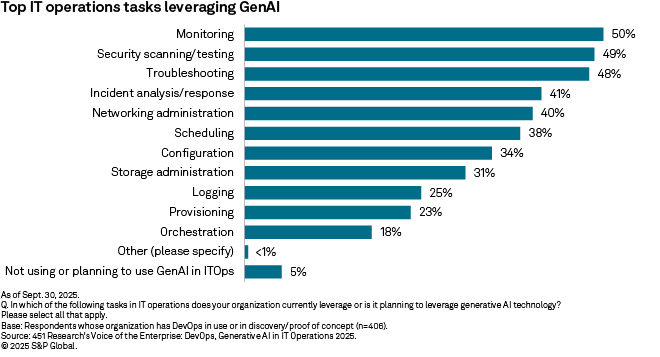
The top IT operations tasks leveraging GenAI are monitoring (50%), security scanning/testing (49%) and troubleshooting (48%), consistent with our 2024 survey. Monitoring, observability and security are broadly identified as candidates for more automation. This also reflects an evolving market where the preferred approach is to focus on smaller tasks to integrate and automate with GenAI, rather than trying to integrate it throughout IT operations all at once. This more pragmatic and granular approach also appears to be helping organizations better prepare to measure and manage their progress with implementing GenAI for IT operations.
AI infrastructure and future technology considerations
AI infrastructure market performance remains strong going into the second half of 2025. It has become a point of emphasis on virtually every earnings call, with vendors providing increasingly deeper insight into their current and projected performance, which in some cases stretches into multibillion-dollar ranges. Based on our preliminary estimates of roughly 160 participating vendors in the AI infrastructure market, we expect the market to generate more than $250 billion in aggregate revenue during 2025. Customers continue to show remarkable interest in and uptake of AI technologies across all levels of adoption and skillsets. Many find themselves in earlier stages of development, while others are growing or even scaling their projects and capabilities. In either case, AI infrastructure remains a critical pillar. While AI infrastructure can be an enabler when planned and implemented correctly, a common challenge is having multiple single points of failure in hardware and software stacks, which can derail projects and other initiatives. In response, AI infrastructure users, commercial suppliers and open-source communities are taking steps to combat many of these potential pitfalls, in addition to creating incremental value, but there is still work to be done.
Key trend: Preparing a cloud-anywhere operating model: The path to agentic cloud operations
Enterprises face mounting complexity in managing highly distributed, hybrid multicloud IT estates. Workloads span public cloud, private infrastructure, edge and colocation environments, each with distinct operational models and tooling. This fragmentation inhibits agility, raises operational costs and increases risk. A cloud-anywhere operating model addresses these challenges by abstracting infrastructure differences and delivering a unified, self-service cloud experience across all environments. It enables dynamic workload placement based on performance, cost, compliance, sustainability and evolving business needs, while simplifying governance, reducing vendor lock-in and paving the path toward agentic cloud orchestration.
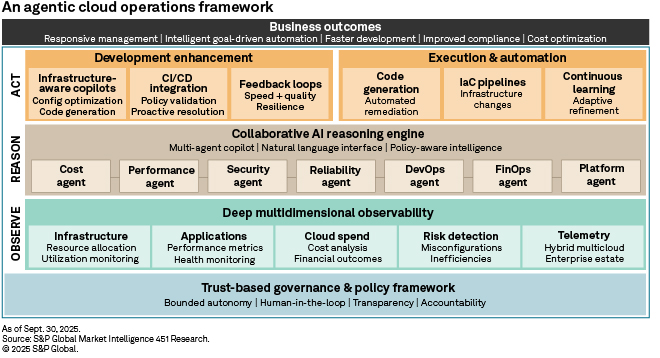
Such a model is essential in the AI era. As AI becomes embedded across the IT stack, enterprises must lay the groundwork for intelligent, autonomous operations. The cloud-anywhere model standardizes how IT resources are provisioned, managed and observed. It enables automation, telemetry and interoperability at scale — capabilities foundational to agentic cloud operations. Agentic cloud operations platforms advance hybrid multicloud management by integrating AI agents that reason through trade-offs, make policy-aligned decisions and execute actions autonomously across the IT estate. They shift operations from reactive responses to adaptive optimization, learning from outcomes and improving continuously.
The benefits can be transformative. Agentic operations can improve uptime, optimize resource use and reduce operational overhead. They empower developers with intelligent platforms, accelerate secure software delivery and align IT execution with business goals in real time. However, to realize these gains, enterprises must first implement a cohesive cloud-anywhere model that enables observability, workload portability and governance by design.
In short, the cloud-anywhere operating model is not just a modern IT best practice but a strategic imperative. It prepares enterprises to navigate today's distributed environments with control and flexibility while laying the essential foundation for intelligent, autonomous, agentic cloud operations that will define the next era of enterprise IT. Agentic cloud operations mark a significant evolution in how enterprises manage complex, distributed, hybrid multicloud environments. This approach advances the cloud-anywhere operating model beyond orchestrated automation to intelligent, goal-directed execution. Agentic cloud operations platforms build on proven IT disciplines — such as DevOps, DevSecOps, site reliability engineering, platform engineering and FinOps — by incorporating advanced observability, collaborative AI reasoning and autonomous workflows in a tightly governed, policy-driven framework.
Emerging tech: GPUaaS market momentum
The launch of ChatGPT in late 2022 and the subsequent rapid adoption of generative AI sparked a global surge in demand for accelerated compute resources, contributing to several years of GPU chip shortages and driving unprecedented demand. These dynamics have built significant momentum for GPU as a service. The hyperscalers have responded by developing and integrating custom silicon, while specialized GPUaaS providers have gained competitive ground with faster and simpler provisioning, multi-accelerator flexibility, strategic partnerships with key GPU suppliers such as NVIDIA and AMD, and transparent, flexible pricing structures. These "neoclouds" posit that, unlike the hyperscalers, their infrastructure is architected specifically for the rigors of parallel processing and GPU interconnect needed for large language model training and inferencing. But the hyperscalers are rapidly answering with new service offerings and more competitive pricing. Given their enterprise relationships, hyperscalers possess deployment, scale and revenue advantages compared to the neoclouds. Meanwhile, the GPU suppliers themselves are moving up the stack, building AI application platforms and contributing to uncertainty in this thrashing and competitive market.
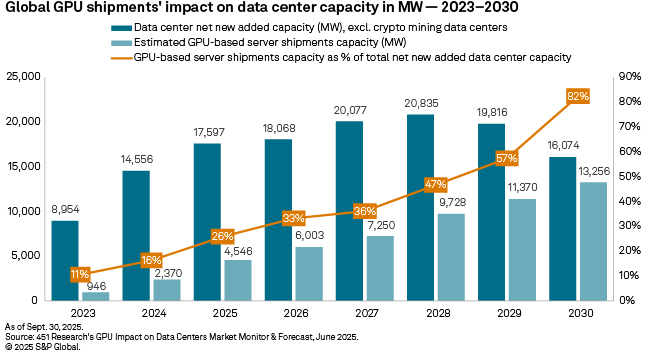
Powering AI data centers may be the biggest challenge. Data center build-out challenges have limited the speed at which cloud providers have been able to deploy new capacity, with one of the most significant issues being securing sufficient power. S&P Global's recently published report, "Truths about how the power sector can (and cannot) respond to datacenter needs," anticipates that global data center power demand could grow 10%-15% annually to 2030.
Much of that demand will come from GPUs. 451 Research's GPU Impact on Datacenters Market Monitor & Forecast projects that GPU capacity will grow to consume 82% of newly added data center capacity by 2030. The model includes estimates of average power consumption and utilization of the chips, as well as the additional components and power needed in typical GPU server nodes. The result is an estimate of data center capacity required for these chips, excluding the power needed for cooling, which means that total power consumed will likely be even higher.
M&A in focus: Appetite for agentic AI could spur M&A as buyers seek search specialists
As organizations increasingly rely on AI to power automation and decision-making, enterprise search is evolving from a peripheral utility into a foundational functionality. With the technology's strategic importance growing, consolidation is also accelerating. In 2025 to date, several large tech providers have acquired smaller, specialized vendors to bolster their platforms with advanced semantic search, neural retrieval and indexing capabilities. As CTOs evaluate startups as potential acquisition targets, alongside self-build options or modifications to their existing software stack, they need to understand the broader race among providers to build next-generation, AI-native enterprise platforms where intelligent search plays a central role in unlocking value from organizational knowledge.
Notable companies
Gravitational Inc.'s (dba Teleport) identity security product portfolio now spans identity threat detection and response, identity security posture management, cloud infrastructure entitlement management and identity attack surface management — albeit with a focus on access to cloud and on-premises infrastructure by engineering personas.
RealTheory Inc., which is yet to emerge from stealth with initial funding, positions its Kubernetes Intelligent Platform for "agentic cloud management." Conversational and agentic AI can make conventional cost and performance dashboarding obsolete. Instead, agentic-driven conversational observability means that users who may have needed to traverse multiple dashboards to get the detail they required can use KIP as an AI layer for autonomous infrastructure optimization.
VFunction Inc. integrates with coding assistants to put architectural context into context engineering. Using LLMs, prompts and coding assistants to create blocks of AI-generated code within a program has limitations when it comes to maintaining and modernizing brownfield applications. The company says that adding GenAI agents to accelerate refactoring speeds the process by an order of magnitude.
Index Engines, Inc. is focused on cyber resilience, ransomware detection and recovery. While primarily focused on these capabilities in backup and recovery environments, it continues to grow its partner network and expand into other storage types. The company recently patented an AI-enabled ransomware identification process and remains committed to investing in its CyberSense Research Lab, where it collects and develops unique datasets used for training its ransomware-detection models.
Cy4Data Labs Inc. looks to actively encrypt enterprise data to optimize use cases. Its focus is to protect data and govern access in common use scenarios, rather than being limited to specialized use cases or systems. The flow of data today often involves encrypted storage and encryption in transit to protect data on its way to a data warehouse or database. Both data-at-rest and data-in-transit encryption entail the eventual decryption of data for authorized parties. Cy4Secure, in contrast to these methods, keeps data encrypted throughout its life cycle, without sacrificing data utility.
Alice & Bob SAS is a quantum computing provider doubling down on production and productization. 2025 has ushered in a sea change for the quantum computing industry, with ongoing technical advancement, increased funding and heightened interest propelling the industry toward fault-tolerant, commercially useful systems. After weathering the early stages of its debut with grace, Alice & Bob is positioning itself for the next five years of growth and development.
Read AI Inc. wants to expand into an orchestration platform for workforce productivity. It uses deep-learning models to create a proprietary narration layer capable of analyzing audio, visual and language inputs; it has two patents associated with those capabilities. The platform delivers sentiment analysis in conjunction with traditional text-based transcripts, as well as scores and proprietary metrics that assess individual meetings, offer insights into interpersonal dynamics and track trends over time.
ViralMoment Inc. uses AI to identify critical moments in social video content. The company holds a patent for a technological process titled "contextual sentiment analysis of digital memes and trends systems and methods," which powers its technology. The platform's basis is the deployment of multimodal AI. It can understand a video's context, including images, audio and text, at a deeper level than traditional models by analyzing visual and audio elements as well as assessing the circumstances within the material.
Regie.ai Inc. uses AI agents to improve the efficiency of the sales prospecting process. The agents autonomously manage and prioritize accounts based on intent signals and engagement metrics, optimizing the allocation of sales resources. Regie features an integrated parallel dialer, enabling users to increase call efficiency by making multiple simultaneous calls, a functionality not commonly found in sales engagement platforms.
Gloat Ltd. enables augmented workforce planning with its Work Orchestration Platform. It is powered by a proprietary Multi-Ontology Workforce Graph, a dynamic representation of workforce data that interlinks several categories of organizational information. The AI engine ingests this graph and uses Gloat's Skills Foundation — a unified taxonomy of skills built from machine learning on job, task and skill datasets — to understand relationships between skills represented in the data.
What to watch
The integration of AI into IT operations is not just a trend but a transformative shift that requires strategic foresight from CTOs. As they navigate this landscape, the emphasis must be on balancing innovation with operational stability, ensuring that AI's potential is fully realized without compromising existing systems. Rapid advancements in AI infrastructure, coupled with competitive pressures related to mergers and acquisitions, highlight the need for a proactive approach to technology adoption. By focusing on skill development, resource optimization and strategic planning, CTOs can position their organizations to thrive in this new era of technological advancement, ultimately driving sustained growth and innovation.
These developments will play a crucial role in shaping the future of enterprise technology, offering new opportunities and challenges for businesses worldwide. 451 Research provides essential insight into the pace and extent of digital transformation across the global technology landscape, including differentiated insight and data on adoption, innovation and disruption across markets, backed by a global team of industry experts. As the enterprise technology landscape evolves, several key trends are emerging. Keeping an eye on these developments will be essential for organizations aiming to navigate the complexities of digital transformation successfully.
Content Type
Products & Offerings
Segment
Language