24 Sep, 2026
AI spending drives capital markets activity, sector rotation - S&P webinar

➤ Hyperscalers' AI-related capital expenditure grew to over $700 billion in 2026 from $80 billion in 2019, and is expected to exceed $3 trillion over the next three years.
➤ Technology sector US capital raises reached record levels in 2026, accounting for 60% of convertible bond issuance, 50% of equity follow-ons, 27% of investment-grade corporate bonds and 20% of high-yield issuance.
➤ The AI build-out is creating supply constraints in memory chips and copper, while some forecasts suggest that data center energy demand is expected to make up 14% of the US grid by 2030.
A surge in AI-related capital expenditure by major firms is reshaping technology capital markets, driving record levels of capital raising activity and creating new investment opportunities across semiconductors, memory and metals.
Investment by the Big Four hyperscalers — Amazon.com Inc., Meta Platforms Inc., Google LLC and Microsoft Corp. — has accelerated to an expected $1 trillion in 2027, up from $80 billion in 2019 and is forecast to exceed $3 trillion over the next three years.
This is creating unprecedented demand for financing, while simultaneously driving sector rotation as investors seek exposure to the AI supply chain, according to experts who spoke at the S&P Global Market Intelligence "Impact of the AI Buildout on the Technology Capital Markets" webinar.
"Over the past 10 years, companies have developed very strong balance sheets and exceptional cash flow. Companies were really faced with a question, say, two years ago, 'What do we do with all this cash? How do we really think about where the next leg of innovation is going to come from, and where do we really want to be?' And that is at a nexus point around where AI starts to get really interesting," Melissa Otto, head of Visible Alpha Research at Market Intelligence, said.
Most hyperscalers maintain strong balance sheets with low debt-to-equity ratios, indicating substantial capacity for additional leverage if needed, Otto said.
"Most hyperscalers have low debt-to-equity ratios, less than one, indicating strong financial health and capacity for further leverage," Otto said, though she noted Oracle Corp. as an exception with a debt-to-equity ratio of 3-4 times, making it more vulnerable.
Amazon has recently strengthened its balance sheet, while the other hyperscalers maintain robust financial positions that enable continued large-scale investment in AI infrastructure.
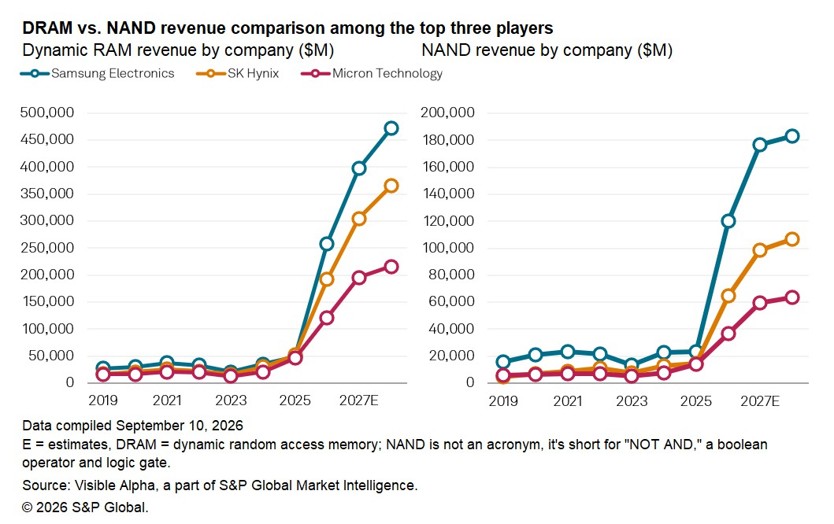
"Memory companies — Micron Technology Inc., SK hynix Inc., Samsung Electronics Co. Ltd. — are seeing strong growth and upward estimate revisions," Otto noted, as memory chips face undersupply conditions with rising prices and margins.
Copper is emerging as the next potential investment theme due to its critical role in data center power infrastructure. "Copper is critical for data center power infrastructure; demand is expected to surge, possibly leading to supply constraints," Otto said.
Technology, equities and debt
Technology companies dominated US capital markets this year, accounting through Sept. 11 for about 60% of convertible bond issuance, 50% of equity follow-on offerings, 27% of investment-grade corporate issuance and 20% of high-yield issuance, said Chris Fenske, head of capital markets research at Market Intelligence.
"Technology sector issuance has already exceeded most prior full-year numbers, except for IPOs," Fenske said during the webinar. The preference for convertible bonds reflects their less dilutive nature compared to equity follow-ons, he added.
US investment-grade total issuance is running 6% ahead of the record 2020 pace, despite higher interest rates and the absence of government bond-buying programs that existed during the pandemic, Fenske noted. High-yield issuance from the technology sector is also at record levels.
However, technology sector investment-grade spreads have widened by approximately 50 basis points relative to the broader IG market since late 2025, reflecting the increased supply, according to Fenske.
Hyperscaler debt dynamics
Among the major hyperscalers— Alphabet Inc., Amazon, Apple Inc., Meta and Oracle — about 75% of bond issuance has been denominated in US dollars, with Alphabet and Amazon also issuing in other currencies, Fenske said. Microsoft has not issued corporate bonds directly in the past two years.
The maturity profile shows that 58% of hyperscaler bonds mature by 2036, with another concentration of maturities in 2056, creating distinct maturity walls.
Significant short interest of about 9.3% is concentrated around the 2036 maturity wall for hyperscaler bonds, with Meta and Oracle showing the highest short interest among issuers, Fenske said. Dealers have been short 10-plus-year corporate bonds since summer 2024, reflecting bearish or hedged sentiment in that part of the curve.
Exchange-traded funds positioning shifts
Exchange-traded fund (ETF) demand has been exceptionally strong, with industry inflows topping $1 trillion by midyear and assets under management surpassing $24 trillion by the end of August, said Matt Chessum, executive director of equity analytics products at Market Intelligence.
In August, North America accounted for nearly $139.2 billion of the $216.2 billion in global net ETF inflows, while Europe added $8.1 billion. The Asia-Pacific region, however, experienced $19.3 billion in net outflows despite local interest in AI and technology themes.
"What we're seeing here isn't investors leaving the theme altogether. It's investors changing how they hold and invest in it, moving from those more concentrated expressions to more of a benchmark expression," Chessum said.
The Invesco QQQ trust, which tracks the Nasdaq index, pulled in roughly $15 billion during August. Meanwhile, larger semiconductor and memory ETFs, including SOXX, SMH, XLK, DRAM and AIQ, saw combined redemptions of about $6.6 billion.
Chessum attributed the shift to two factors: a summer semiconductor drawdown after a strong start to the year and hyperscalers raised rather than cut capital expenditure guidance, meaning "more of the payoffs tend to accrue to the larger platform companies, and those are exactly what the broad benchmark product holds more directly."
Securities lending data shows AI borrow demand has shifted from occasional and concentrated to steady and broad-based across applications, servers, compute, robotics and semiconductor equipment. In August alone, 10 AI infrastructure names generated nearly $100 million in lending revenue, versus $166 million for a comparable cohort throughout 2025, indicating sustained shorting and hedging activity across the ecosystem, Chessum said.
M&A and private equity activity
"Hyperscalers are choosing to build rather than buy when it comes to AI. The environment is pretty good, but with these big tech players on the sidelines, you can't say that M&A is firing on all cylinders," said Joe Mantone, editorial senior lead of US Financial Institutions News at Market Intelligence.
The trend of lower M&A volumes, despite several large deals in transaction value, is mostly due to the higher-interest-rate environment, Mantone said.
While higher rates have not been the best backdrop for M&A, and there has been a bit of a slowdown in the third quarter, there are other concerns. M&A activity has been affected by overall uncertainty, and while some of that is geopolitical, there is also an AI-related component.
"A recent example of this is private equity firms being less active in the tech space after the sell-off of software companies," Mantone said.
"It's difficult for buyers and sellers to agree on valuations when it's unclear how an industry could be disrupted by a game-changing technology like AI," he added.
This content may be AI-assisted and is composed, reviewed, edited and approved by a human at S&P Global. S&P Global uses generative AI to create content in accordance with our Terms of Use.
|