
Guide to Trucking KPIs
This guide highlights the key performance indicators for the trucking industry and where investors should look to find an investment edge.
Industry Overview
The trucking industry comprises companies that provide shipping services to their customers via trucks and trailers. A major source of revenue for the trucking industry is through the transport of domestic shipments, given that most international shipments require either air or sea-based transportation. Most companies in the trucking industry own and operate the trucks in their fleet, while some rely on leased fleets. The trucking industry uses either the truckload (TL) or the less-than-truckload (LTL) mode of transport for the movement of cargo. Other shipping services provided by companies in the trucking industry include dedicated and intermodal transportation services.
Two prominent modes that companies utilize when transporting commodities or shipments are either trucks or rails, making the railroads industry a leading competitor to the trucking industry in this regard.
Key Trucking Metrics
Key performance indicators (KPIs) are the most important business metrics for a particular industry. When understanding market expectations for the trucking industry, whether at a company or industry level, here are some of the KPIs to consider:
- Total Miles
- Loaded Miles
- Revenue Per Loaded Mile
- Revenue Per Loaded Mile, excluding Fuel Surcharge
- Average Number of Units, Trucks
- Revenue Per Truck
- Total Operating Days
- Tonnage Per Day
- Truck Tonnage

Trucking Business Model
-
Services
-
Revenue
Dedicated transportation services
Dedicated transportation services refer to dedicated transportation solutions provided by a trucking company to its customers/suppliers. Dedicated services are typically custom-designed depending on the customer’s requirements and include services such as trailers, combined equipment, fleet maintenance, drivers, and other additional services. Dedicated contract carriage offers significant benefits to companies such as increasing their competitive position, improving risk management, and integrating their transportation needs with their overall supply chain. Dedicated transportation services usually include a written, formal, longer-term agreement or contract that governs the services performed by the trucking company and the applicable rates.
Intermodal services
Intermodal transport refers to the movement of freight by two or more modes of transportation. By loading cargo in an intermodal container, the cargo can be moved seamlessly between multiple modes of transportation, without any handling of the cargo itself when changing modes. Trucking companies charge for intermodal services rendered primarily through contractual rate quotes with customers that are held static for a given period, usually one year.
Freight brokerage
A freight brokerage service provider acts as an intermediary between the shipper and the trucking company or the carrier. A freight broker provides the truck and trailer capacity suited for the requirements of the shipper along with others and also negotiates the freight rates for the customer/shipper.
Logistics
Logistics management is an integral part of delivering goods from suppliers to end-users or customers. It involves ensuring timely delivery of the cargo to the end-user, in the right quantity, in a good condition, and in the right place. Logistics managers are responsible for everything from packaging, storage, documentation, inventory management, freight damage, and other shipment-related services. Logistics management involves both internal and external distribution networks.
Fuel surcharge
Due to the volatile nature of fuel costs, trucking companies usually ensure a fuel surcharge revenue program is in place with most of their customers. Under this program, a majority of the fuel costs are billed and charged to the customers. These programs typically involve a specified computation based on the change in local, national, or regional fuel prices. Given the fluctuations in fuel prices, some of these programs have a time lag between when the fuel prices change and when this change is reflected in the revenue. It is not meaningful to compare the amount of fuel surcharge revenue or the change in fuel surcharge revenue between reporting periods to fuel and fuel taxes expense. Hence, companies separately report excluding fuel surcharge revenue as well.
The total revenue generated by companies in the trucking industry primarily comes from segments such as truckload (TL), less-than-truckload (LTL), dedicated services, intermodal services, freight brokerage, and logistics services.
Truckload (TL) shipping, also known as full truckload shipping, refers to the transportation of a large volume of shipment, typically enough to fill more than half or up to the full capacity of a 48 or 53 feet trailer. Full truckload shipping only carries cargo from a single customer or supplier, who has full and exclusive use of the trucking company’s trailer or truck. Companies charge for truckload services either based on a contract rate quota or a spot rate quota. A contract rate is a rate quota agreed upon by the freight provider in a contract, for a given period, usually one year. A spot rate quota is a one-time rate quota issued by a freight service provider, depending on the market conditions, to move the supplier’s product from point A to point B.
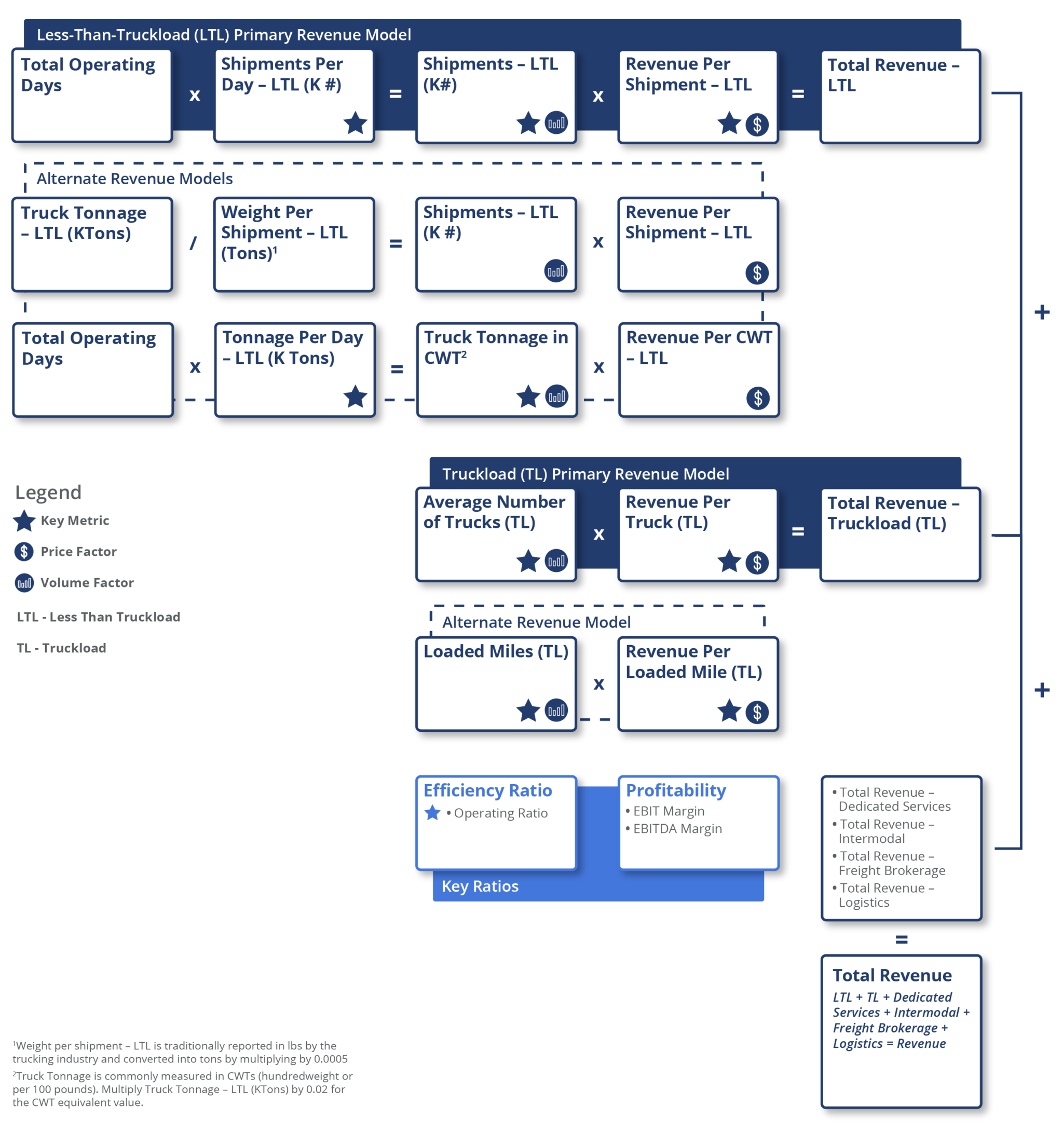
The total revenue generated from truckload services is derived by multiplying the volume metric – loaded miles by the pricing metric – revenue per loaded mile. The total revenue for truckload (TL) can be also computed by multiplying the average number of trucks by the revenue per truck.
Less-than-truckload (LTL) shipping refers to the transportation of small amounts of cargo from several different customers, to various delivery destinations. This type of shipping is affordable for small businesses or suppliers, as they can share the transportation costs with other businesses while using a third-party logistics (3PL) company for their cargo. Each supplier takes up a certain portion of space in the truck for their cargo and only pays according to the amount of cargo shipped and the distance traveled. LTL shipments often make several stops, thereby taking longer to reach the destination. Companies usually charge for LTL services based on spot rate quotas.
The total revenue generated from LTL services can be computed using two main approaches:
- By Shipments
In this approach, the total revenue from less-than-truckload (LTL) services is calculated by multiplying the total shipment by the pricing metric – revenue per shipment.Total shipments can be calculated by multiplying shipments per day by the total operating days. Total shipments can also be calculated by multiplying truck tonnage by weight per shipment. If the weight per shipment is available in pounds (lbs), it is converted to tons by multiplying it by 2000.
- By Truck Tonnage
In this approach, truck tonnage is calculated by multiplying the tonnage per day by total operating days. Truck tonnage is then multiplied by revenue per unit to arrive at the total revenue generated from less-than-truckload services (LTL). If the revenue per unit for LTL is in cwt, i.e., 100 pounds, it is converted into tons by multiplying it by 20.
Available Comp Tables - Consensus Estimates
Visible Alpha offers four trucking-related comp tables, comparing forecasts for key financial and operating metrics, to make it easy to quickly conduct relative analysis. Every pre-built, customizable comp table is based on region, sub-industry, or key operating metrics.

Global Financial and Operating KPIs Company Examples:
- XPO Logistics, Inc
- J.B. Hunt Transport Services, Inc. (JBHT_US)
- Knight-Swift Transportation Holdings Inc. (KNX)
- YRC Worldwide, Inc. (YRCW_US)
- Schneider National Inc (SNDR_US)
- Landstar System Inc (LSTR_US)
- Old Dominion Freight Line Inc (ODFL)
- Hub Group Inc. (HUBG_US)
- Arcbest Corp (ARCB)
- Werner Enterprises, Inc. (WERN)
- SAIA Inc (SAIA_US)
- US Xpress Enterprises Inc (USX_US)
- Daseke, Inc. (DSKE_US)
- Forward Air Corp (FWRD_US)
- Marten Transport, Ltd (MRTN_US)
- Covenant Transportation Group, Inc. (CVTI_US)
- Heartland Express (HTLD_US)
- USA Truck, Inc. (USAK_US)
Download Report
This guide highlights the key performance indicators for the trucking industry and where investors should look to find an investment edge, including:
- Trucking Industry Business Model & Diagram
- Key Trucking Metrics PLUS Visible Alpha’s Standardized Industry Metrics
- Available Comp Tables
- Industry KPI Terms & Definitions