
Guide to Passenger Railroads KPIs
This guide highlights the key performance indicators for the Passenger Railroads industry and where investors should look to find an investment edge.
Industry Overview
Companies in the passenger railroad industry facilitate the transit of passengers from one place to another through their rail systems. In this industry guide, we provide an overview of the Japanese passenger railroad industry.
Japan’s passenger railroad industry is classified based on the type of railway line or network used, which includes the Shinkansen railway line and the conventional or the non-Shinkansen railway line. Shinkansen, which is Japanese for bullet trains, refers to a network of high-speed, inter-city railway networks. Conventional lines, on the other hand, refers to trains that run on conventional rail tracks at relatively slower speeds when compared to bullet trains. A major source of revenue for both railways is the fare they charge their passengers for the services rendered. They generally offer passengers commuter and non-commuter passes, which are essentially tickets for train travel. A commuter pass is a weekly or monthly pass that enables daily commuters to travel between two designated stations without having to buy a ticket each time. The non-commuter pass is a one-time ticket for passengers that do not regularly travel by train.
Key Passenger Railroad Metrics
Key performance indicators (KPIs) are the most important business metrics for a particular industry. When understanding market expectations for passenger railroads, whether at a company or industry level, some passenger railroads KPIs to consider include:
- Passenger Kilometers
- Revenue Per Passenger Kilometers
- Passenger Kilometers - Shinkansen
- Revenue Per Passenger Kilometer - Shinkansen
- Passenger Kilometers - Conventional
- Revenue Per Passenger Kilometer - Conventional
- Operating margin

Passenger Railroad Business Model
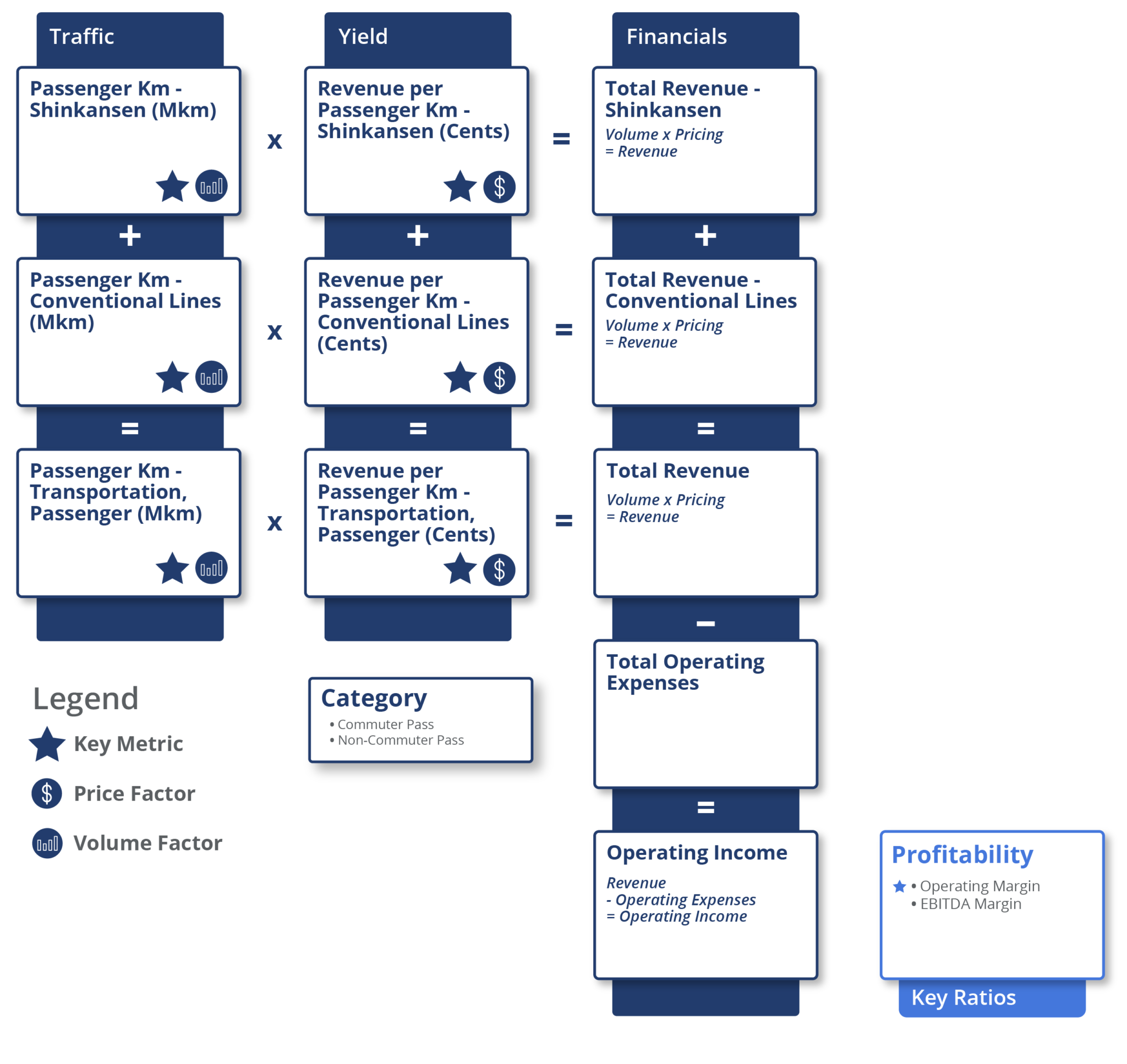
The business model of the Japanese passenger railroad industry is fairly straightforward. Companies in the passenger railroad industry generate revenue by charging a travel fare to passengers for the transit services rendered. These companies also determine the prices of passenger fares, however, these fares are regulated by Japan’s Ministry of Land, Infrastructure, Transport, and Tourism.
REVENUE ANALYSIS
Companies in the passenger railroad industry use the following metrics to compute revenue:
- Passenger kilometers; and
- Revenue per passenger kilometer
To calculate revenue, analysts multiply passenger-kilometers with revenue per passenger kilometer, for the particular type of rail network used. This calculation is done separately for the network of railway lines used, commuter pass and non-commuter pass and eventually summed together to arrive at total revenue.
Passenger kilometers are a measure of the movement of passengers over the distance traveled. It is calculated as total passengers carried (number) multiplied by the total distance traveled (km). Revenue per passenger kilometer is the fare charged to a passenger for every kilometer traveled.
Available Comp Tables - Consensus Estimates
Visible Alpha offers 5 passenger railroads-related comp tables, comparing forecasts for key financial and operating metrics, to make it easy to quickly conduct relative analysis, whether you are interested in looking at key values for East Japan Railway, West Japan Railway, or Central Japan Railway. Every pre-built, customizable comp table is based on region, sub-industry, or key operating metrics.

Global Financial and Operating KPIs Company Examples:
- East Japan Railway Company (9020_JP)
- West Japan Railway Company (9021_JP)
- Central Japan Railway (9022_JP)
Download Report
This guide highlights the key performance indicators for the passenger railroad industry and where investors should look to find an investment edge, including:
- Passenger Railroad Business Model & Diagram
- Key Passenger Railroad Metrics PLUS Visible Alpha’s Standardized Industry Metrics
- Available Comp Tables
- Industry KPI Terms & Definitions