
Guide to Online Travel Industry KPIs
This guide highlights the key performance indicators for the online travel industry and where investors should look to find an investment edge.
Industry Overview
The travel & tourism industry encompasses a wide range of sub-industries related to travel, hospitality, and leisure, including transportation, accommodation, food and beverage, attractions, events, and travel services.
Given the size of the travel industry, this guide will primarily focus on online travel agencies (OTAs). OTAs operate as intermediaries between travelers and travel suppliers, providing online platforms and services for booking flights, hotels, rental cars, vacation packages, and other travel-related products. Leading players in this field include Expedia, Booking Holdings (which owns Booking.com, Priceline, Kayak, and Agoda), Trip.com, and Airbnb.
There are different types of OTAs, classified based on their service offerings:
- Full-service OTAs such as Booking Holdings, Expedia, and MakeMyTrip offer various travel services and products, including flights, hotels, car rentals, vacation packages, and more. They provide comprehensive search and booking functionalities and often have partnerships with multiple travel suppliers to offer a variety of options to travelers.
- Aggregator OTAs such as Kayak (owned and operated by Bookings Holdings) and Skyscanner (owned by Trip.com), consolidate information from multiple travel suppliers and display them in one place for easy comparison. They allow users to search and compare prices, availability, and reviews across various websites and providers.
- Metasearch OTAs, or travel guidance platforms, function similarly to aggregator OTAs by gathering information from different travel websites. However, they often redirect users to the supplier’s website for the actual booking. They provide price comparisons, user reviews, and other relevant details to help travelers make more informed decisions. TripAdvisor and Trivago fall under this category.
- Hotel-only OTAs specialize in offering hotel accommodations and related services. These platforms focus primarily on hotel bookings, providing a wide range of options, deals, and exclusive discounts for various accommodations. HotelTonight and Hotels.com are examples of hotel-only OTAs.
- Vacation rental OTAs focus on connecting travelers with rental properties such as apartments, houses, villas, and vacation homes. Airbnb, Vacasa, HomeAway, and Vrbo are popular vacation rental OTAs.
- Lastly, corporate OTAs such as Corporate Travel Management and Flight Centre Travel Group facilitate business travel for corporates.
It’s worth noting that some OTAs may offer a combination of services or fall into multiple categories.
Key Online Travel Industry Metrics
Key performance indicators (KPIs) are an industry’s most important business metrics. When understanding market expectations for the online travel industry, whether at a company or industry level, some KPIs to consider include:
- Take Rate (Rooms, Air Ticket, Bus, Agency, Merchant)
- Booking Volume (Rooms, Air Ticket, Bus)
- Gross Bookings (Rooms, Air Ticket, Bus, Agency, Merchant)
- Total Revenue (Rooms, Air Ticket, Bus, Agency, Merchant)
- EBITDA Margin

Online Travel Industry Business Model
-
Expenses
-
Revenue
-
Profitability
A major expense for online travel agencies lies in marketing and advertising. OTAs invest heavily in marketing and advertising through search engines like Google to attract customers to their platforms. This includes digital marketing campaigns, search engine advertising, social media promotion, affiliate marketing, and other advertising channels. Another important expense for these players consists of technology and infrastructure expenses to support their platforms, manage bookings, process payments, and ensure a smooth user experience.
Some major expenses for online travel agencies include:
- Selling and marketing expenses
- Research and development (R&D) expenses
- General and administrative expenses
Online travel agencies (OTAs) generate revenue from a variety of sources, including commissions on bookings, advertising, subscriptions, and other ancillary services such as travel insurance, airport transfers, tours, or activities. OTAs rely on commissions earned from bookings made through the hotel and airline industry, earning a percentage of revenue from each transaction facilitated for hotels, airlines, and other service providers.
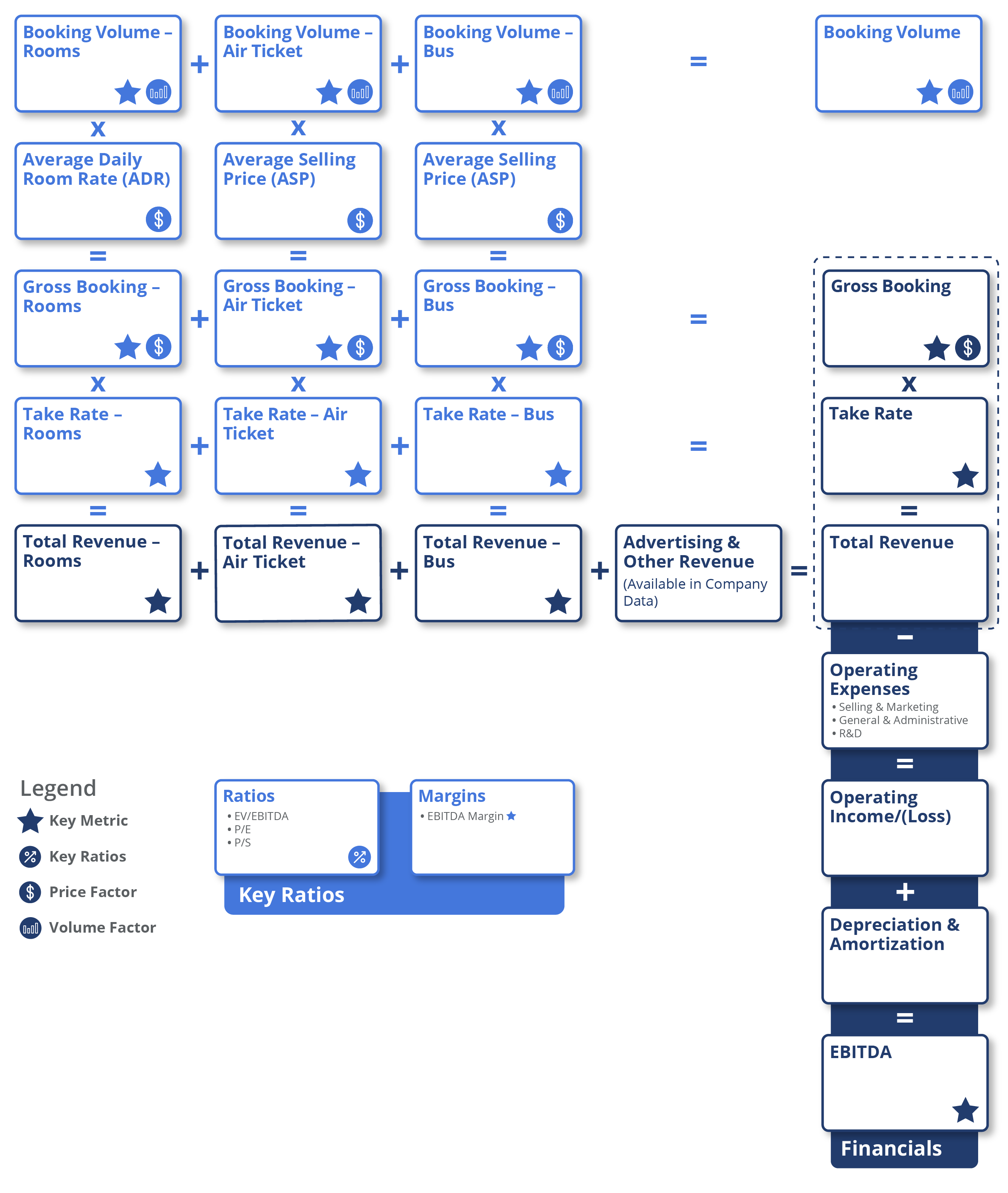
Total revenue for companies in the industry can be derived as the sum of revenue from bookings on rooms, air tickets, bus tickets, advertising, and other services, depending on which of these services the OTA offers. To determine the total revenue from room bookings, we consider factors such as the volume of bookings, average daily room rate (ADR), gross booking amount, and take rate.
Here, booking volume is the total number of room bookings made through the OTA’s platform during a specific period. It represents the volume or quantity of bookings. Gross booking refers to the total value of all the room bookings made through the OTA’s platform. It includes the price paid by the customer for the room, any additional charges, and taxes. This represents the total value of all the transactions before deducting the OTA’s commission or markup. And lastly, the take rate is the percentage or proportion of the gross booking that the OTA retains as revenue. It represents the OTA’s share of the total transaction value. Take rate is typically expressed as a percentage.
Average daily room rate (ADR) is a common metric used in the hotel industry to measure the average price or rate that a hotel earns for each room rented out per day. For OTAs, ADR refers to the average rate they receive from hotels or other lodging partners for each booking made through their platform. Average selling price (ASP) measures the average price at which OTAs sell air and bus tickets on their platform.
Online travel agencies like Expedia and Bookings.com operate using the agency and merchant business models. For these companies, total revenue is calculated as the sum of total agency revenue and total merchant revenue.
In the agency model, revenue is generated based on a per-room basis. The property owner sets the prices for the rooms and is solely responsible for maintaining the rooms and providing customer service. After the guest checks out of the hotel, the property owner pays a commission to the online travel agency.
In the merchant model, transactions occur between the property owner and the online travel agency. In this model, the property owner sells the rooms to the online travel agency at a discounted price compared to the standard rate. The online travel agency then sells the rooms to customers and earns revenue from the price difference. This model focuses on selling rooms in large quantities without considering any standardization of the guest profile.
Advertising revenue is also an important component of revenue for OTAs. Online travel agencies often engage in advertising partnerships and generate revenue by displaying ads on their websites and/or mobile apps.
To evaluate the profitability of companies in this industry, analysts focus on the EBITDA margin.
Other ratios that are key to this industry include:
- Enterprise Value-to-EBITDA (EV/EBITDA)
- Price-to-Earnings (P/E)
- Price-to-Sales (P/S)
Available Comp Tables - Consensus Estimates
Visible Alpha offers six travel & tourism-related comp tables, comparing forecasts for key financial and operating metrics to make it easy to quickly conduct relative analysis, whether you are interested in looking at key values for global companies, Americas, or Europe. Every pre-built, customizable comp table is based on region, sub-industry, or key operating metrics.

Global Financial and Operating KPIs Company Examples:
North America
- Expedia Group, Inc. (NASDAQ: EXPE)
- Booking Holdings Inc. (NASDAQ: BKNG)
- Airbnb, Inc. (NASDAQ: ABNB)
- Tripadvisor, Inc. (NASDAQ: TRIP)
EMEA
- Trivago N.V. (NASDAQ: TRVG)
- TUI Group (LSE: TUI)
- FirstGroup PLC (LSE: FGP)
- National Express Group PLC (now Mobico Group, LSE: MCG)
APAC
- MakeMyTrip Ltd. (NASDAQ: MMYT)
- Trip.com Group Limited (NASDAQ: TCOM)
- MTR Corporation Limited (SEHK: 0066)
- H.I.S. Co., Ltd. (TSE: 9603)
Download Report
This guide highlights the key performance indicators for the online travel industry and where investors should look to find an investment edge, including:
- Online Travel Industry Business Model & Diagram
- Key Online Travel Metrics PLUS Visible Alpha’s Standardized Industry Metrics
- Available Comp Tables
- Industry KPI Terms & Definitions