
Guide to Hotel KPIs
This guide highlights the key performance indicators for the hotel and timeshare industry and where investors should look to find an investment edge.
Industry Overview
The hotel industry is a sub-industry of the hospitality industry and is made up of companies focused on providing lodging facilities. These companies include hotels that are either company-owned, company-operated, franchised or licensed.
Hotels are establishments that host guests overnight by providing accommodations, meals and other related services mainly on a short-term basis. A major investment for a hotel business is its property, which includes rooms equipped with basic amenities. In exchange for accommodations and other services, hotels charge room rates that can vary across hotel properties and can also vary based on the services offered. Some hotels may not only levy room charges on their customers but also charge them for access to additional amenities such as restaurants, spas, swimming pools, meeting rooms, game zones, gyms, childcare and housekeeping services. The amount and manner in which these charges are levied on the customers can vary across hotel properties. Hotel room charges depend on several factors such as the hotel location, the surroundings, rating of the hotel, the quality of services offered, hotel room size and so on. Every country has its own set of laws governing the requirements for setting up a hotel. For example, the U.K. has a prerequisite for hotels to have food and beverage outlets, while other countries require hotels to meet a minimum hotel room size.
The timeshare industry, also referred to as the vacation ownership industry, enables consumers to share ownership of the vacation properties. Multiple parties hold exclusive rights to use a property for a specific time period (usually a week). The industry has evolved from a weekly intervals system to a points-based system that provides more flexibility to exchange vacations over several properties at various destinations.
Key Hotel Metrics
Key performance indicators (KPIs) are the most important business metrics for a particular industry. When understanding market expectations for hotels and timeshares, whether at a company or industry level, here are some of the hotel KPIs to consider:
- Rooms
- Room Nights
- Number of Days
- Occupancy Rate
- Daily Rate Average (ADR)
- Revenue Per Available Room (RevPar)
- Royalty Rate
- Tour Flow
- Volume Per Guest (VPG)

Industry Revenue Model
-
Hotel
-
Timeshare
-
Revenue
The hospitality industry operates its hotels and other business segments under one of the following operating models:
- Franchised or licensed hotels,
- Managed or company-operated hotels, or
- Owned or leased hotels.
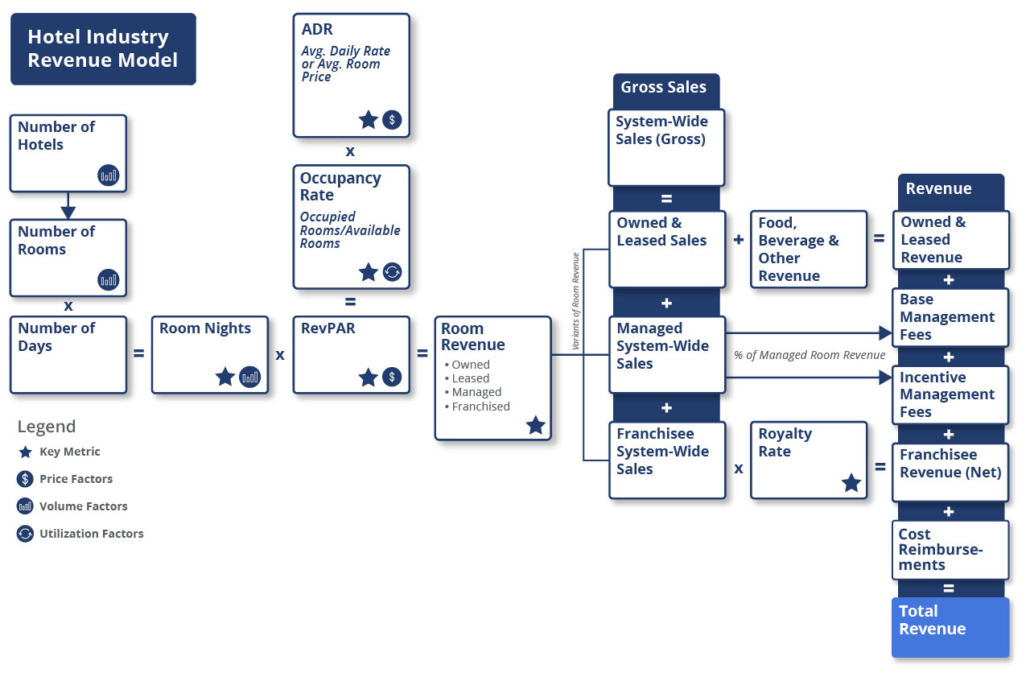
Franchised or licensed model: In the franchise model, the hotel group functions as a franchisor, with which different hotel owners sign a franchise agreement. The hotel owners who run the franchisee hotels are thereby licensed to run their hotel using one of the hotel group’s or franchisor’s branding. The franchise agreement allows the franchisee to not only use the franchisor’s brand name but also related commercial services, such as reservation systems and marketing and information technology services. However, the franchisees have to invest their capital into the hotels and are charged a certain percentage of room sales as franchise fees.
The franchisor has a performance obligation to provide the franchisees a license to use the company’s brand names. The franchisor is in turn entitled to initial application fees and ongoing royalty fees. The initial application fees are fixed considerations, payable upon submission of a franchise application. The royalty fees are variable considerations and are based on a percentage of certain hotel revenues, mainly room revenues plus a percentage of food and beverage revenues.
Managed or company-operated model: Company-operated hotels are either owned or managed by the company. In this model, companies have performance obligations to provide hotel management services and an intellectual property license of the hotel system to the managed hotel for using the company’s brand name. As compensation for such services, the company is entitled to receive base management fees, which are a percentage of the hotel revenue, and incentives fees, which are generally based on the hotel’s profitability.
Owned or leased model: In an owned or leased business model, revenue is generated from hotel room sales, food and beverage sales, and other such services. For owned and leased hotels, companies provide accommodations and other ancillary services to hotel guests and are entitled to a nightly hotel room revenue and additional fees for any ancillary goods and services sold. Revenue is recognized when rooms are occupied and services are rendered; however, they are payable by the hotel guests at the time of check-out.
Average daily rate (ADR) measures the average room price and is used to assess the operating performance and pricing levels of hotels. ADR trends provide information related to the pricing environment of a hotel group. ADR is calculated by dividing the property room revenue by the total number of rooms sold.
Occupancy rate refers to the number of rooms occupied in a hotel, compared to the total number of rooms available at a given time. Expressed as a percentage, occupancy rate is used to gauge the demand at a hotel group for a given time period. It measures the capacity utilization of a hotel. Achievable ADR can also be determined based on the occupancy percentage as it indicates an increase or decrease in demand for hotel rooms. Occupancy rate is calculated by dividing the total number of occupied rooms in a hotel by the total number of rooms available in the hotel.
Revenue per available room (RevPAR), a commonly used performance measure in the hotel industry, is the product of ADR and occupancy rate. RevPAR for hotels enables the comparison of room revenues among comparable properties to evaluate a hotel’s performance.
Room nights are calculated by multiplying the number of days available in a given period by the total number of rooms available across all hotels of the hotel group.
Room revenue is calculated by multiplying the total number of room nights by RevPAR. Such room revenues are generated at owned, leased, managed and franchised hotels.
System-wide revenue is the total sales generated at hotels. A major component of system-wide revenue is room revenue. Base management fees and incentive management fees are computed on the basis of system-wide sales for managed hotels. Franchise fees are calculated by multiplying system-wide sales for franchisee hotels by the royalty rate. These fees together constitute managed and franchise revenue.
Other revenue may include global design fees, termination fees, and other property and brand revenues. As a part of the loyalty program, companies enter into agreements with financial institutions to issue co-branded cards and receive certain fees when customers redeem their loyalty points.
Cost reimbursements are applicable under management and franchise agreements. Companies are entitled to reimbursement for certain costs incurred on behalf of the managed, franchised and licensed properties. These costs mainly consist of payroll and related expenses at managed properties and also include certain operational and administrative costs that are predetermined in the contracts.
Total revenue is the sum of owned and leased revenue, managed and franchise revenue, other revenue and cost reimbursements.
Available Comp Tables - Consensus Estimates
Visible Alpha offers 8 hotels, resorts and cruise lines comp tables, comparing forecasts for key financial and operating metrics, to make it easy to quickly conduct relative analysis, whether you are interested in looking at key values for Marriott International competitors or RevPAR. Every pre-built, customizable comp tables is based on region, sub-industry or key operating metrics.
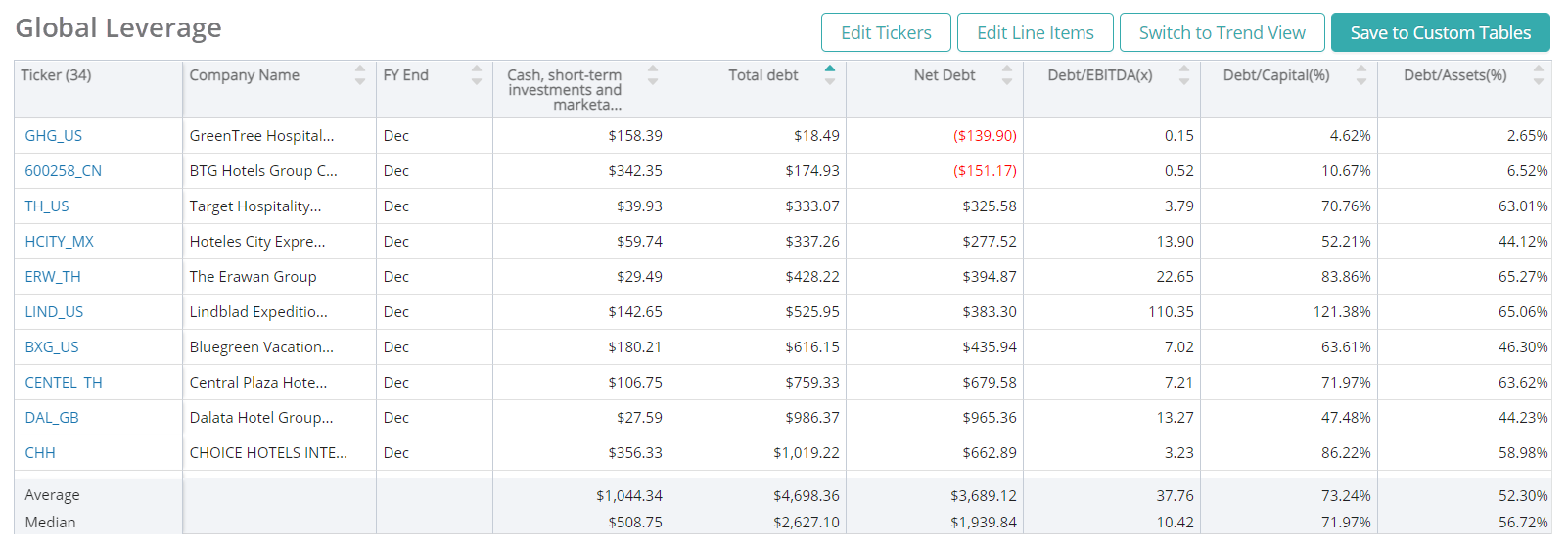
Global Financial and Operating KPIs Company Examples:
AMER Hotels
- Choice Hotels International, Inc. (CHH)
- Hilton Worldwide Holdings Inc (HLT)
- Hoteles City Express S.A.B. de C.V. (HCITY_MX)
- Wyndham Hotels & Resorts Inc (WH_US)
EMEA Hotels
- AccorHotels (AC_FR)
- InterContinental Hotels Group PLC (IHG)
- Melia Hotels International SA (MEL_ES)
- Scandic Hotels Group AB (SHOTE_SE)
AMER Timeshares & Cruise Lines
- Bluegreen Vacations Corp (BXG_US)
- Marriott Vacations Worldwide Corp (VAC_US)
- Norwegian Cruise Line Holdings Ltd (NCLH)
- Royal Caribbean Cruises Ltd (RCL)
APAC Hotels
- Huazhu Group Ltd (HTHT_US)
- Central Plaza Hotel (CENTEL_TH)
- BTG Hotels Group Co Ltd (600258_CN)
- Shangri-La (0069_HK)
- GreenTree Hospitality Group (GHG_US)
Download Report
This guide highlights the key performance indicators for the heotels industry and where investors should look to find an investment edge, including:
- Hotels Industry Business Model & Diagram
- Key Hotels Metrics PLUS Visible Alpha’s Standardized Industry Metrics
- Available Comp Tables
- Industry KPI Terms & Definitions