
Guide to eVTOL Industry KPIs
This guide highlights the key performance indicators for the electric vertical take-off and landing (eVTOL) industry and where investors should look to find an investment edge.
Industry Overview
Urban air mobility (UAM) refers to the concept of using air transportation systems to move people or goods in and around urban areas. It involves integrating various aerial technologies and infrastructure to enable short-distance flights, typically within or between cities. The UAM landscape is undergoing a profound transformation, driven by the emergence of electric vertical take-off and landing (eVTOL) aircraft. This new class of air vehicles promises to reshape how people and goods move within urban environments, addressing challenges related to traffic congestion, pollution, and the demand for faster, more efficient transportation options.
eVTOL is an aircraft designed to take off and land vertically, using electric propulsion systems. Unlike traditional airplanes, eVTOLs don’t require a runway and can operate from smaller spaces, making them ideal for urban settings. eVTOLs focus on shorter, intra-city, or regional flights, often using smaller, electric, piloted/autonomous aircraft that can take off and land vertically from locations within urban environments, such as vertiports.
The eVTOL industry encompasses a diverse range of companies, including:
- eVTOL Aircraft Manufacturers and Air Taxi Service Providers: Companies designing and manufacturing eVTOL aircraft tailored for urban air transportation and provide air taxi services for urban mobility.
- Aircraft Sales and Leasing: Companies engaged in selling or leasing eVTOL aircraft to operators and government entities.
- Logistics and Cargo Delivery: Companies expanding their services to include cargo delivery via eVTOL aircraft.
- Infrastructure (Vertiports): Companies investing in or operating vertiports—landing hubs that generate revenue through landing fees and maintenance services.
This guide specifically focuses on eVTOL aircraft manufacturers and air taxi service providers. eVTOL aircraft are electric-powered vehicles capable of taking off and landing vertically, without the need for runways. Their design typically incorporates advanced aerodynamics, lightweight materials, and distributed propulsion systems. By enabling vertical takeoff, eVTOLs can operate in densely populated urban areas where space is limited. The electric propulsion system reduces emissions, making it a sustainable alternative to traditional combustion-engine helicopters and planes.
eVTOLs typically fall into three main configurations:
- Multi-rotor: Resembling helicopters, multi-rotor eVTOLs lack wings and rely on several rotors to provide lift. This design makes them ideal for short-range flights, though their fixed rotors create higher drag.
- Lift and Cruise: These winged eVTOLs separate lift and propulsion, simplifying control systems. While efficient, they generate more drag than tilt-rotor designs.
- Tilt Rotor/Wing: These aircraft use tilting rotors or wings, directing thrust between vertical and horizontal flight. Though complex, they benefit from lower drag, increasing efficiency for longer trips.
Key eVTOL Industry Metrics
Key performance indicators (KPIs) are the most important business metrics for a particular industry. When understanding market expectations for the eVTOL industry, whether at a company or industry level, some KPIs to consider include:
- Deliveries - Direct eVTOL
- Average Selling Price (ASP) - Direct eVTOL
- Available Seat Miles (ASM) - Urban Air Mobility (UAM)
- Revenue Per Available Seat Mile (RASM) - Urban Air Mobility (UAM)
- Revenue Passenger Mile (RPM) - Urban Air Mobility (UAM)
- Load Factor (%) - Urban Air Mobility (UAM)
- Total Revenue - Urban Air Mobility (UAM)

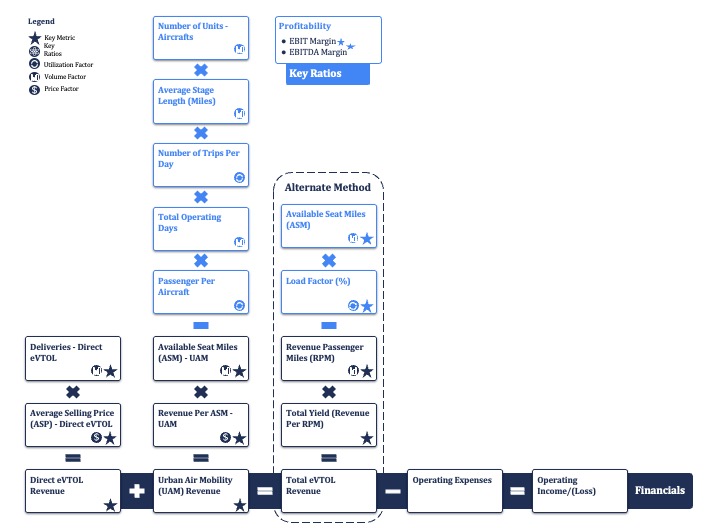
eVTOL Industry Business Model
-
Expenses
-
Revenue
-
Profitability
eVTOL companies face a variety of major expenses as they work to develop, produce, and operate electric vertical take-off and landing aircraft. These costs reflect the complexities of building a new transportation sector and include both upfront capital investments and ongoing operational expenditures. Key categories of expenses include:
- Cost of revenue: This encompasses all direct costs associated with producing, delivering, and maintaining eVTOL aircraft and services, whether the revenue comes from selling aircraft units or providing air taxis and related services. This cost category includes both production expenses and operational costs necessary for fulfilling revenue-generating activities.
- Research and development expense (R&D): Major costs include developing and testing new aircraft designs and electric propulsion technologies. R&D covers areas such as aerodynamics, battery systems, autonomous navigation, safety protocols, and noise reduction. R&D expenses primarily consist of personnel-related costs, which include salaries, bonuses, benefits, and stock-based compensation for employees engaged in research and development. Additionally, R&D expenses cover the costs of developing and constructing prototype aircraft, maintaining related facilities, and accounting for depreciation.
Certification with aviation authorities (e.g., FAA, EASA) requires extensive testing and documentation, which can stretch R&D budgets over many years. - Selling, general, and administrative (SG&A) costs: SG&A expenses cover a broad range of costs essential for running the business but not directly tied to production or operational costs. SG&A includes all expenditures related to corporate functions, sales, marketing, and administrative support, which are critical for scaling, regulatory compliance, and establishing market presence.
Analysts model eVTOL company revenue by accounting for various factors that influence the development, commercialization, and scaling of urban air mobility (UAM). Since UAM is a nascent industry and eVTOL companies are relatively new, revenue modeling involves several assumptions about market adoption, pricing strategies, infrastructure, and regulatory timelines.
The core business model for eVTOL companies is providing air taxi services within urban environments. To estimate revenue, analysts focus on key operational aspects, including:
- Available seat miles (ASM) represent the total number of seat miles available for passengers across the fleet over a specific period.
- Average stage length refers to the average distance traveled in a single flight or journey from the point of departure to the destination. This metric is typically used to measure the range and efficiency of eVTOL operations within urban air mobility networks.
- Revenue passenger miles (RPM) measures the total number of miles flown by paying passengers and provides insights into how much of the available capacity is being utilized for generating revenue.
- Revenue per available passenger mile (RASM) is a key performance metric used to evaluate the revenue generated per mile available for passenger transport. It provides insight into how effectively an eVTOL company generates revenue based on the total capacity it offers passengers.
RASM= Total revenue / Available seat miles (ASM)
- Total yield: Often referred to as revenue per RPM, measures how much revenue the company generates for each mile flown by a paying passenger.
Total yield= Total revenue / RPM
- Load factor: Similar to how airlines assess seat utilization, the load factor measures how effectively the available capacity (seats) of the eVTOL fleet is being utilized by passengers.
Load Factor=RPM / ASM ×100
eVTOL companies generate revenue through two primary channels: by manufacturing or developing, and selling aircraft to operators, governments, and private entities, and by offering ride-sharing services. This revenue structure is typically divided into Urban Air Mobility (UAM) revenue and Direct eVTOL revenue.
UAM revenue—derived from air taxi services—is a pivotal income stream for many eVTOL companies. One way to calculate revenue for eVTOL companies follows a method similar to that used in the airline industry.
First, the available seat miles (ASM) metric assesses total seat supply, offering insight into how capacity might influence pricing. ASM is then adjusted by the load factor, indicating the percentage of seats filled with paying passengers, to produce revenue passenger miles (RPM), which reflects the miles flown by fare-paying passengers. By multiplying RPM by yield (revenue per passenger mile), analysts arrive at the total revenue generated from UAM services.
Analysts break down unit economics to assess the profitability and scalability of eVTOL companies. This includes:
- EBIT margin and EBITDA margin are two key profitability metrics used to assess the financial performance of eVTOL companies. Given the capital-intensive nature of the eVTOL industry, these metrics help evaluate how efficiently these companies are managing their operating expenses and generating profit from core operations before accounting for non-operating costs and capital expenditures.
Available Comp Tables - Consensus Estimates
Visible Alpha offers one eVTOL-related comp table, comparing forecasts for key financial and operating metrics, to make it easy to quickly conduct relative analysis. Every pre-built, customizable comp table is based on region, sub-industry, or key operating metrics.

Global Financial and Operating KPIs Company Examples:
- Joby Aviation (NYSE: JOBY)
- Archer Aviation (NYSE: ACHR)
- Eve Holding (NYSE: EVEX)
- Ehang Holdings Limited (NASDAQ: EH_US)
Download Report
This guide highlights the key performance indicators for the eVTOL industry and where investors should look to find an investment edge, including:
- eVTOL Industry Business Model & Diagram
- Key eVTOL Industry Metrics PLUS Visible Alpha’s Standardized Industry Metrics
- Available Comp Tables
- Industry KPI Terms & Definitions