Research — Nov 13, 2026
With on-demand video, content discovery got much more complicated

By Keith Nissen
When most consumers had a traditional pay TV service, integrated TV guides made finding TV content simple. Today, consumers are increasingly using a wide variety of ways to discover on-demand video.

➤ According to Kagan’s latest US Consumer Insights survey, TV programming guides are the most popular form of broadcast TV content discovery for those with traditional or virtual pay TV services.
➤ For discovering on-demand video content, consumers use varied methods, ranging from browsing the content library and selecting recommended titles to title searches and watch lists.
➤ On-demand content discovery can also be facilitated by recommendations from friends and family, internet searches, and social media.

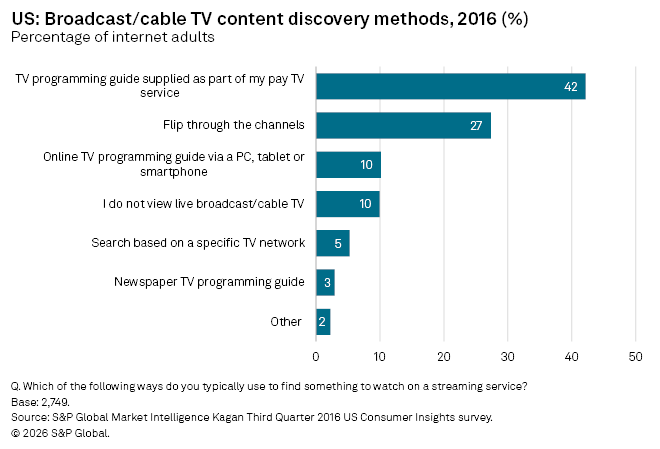
Finding what you wanted to watch on TV used to be straightforward. There were limited options. For example, back in 2016, the S&P Global Market Intelligence Kagan US Consumer Insights survey found that Americans (42%) were most likely to use the TV program guide integrated into their pay TV services for content discovery. Over one-quarter (27%) of internet adults at the time said they preferred just flipping through the channels to find an interesting TV show or movie. Today, for those still subscribing to a traditional pay TV service (e.g. Comcast or Charter) or an online virtual pay TV service, such as YouTube TV, discovery of broadcast TV and cable TV content has probably not changed much.
What has changed dramatically over the past decade is the adoption of paid subscription online video (SVOD) services, as well as free ad-supported video services. The Kagan third-quarter 2025 US Consumer Insights survey found that two-thirds (66%) of Americans strongly or somewhat preferred watching TV/videos on demand rather than scheduled broadcast programs. As a result, Americans are increasingly using different methods for on-demand content discovery.
Comparing data from Kagan US Consumer Insights surveys conducted in 2016 and 2026 shows that overall viewing of on-demand TV/video content has risen from 77% to 90% over the past decade. The percentage of Americans who find content by browsing the service provider’s content library has doubled over the past 10 years, reaching 52% in 2026. One-third of internet adults this year said they search for specific titles, up from 26% in 2016. In addition, selecting a title from your queue, or watch list, has risen in popularity, growing by 14 percentage points to 33% in 2026. Service provider recommendation engines have also improved, as evidenced by a 23-percentage-point increase in use over the past decade.
Today, there are also other ways that consumers discover the TV shows and movies they watch. For instance, 43% of survey respondents said that they receive recommendations from friends and/or family. One-third (34%) indicated they often search the internet for reviews of TV content, and 27% peruse titles listed in their service provider’s trending/popular sections.
Many SVOD services currently offer video libraries that contain titles that are free for viewing with a subscription, as well as titles that can be rented for an additional price. Only 7% of survey respondents said they typically will select rental titles when searching for on-demand content to watch. Kagan believes this reflects the typical consumer preference for avoiding additional costs whenever possible. Historical survey data has indicated that about half of US internet adults rent TV shows or movies each year.
In recent years social media has also become an important factor in content discovery. The Kagan third-quarter 2025 US Consumer Insights survey found that 41% of internet adults believed that they got better TV/video recommendations from social media than from online video services. The 2026 survey found that 20% of Americans typically use recommendations received through social media to find TV/video content.
Age appears to be a factor determining which on-demand content discovery methods are preferred. The survey data shows that selecting titles from service provider recommendation lists is popular with viewers of all ages. However, taking the time to research titles and save to a watchlist is something that skews slightly to older adults aged 45 and above. Similarly, these older adults tend to factor in recommendations from family and/or friends more than young adults. Conversely, young adults under 35 years of age are more likely to use recommendations from social media than older adults. Nearly half (46%) of those indicating they typically rent a TV show or movie that is not included in their service subscription were adults ages 18-34.
The Kagan Q3 US Consumer Insights surveys in 2016, 2025 and 2026 consisted of at least 2,500 internet adults. The margin of error for each of the surveys is +/-1.9 ppts at the 95% confidence level. Survey data should only be used to identify general market characteristics and directional trends.
Consumer Insights is a regular feature from S&P Global Market Intelligence Kagan.
This article was published by S&P Global Market Intelligence and not by S&P Global Ratings, which is a separately managed division of S&P Global.
Content Type
Theme
Segment
Language