Research — Nov 10, 2026
The key to success in digital entertainment is winning over early tech adopters

By Keith Nissen
Early technology adopters come in all ages and are the primary force behind consumer use of digital entertainment services, innovative devices and emerging services, such as prediction markets and AI.

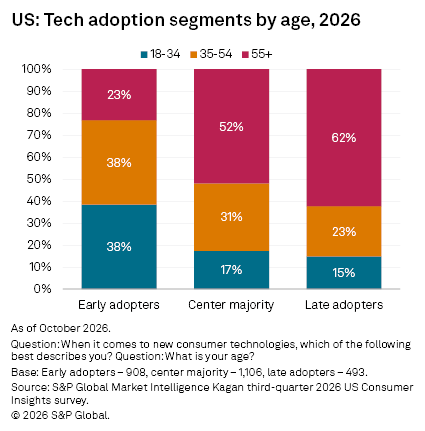
➤ Early tech adopters are spread fairly evenly across age groups, whereas those in the center majority and late adopter segments are skewed toward adults aged 55 and above.
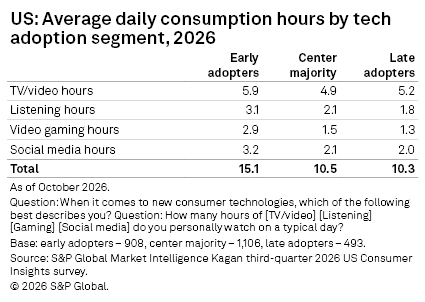
➤ Early adopters spend substantially more time-consuming digital entertainment, including live sports, and on social media than the other tech adoption segments. Early adopters also tend to lead more active lives than those less interested in technology.
➤ Early adopters are also much more likely than other tech adoption segments to own the latest innovative devices, bet on sports and make cryptocurrency and prediction market trades. Eight out of 10 consumers who pay for access to an AI tool are early adopters.

Respondents to the S&P Global Market Intelligence Kagan third-quarter US Consumer Insights survey were asked to identify their interest in adopting new technology. Early technology adopters, representing 36% of survey respondents, were individuals that said they typically are the first to try new technologies or adopt them before most people. Those in the center majority, totaling 44% of respondents, said they adopt only when a new technology is proven to work well. The remaining 20% were late technology adopters who adopt new technology only when it becomes absolutely necessary.
Examining these segments by demographics shows that early technology adopters come in all ages. Approximately four in 10 (38%) early adopters were individuals between the ages of 18 and 34, while an identical percentage was 35-54 years of age. Just under one-quarter (23%) were Americans, 55 years of age and above. Both the center majority and late adopters were heavily skewed toward adults aged 55+. Most of the early adopters (57%) were men, while 56% of the center majority and 65% of late tech adopters were women.
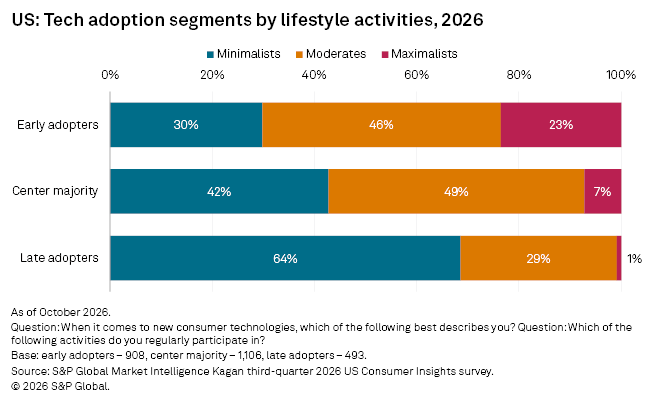
Early adopters also lead diverse lifestyles. For example, nearly one-quarter of early adopters led very active lives (maximalists), regularly exercising, playing sports, attending concerts, dining out at restaurants and traveling for leisure. Approximately half (46%) of early adopters led a moderate lifestyle, performing fewer activities than those in the maximalist group and another 30% led a minimalist group, participating in only one or two lifestyle activities.
In contrast, the center majority segment had very few maximalists, with half (49%) leading a moderate lifestyle and 42% being minimalists. Late adopters were heavily skewed (64%) toward minimalists whose lifestyle activities are limited typically to exercising, reading and socializing with friends.
When it comes to time spent consuming digital entertainment, the survey data shows how different early adopters are from everyone else. Early adopters spend an average of 15 hours per day consuming digital entertainment, compared to 10 hours for center majority and late adopters. Early adopters spend approximately six hours per day, on average, watching TV/online video content and they spend substantially more time each day than others listening to music, playing video games and interacting on social media.
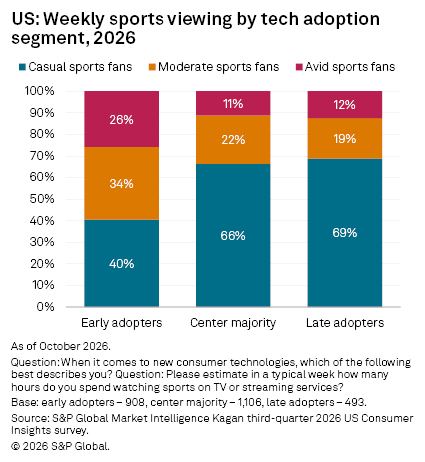
Early adopters also tend to watch more live TV sports than other consumers. For instance, one-quarter (26%) of early adopters said they spend over 10 hours per week watching live sports, making them avid sports fans. Another one-third (34%) of early adopters said they typically spend between five and 10 hours per week watching sports, classifying them as moderate sports fans, and 40% were casual sports fans watching less than five hours of sports per week. Those in the center majority and late adopter groups tend to have very similar behavior regarding sports, with two-thirds being casual sports viewers.
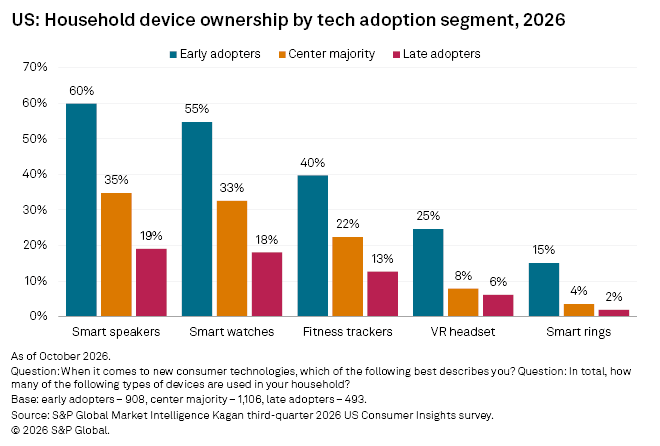
When it comes to ownership of the latest devices, early tech adopters are often the first consumers to buy. The survey found that among US households that operate a smart speaker, such as Amazon’s Alexa, 60% have a resident early adopter. Just over one-third (35%) were center majority households and 19% were owned by late adopters. Early adopter households were also much more likely to own at least one smartwatch, fitness tracker, virtual reality (VR) headset and smart ring than the other segments.
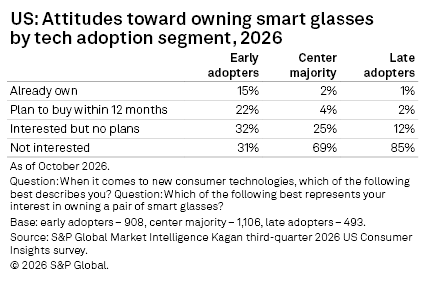
The nascent market for smart glasses is also dominated by early adopters. The survey found that only 6% of US internet adults own a pair of smart glasses, but 85% of buyers were early adopters. Conversely, 15% of early adopters currently own a pair of smart glasses, with another 22% planning to buy over the next year. Very few respondents in the center majority or late adopter groups own or have plans to buy smart glasses.
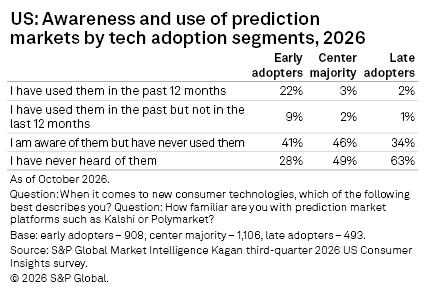
Early adopters also dominate the sports betting and cryptocurrency trading markets. The survey found that seven out of 10 adults (71%) that bet on sporting events or bought and sold cryptocurrency were early tech adopters. In the growing prediction market, early adopters represent 83% of those currently trading on Kalshi, Polymarket or a competitor, while 22% of early adopters said they have used a prediction market service over the past year, far outpacing those in the center majority or late adopter groups.
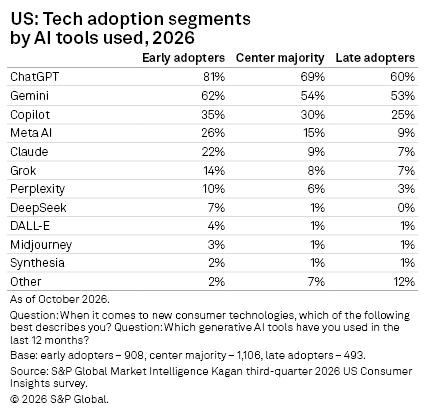
The survey data shows that generative AI tools have a somewhat different adoption pattern than other high-tech products and services. The survey found that half (49%) of total GenAI users in the US were early adopters, but those in the center majority already make up another 40% of AI users. Late technology adopters represent only 10% of Americans currently using AI tools.
The survey data reveals that the majority of Americans across all three tech adoption segments use ChatGPT and Gemini. Use of Microsoft’s CoPilot is substantially lower than the two market leaders, but also appears to have fairly consistent use across the three segments. In contrast, other AI tools, such as Meta AI, Claude and Perplexity are used primarily by early tech adopters, used by relatively few in the center majority and late adopters groups. Eight out of 10 (82%) of those paying for access to AI tools were early tech adopters.
The Kagan third-quarter 2026 US Consumer Insights survey consisted of 2,558 internet adults. The margin of error for the survey is +/-1.9 ppts at the 95% confidence level. Survey data should only be used to identify general market characteristics and directional trends.
Consumer Insights is a regular feature from S&P Global Market Intelligence Kagan.
This article was published by S&P Global Market Intelligence and not by S&P Global Ratings, which is a separately managed division of S&P Global.
Content Type
Theme
Segment
Language