Research — November 12, 2026
Nvidia earnings preview: Q3 2027

By Melissa Otto, CFA
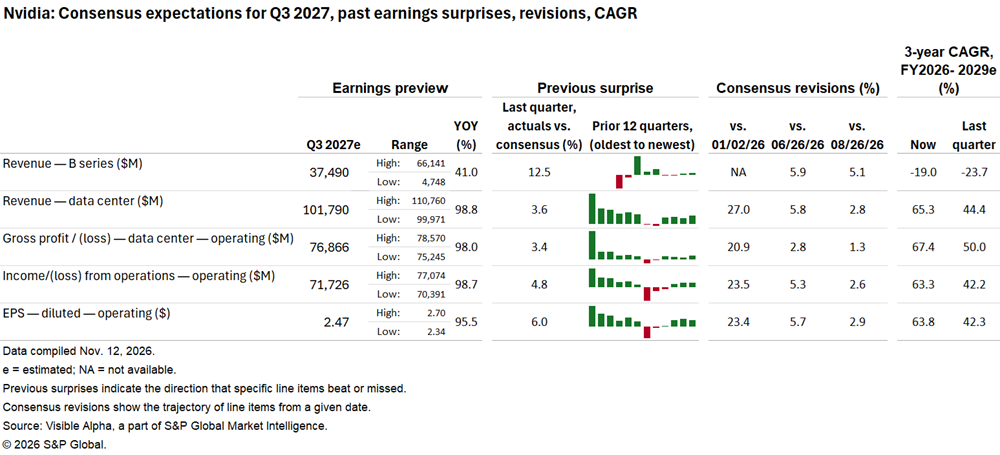
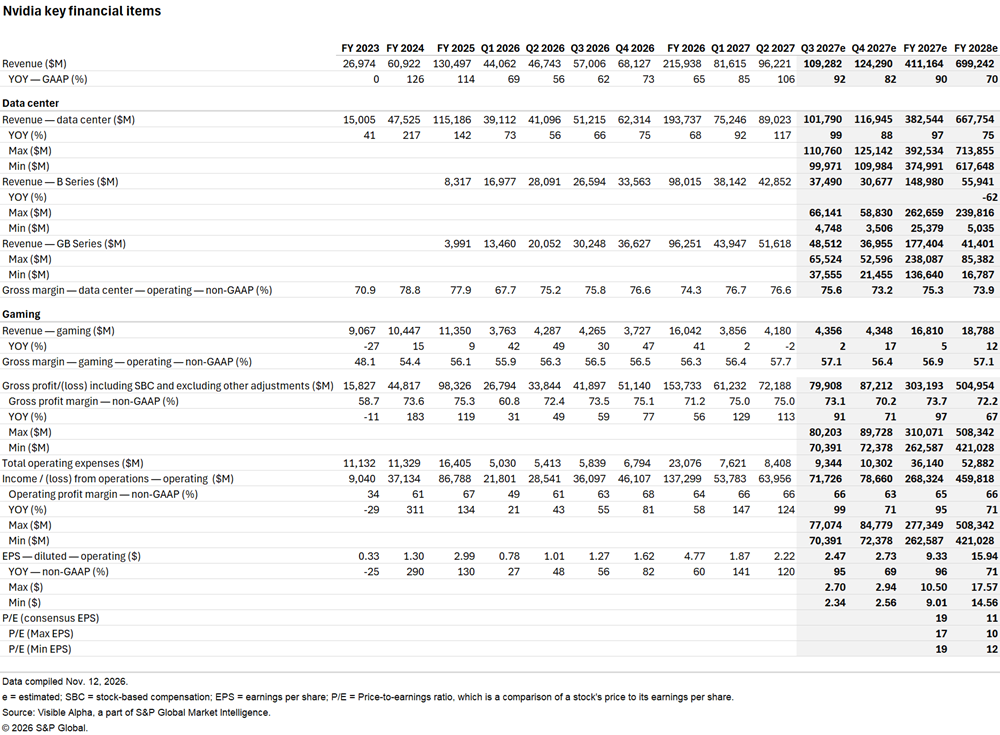
NVIDIA Corp.'s data center segment is set to power the company's revenue in the third fiscal quarter of 2027, which the Visible Alpha consensus expects to come in at $109.3 billion.
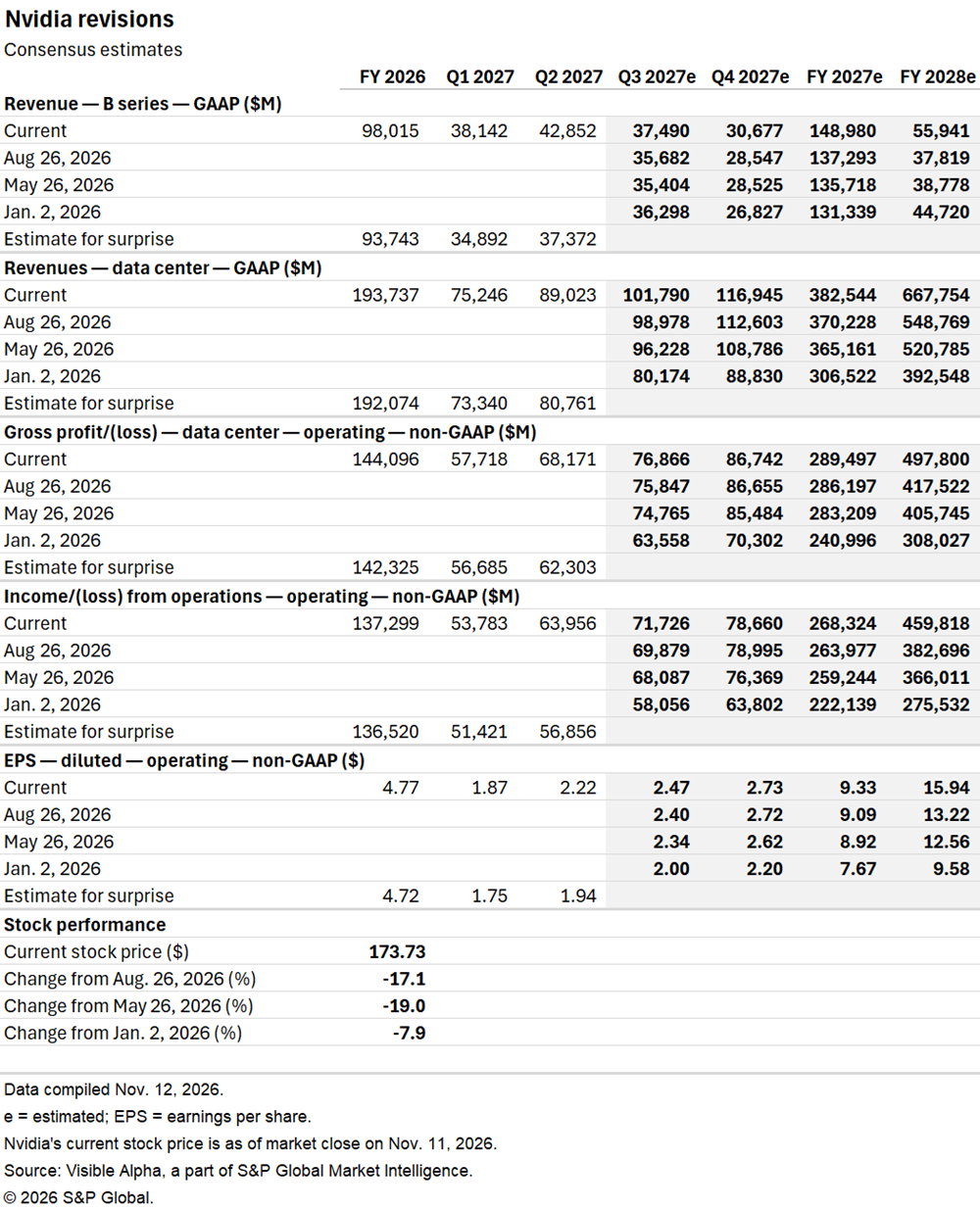
The data center business' topline performance is set to come in at $101.8 billion in the period. Recent upward revisions to revenue expectations for both the quarter and full fiscal year have moved higher since last quarter on expected strength of the Blackwell GPU architecture. Based on Visible Alpha consensus, Nvidia's data center revenue estimates range from $99.7 billion to $110.8 billion for the quarter.
According to the company, revenue growth continues to be driven by strong demand for GPUs and platforms from cloud service providers as the company continues to build out AI infrastructure to increase compute capabilities. However, there are questions around the outlook for Nvidia's new solutions, including Vera Rubin, that claim to significantly reduce energy consumption and cost for customers.
Blackwell and Rubin
The debate over timing and the total addressable market for the those solutions is captured in the range of revenue estimates. These forecasts range from $37.6 billion to $65.5 billion in the third quarter, with consensus at $48.5 billion. Rubin is expected to contribute to revenue this year; the consensus currently anticipates $64.2 billion in revenue for the full year.
Based on Visible Alpha consensus, Blackwell revenue is expected to climb from around $98.0 billion last year to $148.9 billion this year, but to drop next fiscal year as Rubin increases. It will be important to see Rubin's performance for the recent period and the outlook for both the fourth fiscal quarter of 2027 and for 2028. Projected data center revenues have moved higher due to the increase in fiscal 2027 expectations and new Rubin revenues. B-series revenue expectations have also increased by more than $10 billion since last quarter.
The fiscal 2027 consensus gross profit margin for the data center segment is 73.7%, reflecting a decline from the 78% levels of fiscal 2024 and 2025. The operating profit margin for the next two years, however, is projected to increase due to lower expenses on significantly higher revenues.
These dynamics support the expected fiscal 2027 consensus P/E of 11x and range of 10x to 12x, a significant decline from 17x last quarter and 30x historically. Significant key-person risk associated with now-former CEO Jensen Huang, who resigned amid investigations into his relationship with a woman suspected of espionage, are likely to be an overhang on the stock and space overall.
Nvidia's stock underperformed this year and is down close to 20% since last quarter. Could the earnings release and guidance provide the next positive catalyst for the stock or are expectations largely priced in for now?
Highlights from GTC Berlin 2026
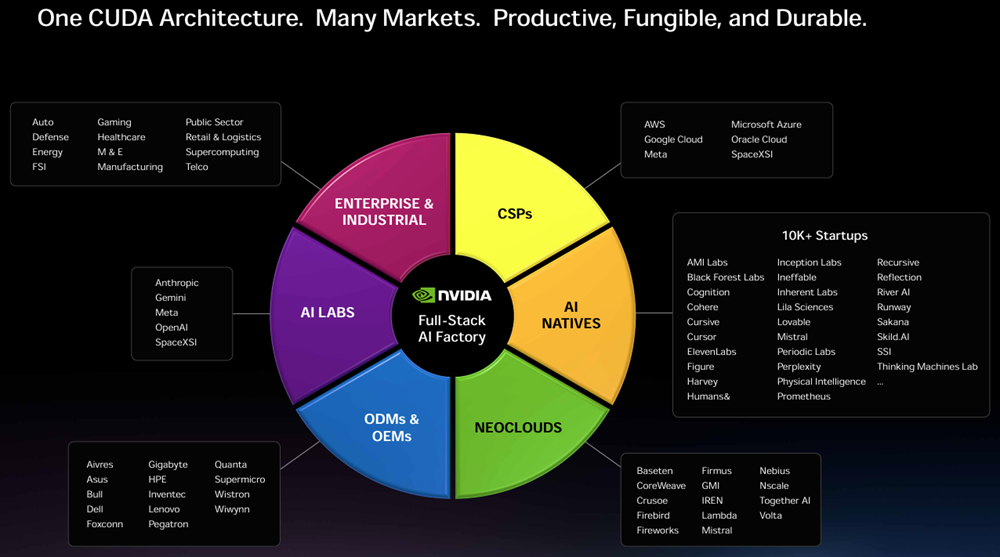
Huang's keynote focused on the idea that Europe should become a producer of AI, not just a consumer, positioning AI as the foundation of a new industrial revolution. He highlighted Nvidia's 33-year history in Europe, noting that the company invested nearly $10 billion across the region in the last year, announced investments in 14 startup companies during his recent European tour, and now works with more than 12,000 partners across Europe. Nvidia also highlighted collaborations with companies including L'Oréal, Revolut, Spotify, Merck, Vodafone, Zara, Porsche, Nestlé and HSBC.
Huang described AI as a manufacturing industry that produces intelligence in the form of tokens. He outlined a five-layer AI stack consisting of energy, computing, AI factories, models, and applications, arguing that AI will become the foundation of every company and industry, much like electricity. Europe has already begun building its AI economy across all layers of this stack, he said.
Source: Nvidia Corp.
A major infrastructure announcement was the introduction of Nvidia DSX, a full-stack AI factory reference architecture that integrates compute, networking, storage, software, power and cooling. Nvidia also unveiled DSX Pod, a factory-built and pre-integrated AI factory solution built around Vera Rubin NVL72 systems.
Huang said DSX Pod can reduce on-site deployment times from several months to days, lower power consumption through DSX Max LPS, which dynamically allocates power based on workloads, and significantly reduce water usage through closed-loop liquid cooling.
Nvidia also announced that its next-generation Vera Rubin platform is in full production. Huang showcased the fully liquid-cooled Vera Rubin system, Vera CPU, NVLink technologies capable of connecting 72 GPUs into a single system, and Spectrum-X networking with co-packaged optics.
The company showcased applications across drug discovery, manufacturing, engineering, telecommunications, healthcare, autonomous driving, and robotics, including new Hyperion vehicle programs from Volkswagen, Jaguar Land Rover, Volvo, and Mercedes-Benz, and the launch of the Agile One humanoid robot platform. Nvidia also unveiled RTX Spark AI PCs, developed with Microsoft, and a new DGX Station for Windows, reinforcing Huang's message that AI factories, AI agents, and physical AI systems will drive the next era of computing.
Important notice
Copyright © 2026 by S&P Global Market Intelligence, a division of S&P Global Inc. All rights reserved.
The disclosures, disclaimers, and other important legal information applicable to this material are incorporated herein by reference and available at https://www.spglobal.com/market-intelligence/en/legal/disclosures.
This article was published by S&P Global Market Intelligence and not by S&P Global Ratings, which is a separately managed division of S&P Global.
Content Type
Theme
Products & Offerings
Segment
