Research — Nov 26, 2026
NC commission issues orders authorizing Duke $1B rate increase over 2 years

By Dan Lowrey
The North Carolina Utilities Commission issued orders Nov. 16 authorizing Duke Energy Carolinas LLC and Duke Energy Progress LLC to increase electric base rates collectively by more than $1 billion over two years beginning in 2027.
The order adopts the parties' comprehensive settlement of revenue requirements and other issues without modification, except for the stipulation of settlement regarding the large-load tariff. The commission ruled on the large-load tariff settlement by approving and adopting new DC Rate Schedule and Supplemental Tariff Provisions that are specifically applicable to data center customers.
The order found credible evidence suggesting that data centers pose unique and substantial risks to Duke's system due to their unprecedented scale and interconnection speed, the risk of rapid departure from the system, and their high load factors and reliability standards. Two commissioners dissented from this decision, arguing that the tariff should apply to all large-load users, not just data centers.

➤ The North Carolina Utilities Commission (NCUC) authorized collective electric rate increases of more than $1 billion over a two-year period beginning in 2027: $496 million cumulative for Duke Energy Carolinas LLC (DEC); $556.6 million for Duke Energy Progress LLC (DEP), inclusive of rider roll-ins. By adopting the parties' comprehensive settlement of revenue requirements virtually without modification, the commission maintained North Carolina's historically constructive regulatory precedent of resolving major utility proceedings through negotiated settlements rather than litigated outcomes.
➤ The authorized rate increases are premised on a 9.80% return on equity (ROE) and a 53% equity ratio for both utilities. This return represents a 30-basis-point reduction from DEC's prior authorized ROE of 10.10% but no change for DEP. The 9.80% ROE aligns closely with the US average authorized electric ROE of 9.84% recorded during 2025 and the first half of 2026.
➤ Regulatory Research Associates considers the utility regulatory framework in North Carolina to be relatively constructive from an investor viewpoint. The NCUC adopted settlements in almost all major rate cases decided during the last five years. In cases that specified a return on equity (ROE), the authorized return was typically slightly above the nationwide average for energy utilities at the time established. For additional details, refer to the North Carolina commission profile.

For DEC, the order authorizes a $190 million electric rate increase in the base case, along with an incremental $96 million increase in 2027 associated with the multiyear rate plan (MYRP) projects and an incremental $210 million increase in 2028 for MYRP projects, for a cumulative increase of $496 million.
For DEP, the order authorizes a $90 million electric rate increase in the base case, along with an incremental $94 million increase in 2027 associated with the multiyear rate plan (MYRP) projects. The company is also rolling into base rates $218.6 million associated with various riders in year one of the plan, bringing the consolidated base rate increase to $403.6 million in year one. In year two, the settlement supports an incremental $153 million rate increase, bringing the two-year base rate increase, inclusive of rider roll-ins, to $556.6 million.
The rate increases are based upon a 9.80% return on equity (53.00% of capital structure), which is 30 basis points below DEC's currently authorized ROE of 10.10% but equal to DEP's currently authorized ROE. The historic base case is based on North Carolina retail rate base of approximately $25.7 billion for DEC and $17.8 billion for DEP, as of Dec. 31, 2024.
The 9.80% ROE approximates national averages. In the first half of 2026, the average authorized ROE in electric rate cases was 9.84%, matching the full-year 2025 average. There were 25 electric ROE authorizations in the first half of 2026, versus 86 in 2025.
The order approves the resolution of all remaining issues related to the revenue requirement in the cases, as well as the mechanics of the decoupling mechanism and ESM, as agreed upon in the settlement. The order also establishes a DC Schedule for certain data center customers, including the following requirements, some of which were incremental to the Large Load Settlement: minimum 15-year contract terms for data centers greater than 100 MW, minimum billing demand of 75% of contracted demand and interim curtailment provisions.
Commissioners Floyd McKissick and John Gajda expressed concern that distinguishing between data centers and other large-load customers could be discriminatory and that other large loads might have equal or larger impacts on the system without facing similar ratepayer protection measures.
The order for DEP extends the amortization of deferred coal ash costs from five years to eight years and increases the flow back of production tax credits (PTC) to customers from $40 million annually in the company's original request to $120 million annually for 2027 and 2028.
Additionally, DEC and DEP will make a $10 million shareholder contribution for customer bill assistance through the Share the Light Fund and health and safety repairs through the Helping Home Fund.
Both utilities will further evaluate delaying their next base rate case filing until no earlier than Nov. 1, 2028, contingent on their ability to defer costs associated with the approved Person County Combined Cycle 1 and Marshall Combustion Turbines and earn the full-weighted average cost of capital during the deferral period.
Both DEC and DEP, units of Duke Energy Corp., expect to record a one-time pretax accounting charge of $10 million as a result of the orders. This amount will be recorded in the fourth quarter of 2026.
Duke Carolinas proceeding background
On Nov. 20, 2025, DEC requested in Docket No. E-7, Sub 1329, a combined rate increase of over $1 billion under a multiyear rate plan (MYRP). DEC proposed a base revenue increase of $597.5 million starting Jan. 1, 2027, plus incremental MYRP project revenues of $132.0 million for year one (2027) and $274.9 million for year two (2028). Rates would rise by $729.5 million in 2027, reaching a cumulative $1.004 billion increase in 2028.
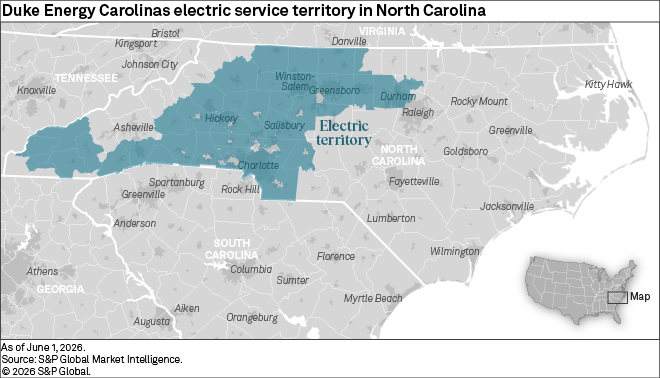
DEC stated investments would strengthen the grid, enhance plant efficiency, and accommodate rapid growth from data centers and manufacturing. The request was premised on a 10.95% ROE (53% equity ratio). The traditional base revenue request utilized a historic 2024 test year adjusted through March 31, 2026. DEC sought a 7.93% return on rate bases of $28.08 billion in year one and $30.67 billion in year two.
DEC indicated that targeted investments would strengthen the grid against storms and enhance the efficiency of existing power plants, resulting in cost savings for customers. Meanwhile, new energy infrastructure would accommodate rapid population growth, advanced manufacturing and data centers, incorporating built-in customer protections.
Drivers of the revenue request included historical plant additions/depreciation changes (42%), projected MYRP investments (41%), ROE changes (15%) and coal ash compliance (7%). Major capital plans featured $1.3 billion for solar and storage assets, aligned with the Carolinas Resource Plan, $2.4 billion for transmission and distribution, and significant fleet reliability investments. DEC also requested a $20 million annual storm reserve.
The NCUC staff filed testimony May 29, 2026, recommending the commission authorize a lower cumulative increase of $252.7 million ($20.8 million base, $80.2 million in year one, and $151.8 million in year two). This was premised on a 9.45% ROE (51% equity ratio) and a 7.06% return on a $25.23 billion rate base. Staff opposed DEC's performance-based regulation (PBR) mechanism as not in the public interest and advocated for a new large-load tariff to address data center risks. Public staff corrected this recommended increase to $262.2 million on June 17.
In response, DEC filed a rebuttal on June 19, offering a voluntary reduction to a cumulative $624 million ($264 million base, $114.5 million in 2027, and $245.5 million in 2028), lowering its requested ROE to 10.48% (53% equity ratio).
On July 2, DEC and public staff filed a partial settlement supporting a $556 million cumulative increase ($201 million base, $114 million in 2027, and $241 million in 2028). This bypassed agreements on ROE, capital structure, depreciation and storm recovery, but resolved specific accounting adjustments (payroll, bad debt and coal ash amortization).
On July 6, the parties settled storm issues, resolving Hurricane Helene and Winter Storm Fern costs; DEC withdrew its storm reserve request.
Finally, on July 17, DEC, public staff, and intervenors filed a comprehensive settlement resolving all remaining revenue requirement issues. Parties to the settlement comprised DEC, public staff, Carolina Industrial Group for Fair Utility Rates III, Walmart Inc., Microsoft Corp., the North Carolina Sustainable Energy Association and Carolina Utility Customers Association Inc.
Duke Energy Progress rate case background
On Nov. 20, 2025, DEP filed its second multiyear rate request (Docket No. E-2, Sub 1380), seeking a cumulative $947.2 million increase through 2028 to fund reliability, grid upgrades and economic development. The initial proposal sought a 10.95% ROE (53% equity) and a 7.79% return on rate base (valued at $20.38 billion in year 1 and $23.34 billion by year 2).
Historically incurred plant investments accounted for 40% of the request, projected MYRP investments for 45%, ROE adjustments for 19% and coal ash compliance for 8%. Major planned outlays included $826 million in solar and storage assets, $2.4 billion in transmission/distribution grid integration, alongside safety and capacity investments in nuclear, coal and hydro assets.
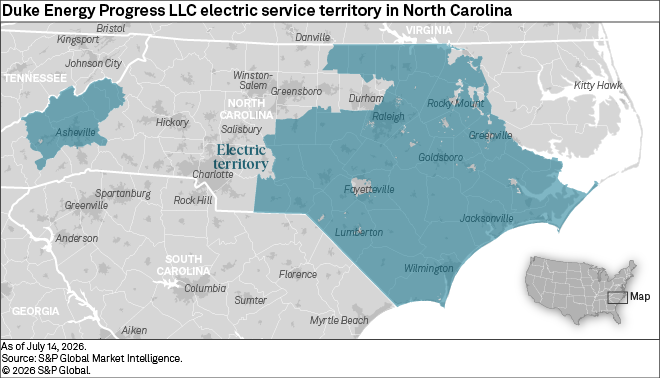
DEP also noted investments in its existing nuclear plants to enhance safety, maintain performance and reliability throughout their extended life operations, and ensure compliance with regulatory requirements. It has also consistently invested in maintaining its coal units and enhancing its generation fleet, including hydroelectric assets and the new Warsaw Battery Energy Storage System, to ensure resource adequacy and reliable generation capacity during peak load periods and extreme weather events.
On July 9, public staff of the commission filed testimony recommending a lower cumulative rate increase, later corrected to $381.5 million ($236.1 million net including riders), premised on a 9.50% return on equity (51% equity) and 6.92% overall return. Staff expressed significant concern that DEP's proposed PBR framework would not benefit ratepayers and recommended establishing a new tariff to address risks from serving large-load customers (25 MW or greater).
In response to affordability concerns, DEP filed rebuttal testimony on July 24, voluntarily reducing its cumulative request to $756.8 million based on a lowered 10.48% ROE request.
On Aug. 5, DEP, public staff, and several industrial and environmental intervenors filed a settlement resolving all revenue requirement issues. The agreement supported a cumulative $556.6 million rate increase over 2027 and 2028, inclusive of rolling $218.6 million in existing riders into base rates. The settlement also establishes agreed-upon performance incentive mechanisms to resolve staff's PBR concerns.
Parties to the settlement comprised DEP, the public staff, Carolina Industrial Group for Fair Utility Rates II, Walmart Inc., the North Carolina Sustainable Energy Association, and Carolina Utility Customers Association Inc.
NC regulatory environment
RRA accords North Carolina energy regulation an Above Average/3 ranking, indicating that the state regulation remains relatively constructive from an investor viewpoint. In almost all major rate cases decided during the last five years, the NCUC adopted settlements. In cases that specified a return on equity, the authorized return was typically slightly above the nationwide average for energy utilities at the time established.
State law requires the NCUC to use a historical year and a year-end rate base valuation in general rate cases but permits adjustments for "known and measurable" changes and allows the commission to include construction work in progress in rate base for a cash return. The NCUC permits timely recovery of electric fuel costs, purchased power expenditures and the costs of certain materials used in reducing or treating emissions. State law enacted in 2019 allows utilities to securitize storm damage costs, providing for cost recovery outside of a general rate case.
On Oct. 13, 2021, RRA raised its ranking of North Carolina to Above Average/3 from Average/1 following the signing into law of comprehensive energy legislation that provides utilities the ability to file MYRPs with the commission and develop performance-based incentives, with the ability to pursue regulatory approval for increases of up to 4% over three years rather than initiating a new rate case each year. The bill (House Bill 951) also effectively solidifies North Carolina's regulated energy monopoly system, maintaining the vertically integrated public utility model and commission regulatory authority. In doing so, it shuts down, at least for now, any hopes that the state might move to an unregulated/competitive power market structure. The bill also provides securitization as an option to recover costs associated with retiring coal plants.
Regulatory Research Associates is a group within S&P Global Energy.
S&P Global Energy produces content for distribution on S&P Capital IQ Pro.
For a complete, searchable listing of RRA's in-depth research and analysis, please go to the S&P Capital IQ Pro Energy Research Library.
For a full listing of past and pending rate cases, rate case statistics and upcoming events, visit the S&P Capital IQ Pro Energy Research Home Page.
This article was published by S&P Global Market Intelligence and not by S&P Global Ratings, which is a separately managed division of S&P Global.