Research — Nov 10, 2026
Latin American wind speeds fall short as solar holds steady in 2026

Through September 2026, solar radiation across Latin America's operating capacity tracked close to the 20-year average, while wind speeds remained below normal across most of the region. Brazil, the region's largest market for both wind and solar, posted a modest solar surplus but continued to record below-average wind speeds year to date.
Through September 2026, solar radiation across Latin America's operating capacity tracked close to the 20-year average, while wind speeds remained below normal across most of the region. Brazil, the region's largest market for both wind and solar, posted a modest solar surplus but continued to record below-average wind speeds year to date.
Solar
Brazil holds the region's largest tracked solar capacity at 18,744 megawatts and recorded a 0.3% positive year-to-date solar radiation deviation through September. Several smaller Central American markets outperformed by a wider margin. Guatemala, with 324 MW of operating solar capacity, posted the region's strongest country-level deviation at 6.2% year to date. El Salvador followed closely at 6.1% across 580 MW.
Colombia recorded the weakest country-level solar radiation performance, with a -1.0% deviation across 2,742 MW of operating capacity. Chile, the region's second-largest solar market at 9,668 MW, was slightly below normal at -0.6%.
|
Download data details in Excel
|

At the project level, Guatemala's Planta de Energía Solar Horus in Santa Rosa recorded a 6.7% year-to-date deviation across its 93-MW capacity, the strongest reading among projects over 30 MW in the region. At the other end, Shangri-La Solar Project in Colombia's Tolima department — a 160-MW facility — posted the most negative project-level solar deviation in the region at -9.2% year to date.
The largest solar project in Latin America is Brazil's Complexo Solar Janauba in Minas Gerais, with 1,600 MW of capacity. The project recorded a -1.8% year-to-date deviation in solar radiation.
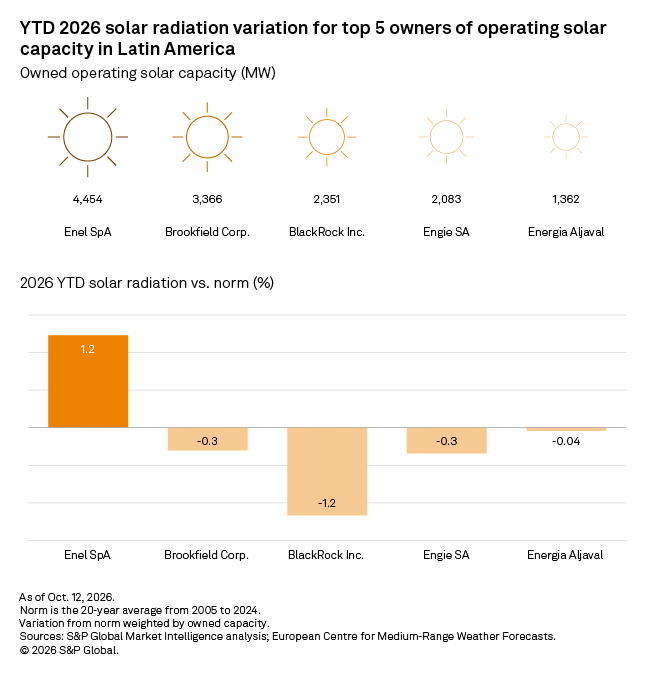
Latin America's top solar capacity owner, Enel SpA, recorded solar radiation 1.2% above the 20-year average year to date across its 4,454-MW portfolio. Of the remaining top five owners, most reported slight negative deviations: Brookfield Corp. (-0.3%, 3,366 MW), BlackRock Inc. (-1.2%, 2,351 MW), and Engie SA (-0.3%, 2,083 MW). Energia Aljaval was flat at 0.0% across 1,362 MW.
Wind
Brazil, the region's leader in tracked wind capacity at 31,160 MW, posted a year-to-date wind speed deviation of -2.9%. That below-normal trend has persisted across the region for most of 2026. The region's largest individual wind project, Brazil's Usina Eólica Rio do Vento in Rio Grande do Norte, recorded a year-to-date wind speed deviation of -5.1% across its 1,038-MW capacity. Peru recorded the weakest country-level wind performance, with a -8.0% year-to-date deviation across 1,021 MW of capacity. Argentina also trailed at -4.1% across 3,800 MW.
Costa Rica delivered the region's strongest wind conditions through September, posting a 22.8% year-to-date deviation across 442 MW of operating capacity. Panama was the second-strongest at 16.4% across 508 MW. Mexico also bucked the regional trend, recording a 5.0% positive deviation across 9,116 MW — the second-largest wind capacity in Latin America.
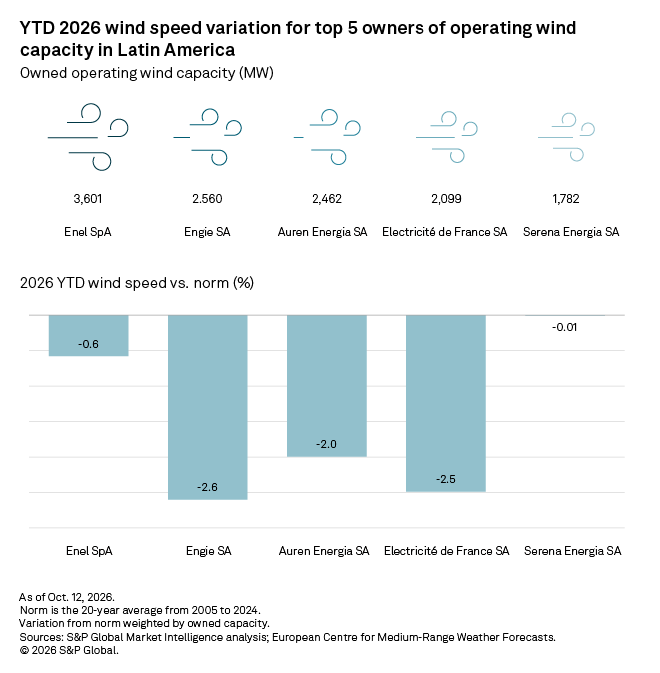
At the project level, the Planta Eólica Orosi in Guanacaste, Costa Rica, recorded the strongest wind performance in the region, with a 26.6% year-to-date deviation on 50 MW of capacity. Mexico's La Bufa Wind Farm Zacatecas had the most negative project-level result, with the 130-MW facility recording a -12.0% year-to-date deviation. Among the top five wind project owners, Serena Energia SA was the only owner to record a near-zero deviation, at essentially flat across its 1,782-MW portfolio. The other four all reported negative deviations: Enel SpA (-0.6%, 3,601 MW), Engie SA (-2.6%, 2,560 MW), Auren Energia SA (-2.0%, 2,462 MW), and Electricité de France SA (-2.5%, 2,099 MW).
Methodology
Solar radiation is the mean surface downward shortwave radiation flux, measured from the fifth-generation European Centre for Medium-Range Weather Forecasts reanalysis. This variable includes direct and diffuse solar radiation and is the model equivalent of global horizontal irradiance — the value measured by a pyranometer, a solar radiation measuring instrument. Wind speed is the value 100 meters above the ground from the same dataset. The data is available at quarter-degree latitudes and longitudes, with a spacing of slightly over 27.5 km. This analysis compares the September 2026 values with the 20-year average (2005-2024) for the year to date through September.
Data visualizations by Leigh Lunas and Oscar Solano.
For wholesale prices and supply and demand projections, see the S&P Global Market Indicative Power Forecast.
Regulatory Research Associates is a group within S&P Global Energy.
S&P Global Energy produces content for distribution on S&P Capital IQ Pro.
For a complete, searchable listing of RRA's in-depth research and analysis, please go to the S&P Capital IQ Pro Energy Research Library.
This article was published by S&P Global Market Intelligence and not by S&P Global Ratings, which is a separately managed division of S&P Global.