ECONOMICS COMMENTARY — 11 Nov, 2026
Indonesian factories enjoy record export sales growth as trade rebounds

Indonesia’s exporters are booming. Against a backdrop of heightened global geopolitical uncertainty, spiralling shipping costs, global supply chain stress and elevated cost of living pressures across the world’s developed markets, goods exports flowed out of Indonesia at an unprecedented rate in October, according to S&P Global’s PMI surveys. The improvement reflects a combination of factors, including supportive government policies, but perhaps most fundamentally coincided with a marked improvement in supply chains.
Record exports
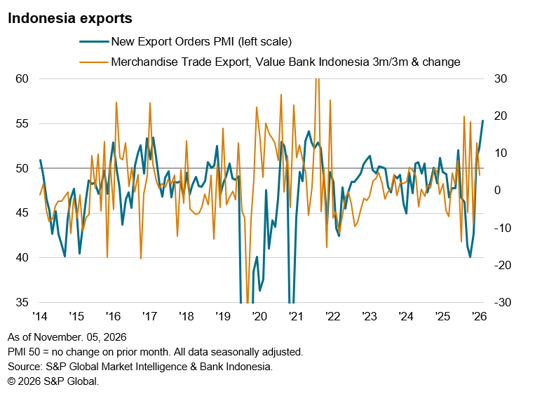
S&P Global’s Manufacturing PMI signalled an unprecedented rise in goods exports flowing out of Indonesian factories in October. The PMI’s New Export Index hit 55.3 in October, up sharply from 52.2 in September and the highest since PMI data were first compiled for the country over 15 years ago, back in April 2011.
Indonesia’s manufacturers have been on a volatile path this year. While exports have now risen for three successive months, the recent record growth surge contrasts markedly with a steep decline seen in the five months to July, which saw trade flows hit by the impact of the war in the Middle East. June’s decline had in fact been the steepest on record if the height of the COVID-19 pandemic is excluded. Rate hikes from the central bank, targeted at supporting the rupiah, were also cited by companies as having dampened demand.
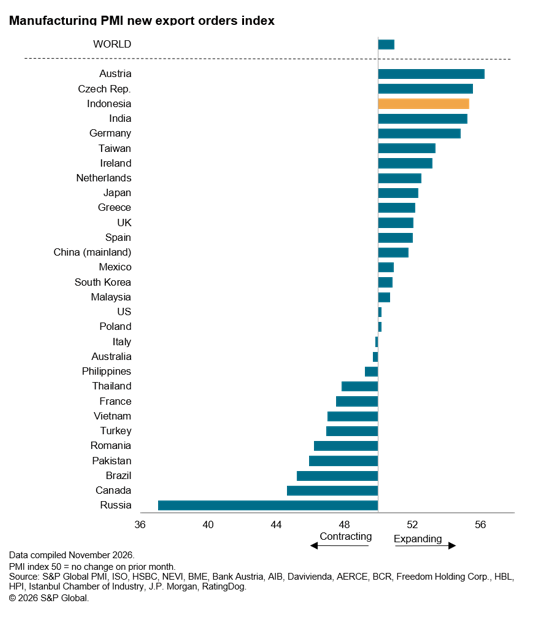
Of the 30 economies tracked by S&P Global’s manufacturing PMIs, only Austria and the Czech Republic reported faster export growth than Indonesia in October.
Coping with trade headwinds
Whereas the outbreak of war in the Middle East saw producers and exporters facing headwinds of reduced oil shipments out of the Strait of Hormuz, surging energy prices and broader shipping delays – all of which pummelled demand via the uncertainty and inflation it created, recent months have seen the impact of these headwinds fade.
Although energy prices remain elevated heading into the fourth quarter, and global supply chain delays continue to be widely reported, with geopolitical uncertainty similarly remaining heightened, Indonesian exporters have found a path to restore trade volumes.
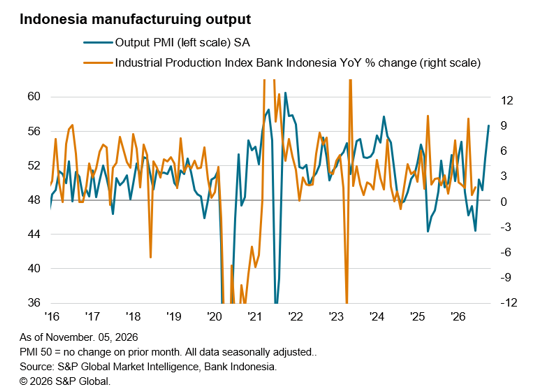
The improvement in exports has helped boost industrial production in the manufacturing economy, which rose in October according to the PMI. The survey’s output index hit one of the highest levels seen since the COVID-19 pandemic.
Policy support
While the central bank has had to tighten monetary policy to prop up the currency, it also reduced its reserve requirements to help support the economy. The economy has received a boost from fiscal policy. Stimulus measures have included a school meals program, the partial delay in raising value-added tax imposition, as well as continued cash and rice handouts. However, these measures have largely boosted domestic, rather than export demand.
Supply chains hold key to growth
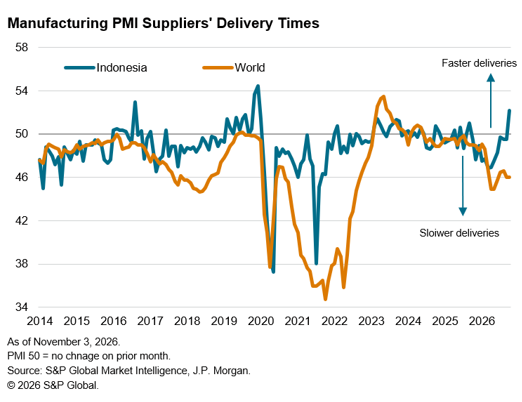
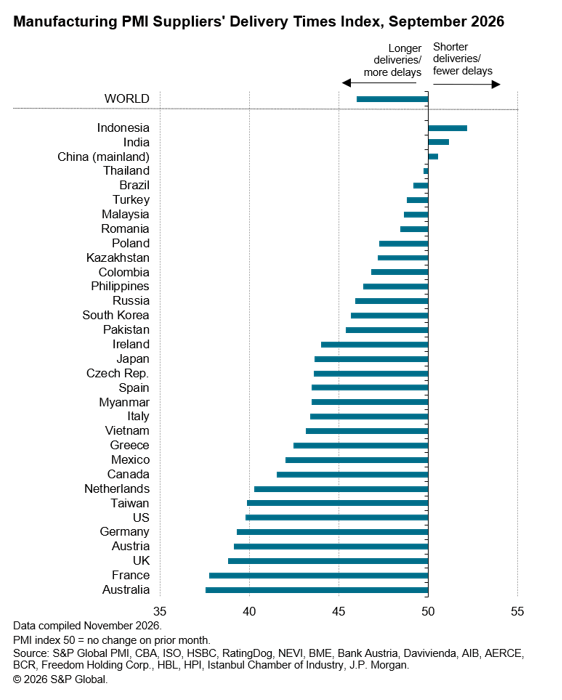
Exports have instead benefitted from greater shipments of palm oil related products, but an additional helping hand has come from improved supply chains. Indonesian manufacturers reported the greatest improvement in supplier lead-times since 2019 in October, contrasting with slower delivery times having been reported continually over the prior 12 months. The delivery times improvement was the greatest of all economies tracked by the PMI. Only India and mainland China also saw an improvement in delivery speeds during the month, but to a lesser degree than Indonesia.
The delivery time improvement reflects fewer international shipping delays and increased stock holding by suppliers, as well as local logistics factors specific to Indonesia, and hopefully sets the scene for a further recovery of manufacturing in the months ahead.
Access the latest PMI press release here.
© 2026, S&P Global. All rights reserved. Reproduction in whole or in part without permission is prohibited.
Purchasing Managers' Index™ (PMI®) data are compiled by S&P Global for more than 40 economies worldwide. The monthly data are derived from surveys of senior executives at private sector companies, and are available only via subscription. The PMI dataset features a headline number, which indicates the overall health of an economy, and sub-indices, which provide insights into other key economic drivers such as GDP, inflation, exports, capacity utilization, employment and inventories. The PMI data are used by financial and corporate professionals to better understand where economies and markets are headed, and to uncover opportunities.
Read our latest PMI commentary here.
This article was published by S&P Global Market Intelligence and not by S&P Global Ratings, which is a separately managed division of S&P Global.
Theme
Location
Products & Offerings