ECONOMICS COMMENTARY — 06 Nov, 2026
Growth in global goods exports slows amid rising transport costs in October

By Jingyi Pan
Global goods exports continued to expand at the start of the final quarter of the year, extending the longest spell of trade growth seen since 2021, according to the Purchasing Managers’ Index™ (PMI®) surveys. Growth was again supported by the major theme of AI-related demand, benefitting tech-focused economies and the respective sectors, as well as ongoing precautionary stock building.
That said, the rate at which global new export orders grew softened visibly from that seen in August and September as inflationary pressures intensified, attributed largely to greater energy and transport costs. The intensification of price pressures had a noticeable impact on export demand for many tech-focused economies in North Asia, including Japan, Taiwan and South Korea.
Exports growth extends into the start of the fourth quarter
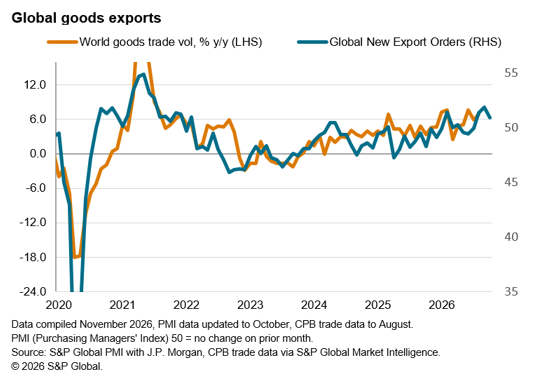
The seasonally adjusted Global Manufacturing PMI New Export Orders Index, sponsored by J.P. Morgan and compiled by S&P Global, posted above the 50.0 no-change mark for a third consecutive month in October. This extended the ongoing sequence of growth to the longest since December 2021. That said, at 50.9, down from 51.6 in September, the latest reading was the lowest in the current growth spell. The latest reading is nevertheless indicative of global merchandise trade growing at a positive annual rate of approximately 6% at the start of the fourth quarter.
The global export increase was again broad-based in October, with the rates of growth converging between manufacturing and services as the latter played catch-up to the former, which slowed. This was likewise the case by region, as developed and emerging markets new export business rose at broadly similar paces in October, albeit with both slowing from September.
Eurozone leads growth in goods new export orders
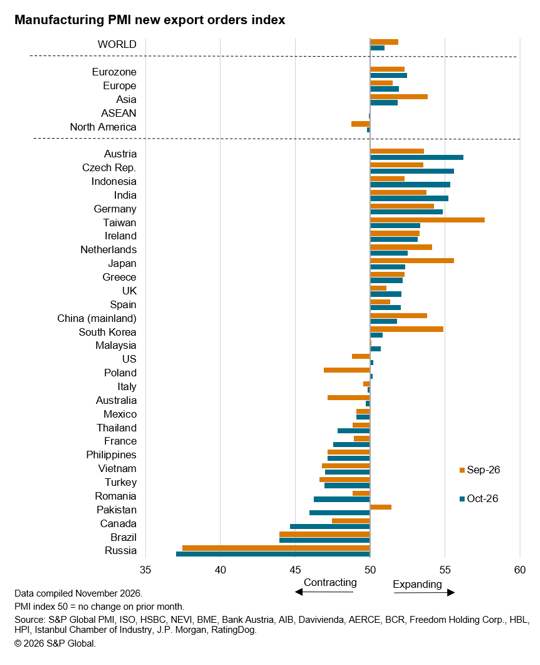
Among the economies tracked by the PMI survey, Austria and the Czech Republic posted the strongest growth in goods new orders from abroad. The former, notably, contributed to strong eurozone performance alongside Germany, which ranked fifth.
Germany’s new export orders grew at the second-fastest pace in just over five years, with only February having seen a faster rate of expansion. The upturn in goods trade had unfolded against a backdrop of still-improving demand as defence and infrastructure spending lifted manufacturing production in October.
Among the mix of other economies seeing strong growth in new export orders were Indonesia and India in October. Manufacturers in Indonesia reported a record expansion in goods new export orders, set against the fastest rise in overall new orders since October 2021 as improved customer confidence and new product launches reportedly drove the uptick in new work. Similarly in India, growth in manufacturing new export orders picked up to a six-month high.
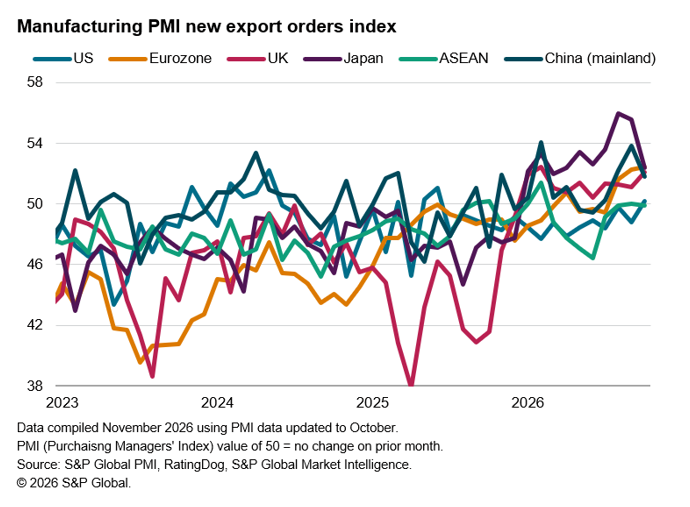
Around the rest of Asia, however, those economies that had led in September, including Taiwan and Japan, saw their rates of goods new export orders growth soften in October with many indicating higher prices as reasons for the slowdown. Taiwanese and Japanese manufacturers’ new export orders rose at the slowest paces in nine and seven months, respectively, even as they remained solid. South Korean goods new export orders rose only marginally, however, in its fourth consecutive monthly expansion.
On the other hand, the worst performers were again Russia and Brazil in October. Russia saw the decline in goods trade further deepen at the sharpest pace since May 2022, with services also trending in the same manner.
In contrast, Brazil’s manufacturing new export orders contraction eased for a second consecutive month in October but remained sharp overall.
By broad region, the eurozone overtook Asia in October to be the best performer with the aforementioned support from Germany and Austria. Still, Asia maintained growth as tech demand continued to fuel the global expansion.
Technology exports growth wanes
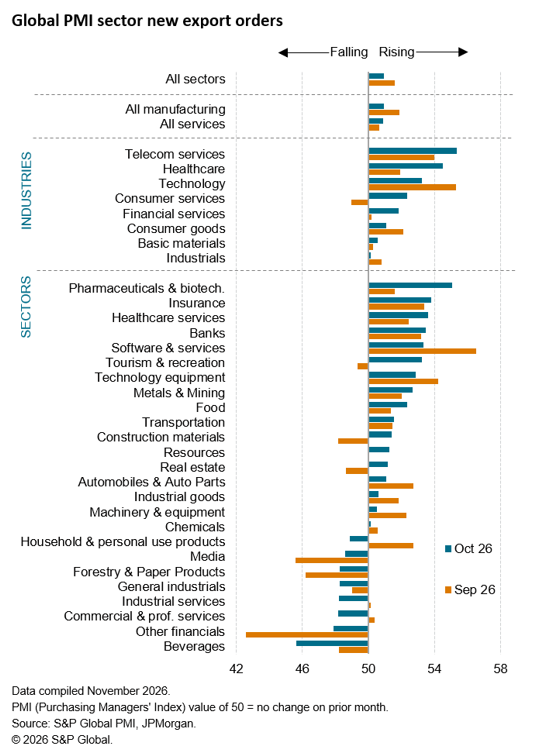
Overall, growth in new export orders was seen for all eight broad sectors for the first time since February 2022, which reflected a further broadening out of the improvement in trade at the start of the final quarter of the year.
Looking more closely at sector performance, the latest PMI survey showed that growth in new export orders was led by the telecommunication services sector, while healthcare trade also improved to overtake technology, which had posted the strongest growth back in September. While the latest data does reflect some waning of growth momentum for technology exports in October, the pace of improvement was still solid at the start of the fourth quarter.
Among the detailed sectors, it was the pharmaceuticals & biotechnology sector that performed the best in October. This was followed by insurance, with banks also close behind. On the flip side, beverages lagged alongside non-bank financials in October.
Rising shipping costs weigh on trade
One notable observation made from the latest October survey was the more pronounced deceleration in global manufacturing new export orders growth compared with overall new orders, owing to transport and fuel costs.
Global goods new orders growth eased modestly in October, attributed largely to the strongest increase in selling prices since 2022, which was in turn driven by the strongest increase in manufacturing input costs since July 2022. In comparison, global goods new orders growth softened much quicker to only a marginal pace in October.
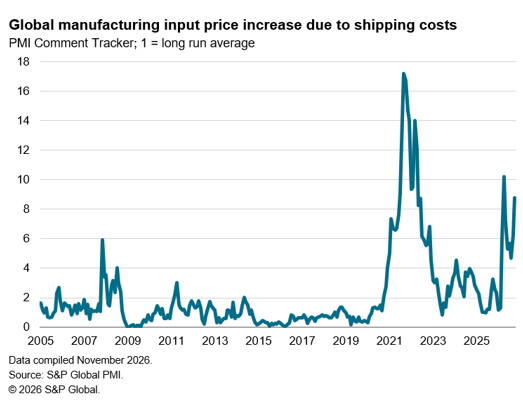
Looking into the key sources of the latest inflation via comments from PMI survey respondents, shipping costs clearly played a major role in the increase in input prices, which undoubtedly was in turn a big factor behind the softening of export demand growth for goods.
The erosion of demand from higher shipping prices is a trend worth monitoring as the latest reduction in business optimism regarding output growth in the next 12 months was tied more to rising prices rather than concerns over the economic outlook and uncertainties, according to the PMI comment tracker. Any further impact of ongoing price increases to global manufacturing demand and production may therefore be more acutely observed through the PMI new export order gauge.
© 2026, S&P Global. All rights reserved. Reproduction in whole or in part without permission is prohibited.
Purchasing Managers' Index™ (PMI®) data are compiled by S&P Global for more than 40 economies worldwide. The monthly data are derived from surveys of senior executives at private sector companies, and are available only via subscription. The PMI dataset features a headline number, which indicates the overall health of an economy, and sub-indices, which provide insights into other key economic drivers such as GDP, inflation, exports, capacity utilization, employment and inventories. The PMI data are used by financial and corporate professionals to better understand where economies and markets are headed, and to uncover opportunities.
Read our latest PMI commentary here.
This article was published by S&P Global Market Intelligence and not by S&P Global Ratings, which is a separately managed division of S&P Global.
Theme
Location
Products & Offerings