ECONOMICS COMMENTARY — 03 Nov, 2026
Divergent manufacturing trends persist as tech demand drives global expansion

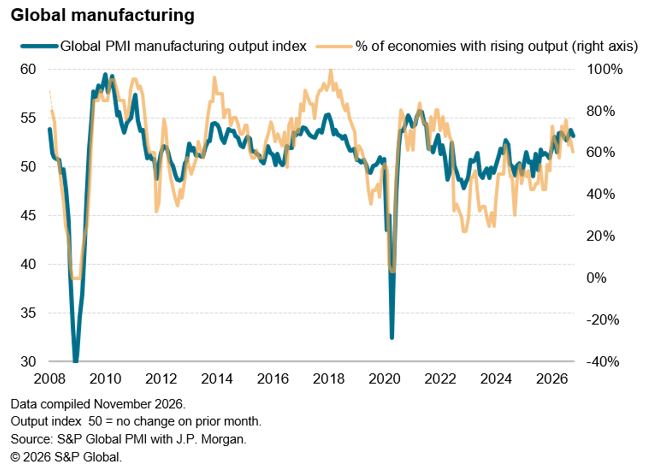
Global manufacturing output continued to rise at a robust pace in October, according to S&P Global’s PMI survey data, but performance remains sharply divergent. Tech-focused Asian economies, northern European equipment producers and the US have benefited from AI-related investment and rising defense spending, while lower-value manufacturing in southern Europe, South and Central America and commodity-focused economies have struggled amid high energy prices and supply chain, tariff and climate-related disruptions. However, some of the tech-oriented economies showed signs of slower growth in October, hinting at a slowing in the AI build-out.
Manufacturing growth seen in fewer economies
Manufacturing output rose globally in October at a sustained robust pace, notching up one of the strongest gains seen over the past five years despite losing a little momentum, according to the S&P Global PMI surveys. The breadth of the upturn fell, with 20 of the 33 economies tracked by the PMIs reporting higher output in October, down from 22 in September, the joint-lowest so far this year (equal to April). However, at just over 60%, the proportion of economies reporting higher output remains high by the standards seen over the past four to five years.
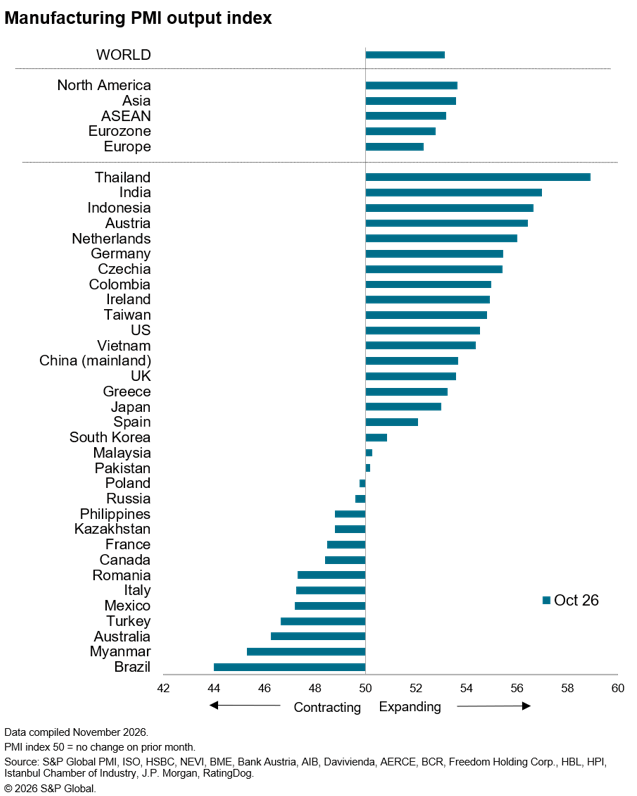
There clearly remains a wide spread of manufacturing trends around the world, however, with strong growth in some economies contrasting with steep downturns in others.
Mixed trends in Asia
The fastest growth of factory production in October was reported in Thailand, which enjoyed its best performance since December 2025, followed by India and Indonesia (the latter reporting its highest growth since March 2024), pointing to Asian dominance.
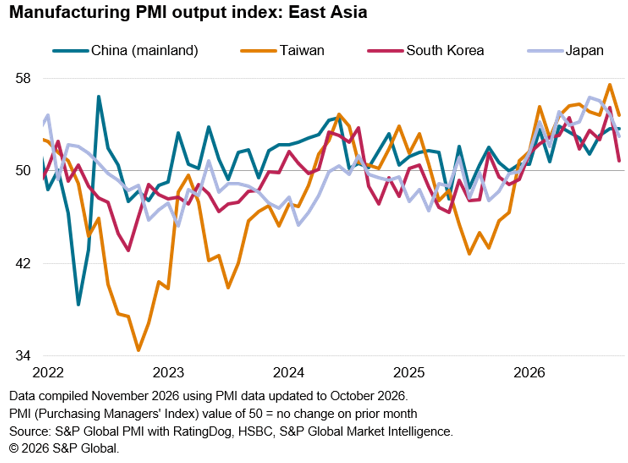
However, Asia also had some notably weaker-performing economies. A further sharp output decline in Myanmar was accompanied by lower output in the Philippines and sluggish gains in both Malaysia and South Korea, the latter reporting its weakest gains in the year so far.
Slower growth in South Korea was joined by weaker performances in Japan and Taiwan, though steady and solid growth – one of the best expansions seen over the past five years – continued to be reported in mainland China.
Europe led by northern eurozone economies as southern states decline
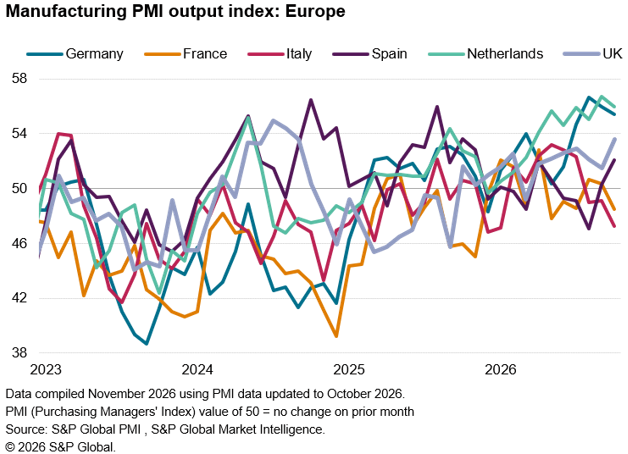
In Europe, October saw something of a north-south divide. Europe has its strong performers, with Austria, the Netherlands and Germany at or close to the head of the leader board, all having seen their best growth trends for over four years in recent months.
Disappointments came from falling output in France and Italy. However, two notable performers were the UK and Spain, where output growth accelerated in October to 25- and 11-month highs respectively.
US drives North American outperformance
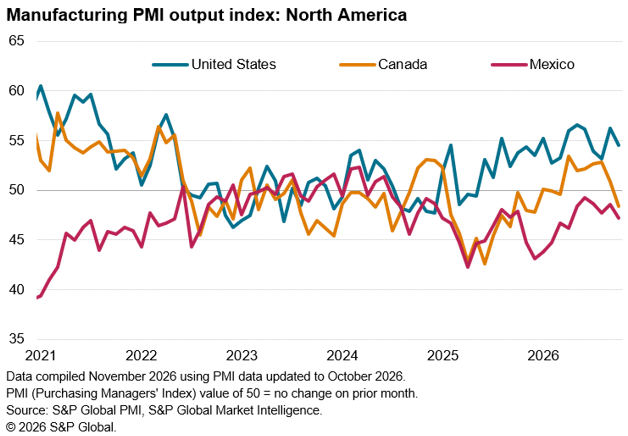
One of the fastest-growing major regions was North America, though here too the PMIs showed varying trends when drilling down to individual economies. Growth of manufacturing output in the US – which has been enjoying one of its best growth spells for five years – contrasted with a sustained fall in output in Mexico and a renewed de-cline in Canada, where the drop in production was the steepest since December 2025.
Diverging sector trends
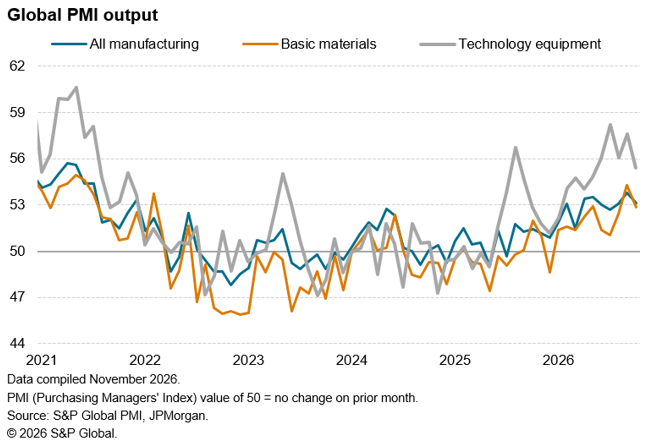
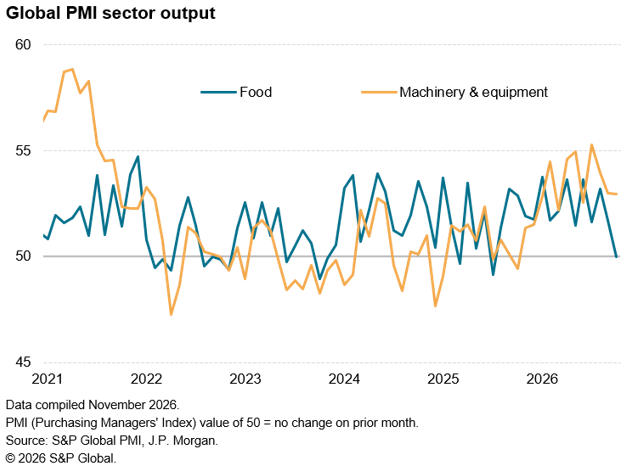
Some of the diverging trends in manufacturing output could be attributed to local factors, notably in Brazil, where October saw a tightly fought general election, and France, where the month saw social unrest in many cities. However, an overriding factor globally has been the AI-investment upturn seen over the past year, where a surge in demand for equipment has favored economies where production is focused on high-tech industries, as well as those economies where rising defense spending has buoyed output of other machinery and equipment. Hence, the tech-focused economies of East Asia and the equipment-making northern European states have fared especially well so far this year, as has the US.
In contrast, lower-value manufacturing has struggled so far this year amid the diversion of business spending toward AI, the disruption of supply chains due to conflicts and tariffs, and disruptions to transport and food production from climate change. Energy-intensive industries have also been hit by the surge in oil prices this year. Hence the economies of southern Europe, South and Central America, and other more commodity-focused economies such as Australia and Canada, have underperformed.
The more recent slowdowns in tech-oriented economies such as South Korea, Taiwan and Japan hint, however, that some of the AI-related growth spurt may be losing momentum, having coincided with a cooling of overall tech industry growth.
Read more about S&P Global’s sector PMI data here.
Access the latest global PMI press release here.
© 2026, S&P Global. All rights reserved. Reproduction in whole or in part without permission is prohibited.
Purchasing Managers' Index™ (PMI®) data are compiled by S&P Global for more than 40 economies worldwide. The monthly data are derived from surveys of senior executives at private sector companies, and are available only via subscription. The PMI dataset features a headline number, which indicates the overall health of an economy, and sub-indices, which provide insights into other key economic drivers such as GDP, inflation, exports, capacity utilization, employment and inventories. The PMI data are used by financial and corporate professionals to better understand where economies and markets are headed, and to uncover opportunities.
Read our latest PMI commentary here.
This article was published by S&P Global Market Intelligence and not by S&P Global Ratings, which is a separately managed division of S&P Global.
Theme
Location
Products & Offerings