Research — Nov 13, 2026
CenterPoint Energy, Great Plains Natural Gas file for Minn. rate increases

By Dan Lowrey
CenterPoint Energy Resources Corp. and Great Plains Natural Gas Co. filed general rate applications with the Minnesota Public Utilities Commission on Oct. 30. CenterPoint seeks an increase in gas rate over three years, totaling $252.4 million. Great Plains seeks a one-year increase of $6.2 million, including money being rolled in by a rider.

➤ Minnesota gas utilities CenterPoint Energy Resources (CER) and Great Plains Natural Gas (GP) have filed new rate cases with the Minnesota Public Utilities Commission. CER's filing is materially larger and spans three years. The company is seeking a cumulative $252.4 million increase through 2029, primarily to recover higher operating costs and support investments in system reliability, infrastructure modernization, technology and customer programs. GP is requesting a smaller, one-year increase of $6.2 million, or about $4.5 million excluding the proposed rider roll-in, reflecting higher operating expenses and capital-related costs.
➤ Both utilities proposed returns above recent national averages. CER requested a 10.30% return on equity and GP requested 10.80%, compared with an average authorized gas utility ROE of 9.83% in the first half of 2026.
➤ Regulatory Research Associates considers the utility regulatory framework in Minnesota to be balanced from an investor viewpoint. Recently authorized equity returns have typically approximated or been below prevailing nationwide industry averages, and adjustment clauses and riders permit the timely recovery of electric fuel, gas commodity, transmission, certain environmental and reliability projects and certain gas infrastructure costs.

The returns on equity requested by both CER and GP exceed national averages tracked by Regulatory Research Associates. The average ROE authorized for gas utilities was 9.83% in rate cases decided in the first half of 2026, slightly below the 9.87% in rate cases decided in full year 2025. There were 13 gas ROE authorizations in the first half of 2026 versus 68 in full year 2025.
For a discussion of trends in ROE authorizations and other rate case parameters, refer to RRA's Major Rate Case Decisions Quarterly Update.
CenterPoint's multiyear rate request
CER is requesting (Docket G-008/GR-26-127) a $114.6 million increase in 2027 and incremental increases of $91.2 million and $46.6 million in 2028 and 2029, respectively.
The increases are premised on a 10.30% return on equity (52.53% of the capital structure) and a 7.77% overall return on rate base of $3.40 billion for a plan year ending Dec. 31, 2029.
CER is seeking an interim rate increase of $92.6 million in 2027 and an incremental $90.0 million in 2028 while the case is adjudicated. The interim rate increase is premised upon a 9.39% return on equity. The company requests that the interim rate increase become effective Jan. 1, 2027.
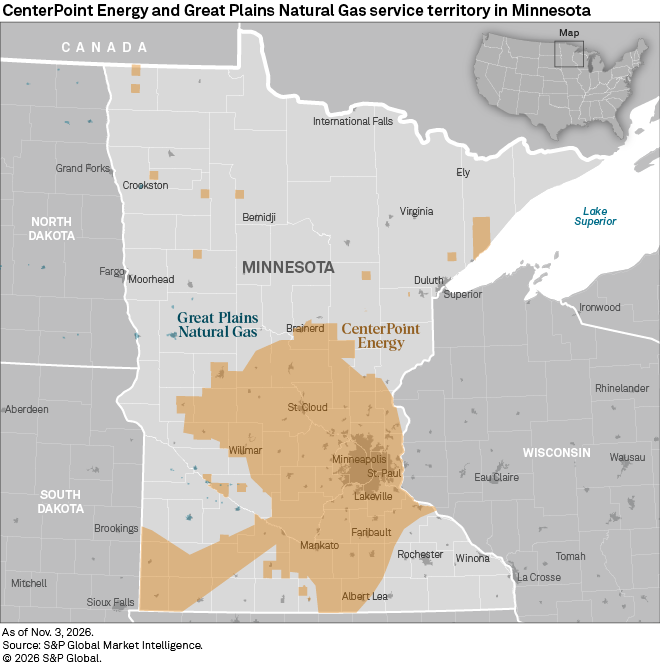
The primary drivers of CER's rate case are to cover increased operating costs, maintain financial health and invest in its natural gas system. The company is investing to maintain safe and reliable gas utility service, strengthen the resilience of the natural gas system, modernize critical infrastructure and implement advanced technologies, including installing over 360,000 additional advanced gas meters from 2027 through 2029. The company plans $133.9 million in information technology investments during the 2027-2029 period to support emergency response, fieldwork, customer communications, billing, asset management, financial controls, cybersecurity and data governance. Additionally, CER is investing in natural gas storage, supply and system resilience to ensure reliable service during Minnesota's coldest weather and peak-demand periods. This also includes additional capacity to support systemwide peak-day reliability and localized growth in several counties.
CER indicated it is prioritizing customer affordability by expanding the company's Gas Affordability Program and by proposing an Asset Limited, Income Constrained, Employed (ALICE) customer pilot funded by redirected late-payment fees. It also seeks to moderate bill increases by shifting Energy Conservation and Optimization and Natural Gas Innovation Act costs out of base rates, using the capital true-up mechanism to defer some recovery, and implementing an Inflation Reduction Act rider to refund or surcharge customers for related tax impacts.
CER is also requesting an increase in the monthly basic charge for residential customers to $12.00 in 2027 from $9.50 and to $15.00 in 2028.
The company's previous Minnesota rate case was concluded May 29, 2025, when the PUC adopted a "black box" settlement that was silent on authorized return but authorized the utility a $60.8 million gas rate increase in the 2024 test year and an incremental $42.7 million increase in the 2025 plan year, agreeing to hold base rates flat in 2026.
Great Plains rate request
Great Plains is seeking (Docket G-004/GR-26-335) a $6.2 million base rate increase, including funds being collected through a Gas Utility Infrastructure Cost (GUIC) rider. Excluding the rider, the net increase requested is about $4.5 million. The rate increase is based on a 10.80% return on equity (50.90% of capital structure) and an 8.04% overall return on rate base of $61.2 million.
The proposed rates are based on a projected 2027 test year, developed using actual calendar-year 2025 financial information adjusted for known and measurable changes through year-end 2026 and projected changes for 2027.
While the case is adjudicated, GP is seeking an interim rate increase of about $5.7 million in 2027, or $3.9 million excluding the rider roll-in. The interim rate increase is premised upon a 9.53% return on equity.
GP's last rate increase was implemented April 1, 2021. Since that time, the company indicated it has experienced meaningful increases in both capital investment and operating expenses. The additional investments have increased GP's rate base, which in turn has increased depreciation expense and property taxes.
The primary drivers of increases in operations and maintenance expenses include higher labor and benefit costs resulting from changes in the labor market, according to the company. Insurance and software maintenance expenses have also increased, reflecting higher insurance premiums, increased software licensing costs and enhanced cybersecurity requirements. Energy Conservation and Optimization expenses have increased due to policy changes in Minnesota, while uncollectible account expense has increased due to higher historical net write-offs.
A final order in the company's previous rate case was issued Oct. 26, 2020, authorizing GP a $2.65 million increase in gas rates based on a 9.53% return on equity (50.185% of capital structure) and a 7.12% overall rate of return on a rate base of $32.6 million. Because the size of the increase was below RRA coverage criteria, this rate case was not included in our database.
Minn. regulatory environment
RRA accords Minnesota regulation an Average/2 ranking, indicating it remains balanced from an investor perspective. The commission recently launched an investigation into the affordability of electric and natural gas utility service.
Recently authorized equity returns typically have approximated or been below prevailing nationwide industry averages. As permitted by statute, significant interim rate increases are usually requested and authorized, and, as a result, rate case test years are effectively fully forecast. In addition, adjustment clauses or riders permit the timely recovery of electric fuel, gas commodity, transmission, certain environmental and reliability projects and certain gas infrastructure costs. Utilities are permitted to file rate requests that adjust rates annually for up to five years, and the PUC may authorize two-step interim increases.
In the gas utility industry, large-use customers have been permitted to purchase gas from competitive suppliers for several years, but there is no movement to extend choice to small-volume customers. Legislation has established aggressive renewable portfolio standards and greenhouse gas reduction requirements, but the related compliance cost recovery does not appear to be in question. Also, the PUC has adopted revenue-decoupling mechanisms for several of the state's utilities, and the commission's merger review standard is not particularly restrictive.
Regulatory Research Associates is a group within S&P Global Energy.
S&P Global Energy produces content for distribution on S&P Capital IQ Pro.
For a full listing of past and pending rate cases, rate case statistics and upcoming events, visit the S&P Capital IQ Pro Energy Research Home Page.
For a complete, searchable listing of RRA's in-depth research and analysis, please go to the S&P Capital IQ Pro Energy Research Library.
This article was published by S&P Global Market Intelligence and not by S&P Global Ratings, which is a separately managed division of S&P Global.