Research — October 9, 2026
Visible Alpha breakdown of US banks’ third-quarter 2026 earnings expectations
By Yash Devale and Pranay Deshmukh
The four largest US banks are set to kick off third-quarter earnings season next week, with Visible Alpha consensus estimates pointing to continued revenue growth but a more uneven earnings picture.
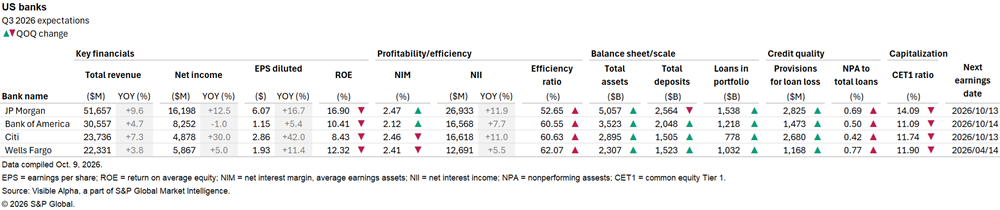
JPMorgan Chase & Co. (NYSE: JPM), Bank of America Corp. (NYSE: BAC), Citigroup Inc. (NYSE: C), and Wells Fargo & Co. (NYSE: WFC) are all expected to post higher revenue year-on-year in the third quarter. JPMorgan leads on expected revenue growth at 9.6% year-over-year in Q3, followed by Citi at 7.3%, Bank of America at 4.7% and Wells Fargo at 3.8%.
Earnings growth, however, varies sharply across the group. JPMorgan’s Q3 net income is expected to rise 12.5% year-on-year, while Citi is projected to deliver a 30% increase. Wells Fargo is expected to post more modest 5% growth, while Bank of America’s net income is expected to fall 1%.
Higher rates continue to support NII, but margin trends are diverging
Net interest income (NII) remains a key driver of earnings growth for the four banks, with aggregate NII expected to rise 9.6% year-on-year to $72.8 billion in Q3. But the underlying margin trends are diverging, highlighting different sources of earnings growth across the group.
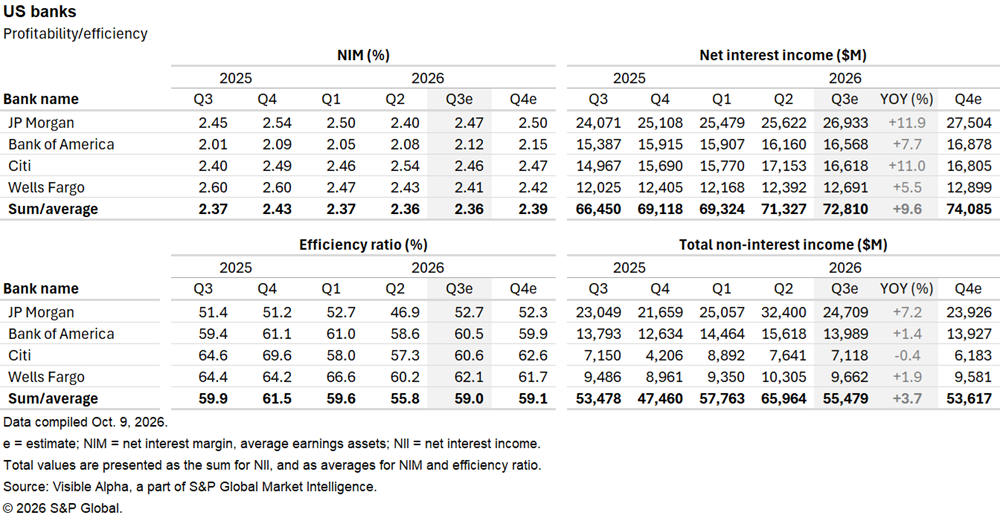
JPMorgan has the strongest NII outlook, while net interest margin (NIM) is forecast to recover in Q3. The combination of margin expansion and strong NII growth makes JPMorgan the clearest beneficiary of the current rate environment among the four banks.
Bank of America is also expected to see modest margin expansion, while NII is forecast to grow 7.7% year-on-year, pointing to continued support from both asset yields and balance-sheet growth.
Citi presents a different picture with NIM expected to decline to 2.46% in Q3, but NII is still forecast to grow 11% year-on-year, as balance-sheet growth helps offset some of the pressure on margins.
Wells Fargo faces the greatest margin pressure. NIM is expected to fall to 2.41% in Q3. NII growth is correspondingly weaker at an estimated 5.5%.
Balance-sheet growth remains supportive
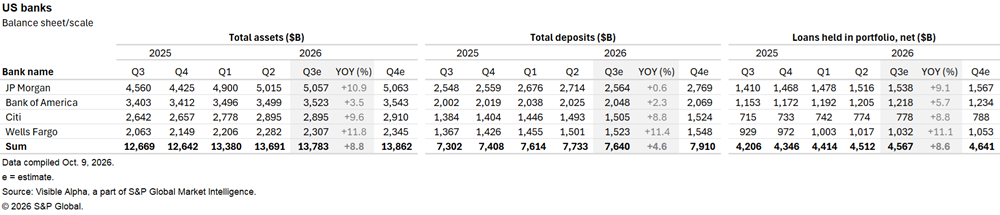
Q3 aggregate assets are forecast to rise 8.8% year-on-year to $13.8 trillion. Loan growth is expected to outpace deposit growth, pointing to continued demand for credit despite a higher-rate environment.
Aggregate loans held in portfolio are expected to increase 8.6% year-on-year to $4.6 trillion, compared with 4.6% growth in deposits to $7.6 trillion. The divergence is most pronounced at JPMorgan, where loans are expected to grow 9.1% and deposit 0.6%.
Credit costs remain controlled, but signs of normalization are emerging
Despite concerns around inflation and higher interest rates, analysts expect credit quality to remain broadly stable, although provisions are gradually normalizing from unusually benign levels. Analysts note that low unemployment, resilient consumer spending, and healthy commercial activity continue to support asset quality. However, reserve builds are beginning to reflect a more cautious outlook, especially in consumer portfolios.
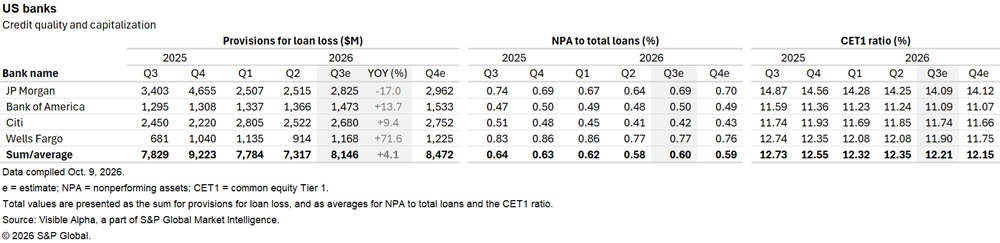
JPMorgan’s provisions for loan losses are projected to decline 17% in Q3, indicating limited reserve pressure despite higher rates. The bank’s capital position is expected to remain strongest among peers, although CET1 is expected to decline slightly to 14.1% as higher rates and AOCI pressure reduce excess capital.
Analysts expect Bank of America’s provision expense to rise 13.7% year-over-year and CET1 fall to 11.1%, reflecting a more conservative stance amid an uncertain rate environment.
Citi’s provision growth remains manageable at an estimated 9.4% in Q3 despite larger credit-card exposure, while CET1 remains relatively stable around 11.7%
Lastly, Wells Fargo’s provision growth is expected to be elevated in Q3 but largely reflects reserve normalization rather than deteriorating credit quality; CET1 is expected to moderate to 11.9%.
This article was published by Visible Alpha, part of S&P Global Market Intelligence and not by S&P Global Ratings, which is a separately managed division of S&P Global.
Content Type
Products & Offerings
Segment
