Research — October 8, 2026
Visible Alpha breakdown of US airlines’ Q3 2026 earnings expectations
By Hardik Dave and Mrunalini Oza
US airlines are heading into the third quarter with strong pricing and resilient travel demand, but a surge in fuel costs is threatening to widen the gap between revenue growth and profitability. Global fuel prices have been pushed higher by geopolitical tensions and supply concerns, raising jet-fuel costs for airlines even as demand for air travel remains strong. Visible Alpha consensus shows analysts expect revenue to rise 16%-22% year-over-year across six major US carriers, with revenue per available seat mile (RASM) increasing 12%-19%. Fuel expense, by contrast, is forecast to climb 55%-67%.
The cost pressure reflects a broader shock to the airline industry. International Air Transport Association (IATA) in their June Global Outlook for Air Transport report highlights expectations of jet-fuel prices averaging at $152 a barrel in 2026, almost 70% above 2025 levels, with fuel accounting for 31.4% of airline operating expenses, up from 25.4% last year. US carriers have responded by scaling back planned capacity growth and reconsidering less-profitable routes, even as booking trends and fares remain resilient.
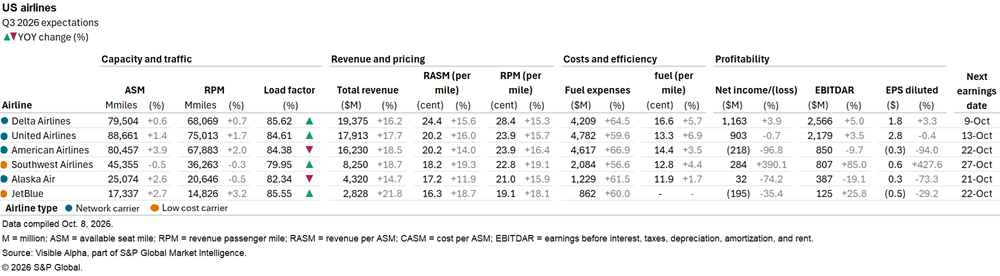
The effect is already visible in Visible Alpha consensus earnings expectations. Delta Air Lines Inc. (NYSE: DAL), which reports earnings on October 9, is expected to post 16.2% year-over-year revenue growth in Q3 to $19.4 billion, with RASM up 15.6%. Capacity and traffic are both expected to rise by around 0.7%, while fuel expense increases 64.5% to $4.2 billion. Net income is forecast to rise 3.9% to $1.2 billion, with EBITDAR up 5% and EPS up 3.3%. The relatively modest earnings growth compared with revenue growth illustrates how much of the pricing benefit is being absorbed by higher fuel costs. United Airlines Holdings Inc. (NASDAQ: UAL) shows a similar pattern, with revenue growth expected to outpace earnings growth as higher fuel costs absorb part of the benefit from stronger pricing.
The contrast is sharper at American Airlines Inc. (NASDAQ: AAL), where revenue is forecast to rise 18.5% to $16.2 billion in Q3 and RASM 14%, while fuel expense jumps 66.9%, the largest increase among the six carriers. Consensus points to a $218 million net loss and a 9.7% decline in EBITDAR.
Alaska Air Group Inc. (NYSE: ALK) faces an even tougher earnings outlook. Revenue is expected to increase 14.7%, with RASM up 11.9%, but fuel expense is forecast to rise 61.5%. Net income is expected to fall 74% to $32 million and EBITDAR by 19.1%. Traffic is also expected to weaken, with revenue passenger miles (RPM) down 0.5% despite 2.6% capacity growth. Alaska's relatively low revenue per seat mile remains a strategic challenge as it invests in higher-yielding premium and international flying.
Southwest Airlines Co. (NYSE: LUV) stands out as an exception. Revenue is forecast to rise 18.7% to $8.3 billion, while RASM increases 19.3%, the strongest gain in the group. Fuel expense is still expected to rise 56.6%, but net income is forecast to jump 390% to $284 million, with EBITDAR up 85% and EPS increasing more than fivefold to $0.60. The magnitude of the earnings improvement is partly a function of the low prior-year base. JetBlue Airways Corp. (NASDAQ: JBLU) is expected to post the fastest revenue growth in the group.
Capacity discipline supports pricing momentum
Visible Alpha consensus points to relatively tight capacity across the group. Aggregate available seat miles (ASM) are expected to increase 1.7% year-over-year n Q3, compared with a 1.2% increase in RPM. That modest capacity growth is helping carriers sustain higher fares and load factors, although Alaska and JetBlue are expected to see slightly lower load factors than a year earlier.
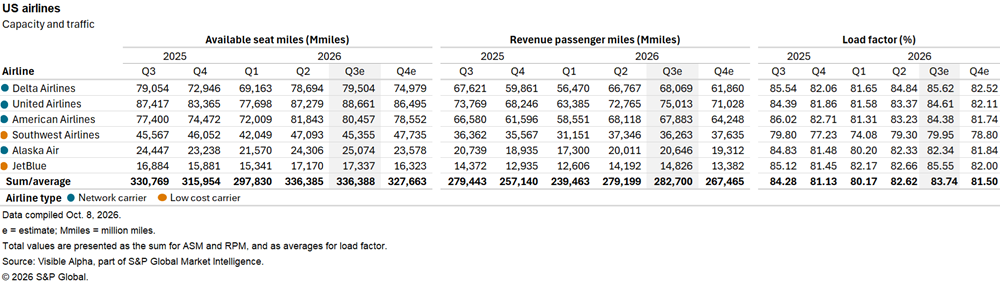
The capacity discipline is increasingly important as fuel costs rise. American, United and Southwest have already moved to reduce planned flying in response to higher fuel prices, prioritizing profitability over market-share gains.
Pricing remains the main driver of revenue growth
Passenger revenue across the six carriers is expected to increase about 18% year-over-year to $60.8 billion, while average RASM rises 15.8% to 19.42 cents. Yield is forecast to increase 16.6% to 23.19 cents, with Delta retaining the highest yield at an estimated 28.44 cents in Q3. Southwest and JetBlue are expected to record some of the strongest year-over-year pricing gains.
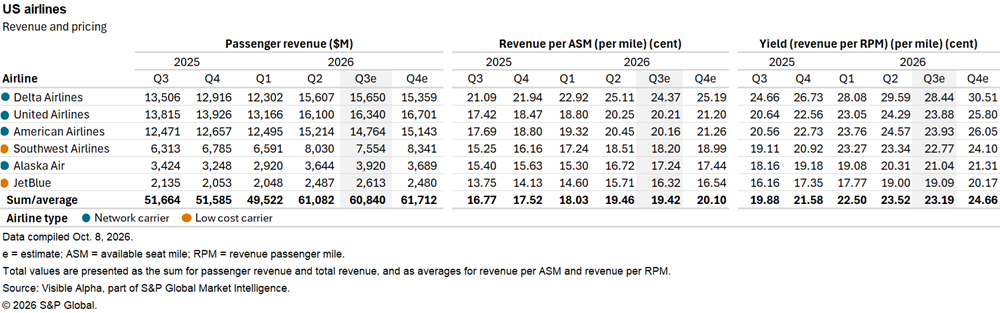
The sequential picture is less striking, however, with pricing momentum expected to moderate at several carriers following a strong second quarter.
Fuel costs widen the earnings divide
The key question going into earnings is whether pricing gains can keep pace with fuel inflation. Aggregate fuel expense across the six carriers is forecast to rise 62.3% year-over-year to $17.8 billion, far exceeding the roughly 8% increase expected in aggregate employee costs. Non-fuel unit costs are more contained, with average cost per available seat mile excluding fuel (CASM ex-fuel) forecast to increase 4.5% to 13.80 cents.
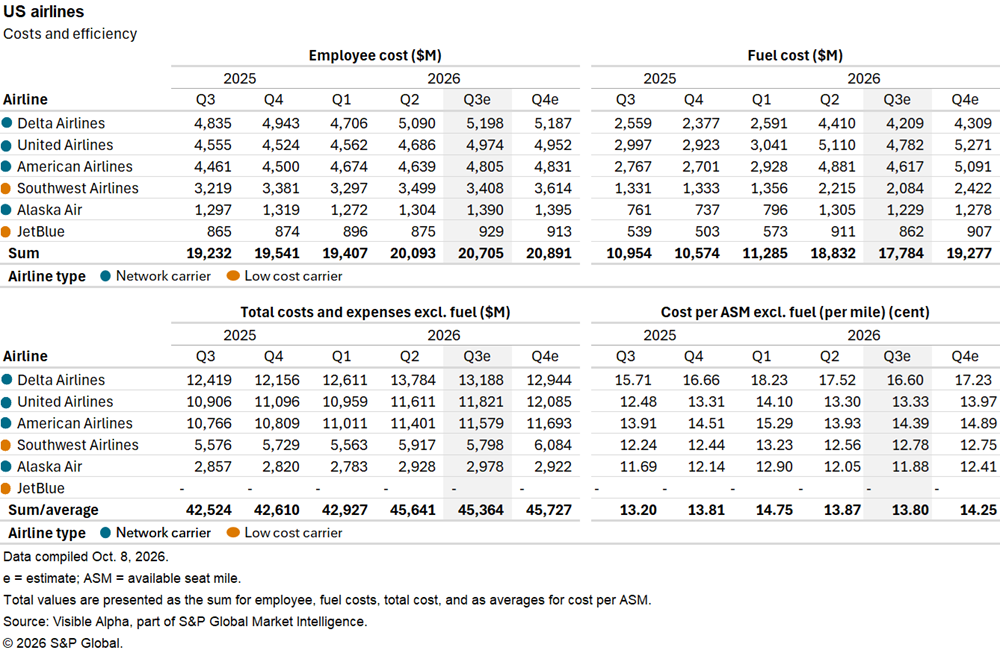
That divergence is producing very different earnings outcomes. Delta and United are expected to remain the strongest performers, while Alaska's earnings fall. American and JetBlue are expected to remain loss-making.
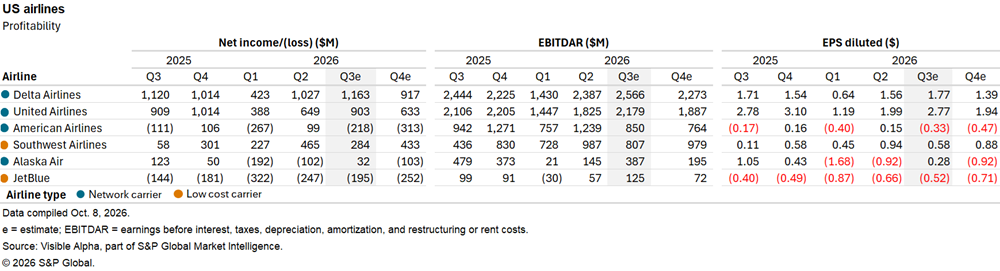
Overall, consensus points to a strong revenue quarter but a far more uneven earnings picture. Resilient demand, constrained capacity and higher fares are supporting the top line, but the fuel shock is preventing that growth from flowing through proportionately to profits.
This article was published by Visible Alpha, part of S&P Global Market Intelligence and not by S&P Global Ratings, which is a separately managed division of S&P Global.
Content Type
Products & Offerings
Segment
