Research — Oct 22, 2026
Skydance inherits blockbuster potential and volatility with Warner Bros. Games

By Neil Barbour
Skydance Corp. has emerged from the Warner Bros. Discovery Inc. merger with a gaming operation far larger and more commercially established than the one it built internally. The combined portfolio includes developers behind Hogwarts Legacy, Mortal Kombat, the Batman: Arkham series and the LEGO games, alongside Skydance’s existing virtual-reality operation and its newer narrative-focused studio.

Skydance has made gaming a stated growth priority and consolidated its inherited development assets into a broader Games and Experiences division. That answers the strategic question, but not the financial one. Warner Bros. Games has produced some of the industry's largest hits, yet its recent performance shows how quickly results can deteriorate when the release calendar thins or a major title misses expectations. Skydance now has the franchises and development scale to build gaming into a larger cross-media business, but the data makes a case for selective investment, shared development risk and greater use of licensing or publishing partnerships rather than maintaining every studio and project under a fully financed internal model.

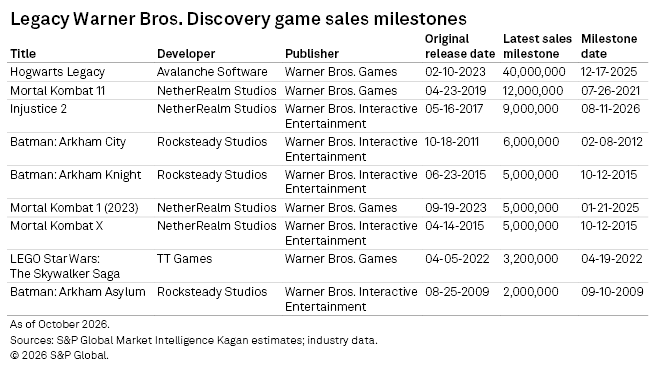
There is considerable value in the acquired assets. Hogwarts Legacy has sold 40 million copies, according to the latest milestone. Mortal Kombat 11 surpassed 12 million copies, while Injustice 2 exceeded 9 million. Several Batman: Arkham titles also cleared 5 million copies.
The difficulty is converting that intellectual property into a steadier business.
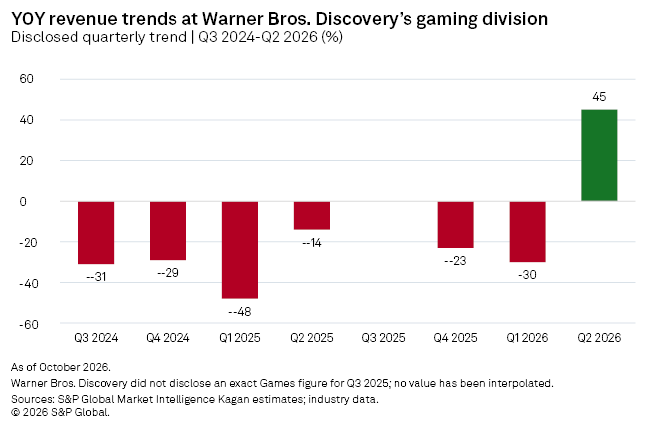
Warner Bros. Discovery's recent results reveal how quickly games revenue can turn when the release schedule weakens. Games revenue established a steady cadence of year-over-year decline stretching back to the third quarter of 2024, which it didn't break until the second quarter of 2026.
Those swings were closely connected to individual releases. Hogwarts Legacy and Mortal Kombat 1 delivered results in 2023 and early 2024, creating difficult comparisons when the slate thinned. Suicide Squad: Kill the Justice League subsequently performed poorly against the prior-year success of Hogwarts Legacy. Warner Bros. Discovery recorded $122 million of games impairments in the third quarter of 2024 and another $50 million in the fourth quarter, contributing to a full-year total of $384 million. The May 2026 release of LEGO Batman: Legacy of the Dark Knight helped reverse the revenue decline in the second quarter.
The pattern is familiar across premium console and PC gaming. Development consumes capital for years, but a publisher may have only a handful of major releases available to produce revenue in a given period.
Library sales can soften the gaps, although Warner Bros. Discovery also pointed to falling library revenue as a drag in the first quarter of 2026. The company has consistently included games within its Studios segment rather than providing stand-alone revenue, profit or development-spending guidance, making the underlying economics difficult to isolate.
Skydance brings a somewhat different history to the combined portfolio. Skydance Interactive established experience in virtual reality (VR) through games including The Walking Dead: Saints & Sinners and BEHEMOTH. However, VR has moved away from its prospects as a high-volume gaming peripheral and into a prosumer curiosity, likely ending any big breakout success potential for the segment.
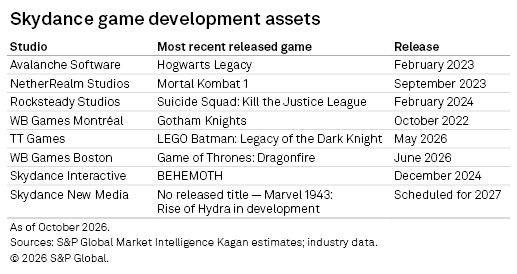
Skydance New Media, led by Amy Hennig, has pursued larger, narrative-driven projects based on major licensed properties. Its pipeline includes Marvel 1943: Rise of Hydra and a collaboration with Lucasfilm Ltd. LLC on a Star Wars game.
The emphasis fits Skydance’s broader transmedia strategy. At the 2024 Game Developers Conference, Amy Hennig demonstrated how Marvel 1943 was using Unreal Engine to render its actors and build detailed environments. The pitch centered on cinematic presentation, character and narrative rather than recurring monetization.
That approach provides a logical creative match with Warner Bros. Games, where many of the strongest assets are tied to film, television and publishing properties. The merger also gives Skydance development and publishing infrastructure that would have taken years to assemble organically. Avalanche Software LC, Netherrealm Studios, Rocksteady Studios Ltd., WB Games Montréal and TT Games Ltd supply experience across role-playing, fighting, action and family-oriented games.
However, the combination does not fundamentally remove hit risk. Both sides remain heavily exposed to premium, production-intensive games. Adding studios creates more shots on goal, but it also increases the number of costly projects requiring disciplined greenlighting and portfolio management.
It's worth noting here that Marvel 1943 has been delayed multiple times, most recently to 2027. It's possible that Warner's development assets may help speed along production, but it's also possible that the game never materializes.
Industry investors and acquirers have recently concentrated capital in proven platforms, established audiences and recurring ecosystems rather than traditional console and PC development. Skydance could follow a similar model by reserving internal investment for the franchises with the strongest commercial prospects while using licensing, co-development and publishing partnerships to retain exposure to a broader slate without carrying the full cost and risk of every project.
The opportunity for Skydance is to build a release cadence that makes better use of Warner Bros.’ catalog between major launches while applying tighter discipline to new development. The enlarged portfolio clearly has the intellectual property to create hits. Its more important test will be whether those hits can support a business that is less volatile between them
Economics of Streaming Media is a regular feature from S&P Global Market Intelligence Kagan.
This article was published by S&P Global Market Intelligence and not by S&P Global Ratings, which is a separately managed division of S&P Global.
Content Type
Theme
Segment
Language