Research — Sep 25, 2026
Gold leads in global new mine additions since 2020

By Cesar Pastrana
Gold prices have climbed to historic highs, yet the industry is facing a quiet crisis: New major gold discoveries continue to trend lower. S&P Global Energy's annual review identified 371 gold deposits discovered between 1990 and 2025, containing a combined 3.2 billion ounces of gold in reserves, resources and past production. Compared with our 2025 study, this represents a 7% increase, or 251 million oz, in contained gold — more than half of which came from older, known deposits.
The S&P Global Energy major discoveries dataset includes all deposits containing at least 2 million oz of gold in reserves, resources and past production. The year of discovery corresponds to the initial drill program that identified potentially economic mineralization that eventually resulted in a reserve or resource estimate meeting, or exceeding, the threshold.

➤ S&P Global Energy identified 371 major gold deposits discovered between 1990 and 2025, containing a combined 3.2 billion oz of gold in reserves, resources and past production.
➤ Despite record-high gold prices and stronger exploration budgets, new major gold discoveries remain scarce, with only a limited number of recent discoveries reaching the 2 million oz threshold.
➤ Exploration activity continues to shift toward known assets, minesite expansion and lower-risk resource growth, rather than frontier greenfield discovery.
➤ The lack of large discoveries raises longer-term supply concerns, as producers balance resource replacement, capital discipline and shareholder returns.

In addition to analyzing past major discoveries, S&P Global Energy examined the future discovery pipeline using initial resource announcements, as tracked monthly in the Industry Monitor series. Excluding announcements for new zones at discoveries already included in our major discoveries list, we identified 258 initial resource announcements from 2020 to 2025, containing a total of 189 million oz of new gold. Only 115 of these announcements, or 45%, were from greenfield assets, with the remainder coming from newly discovered zones or deposits within existing projects — further highlighting the industry's preference for exploring known assets.
Detailed data on these gold discoveries can be found in the accompanying Excel spreadsheet.
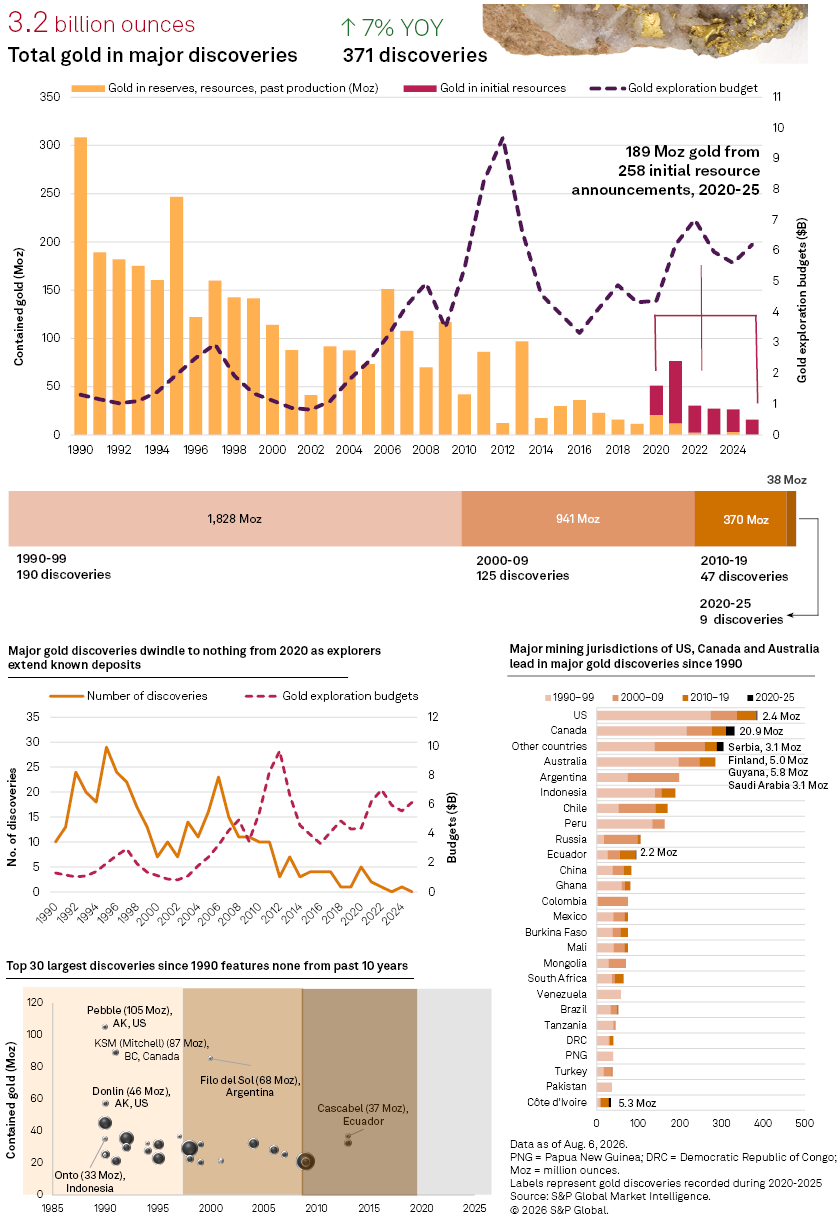
Many of the insights from our 2025 analysis still hold true. The pipeline for new discoveries is becoming thinner: Since 2020, only 9 deposits have reached the major discovery threshold, contributing just 38 million oz of gold in reserves, resources and past production. By comparison, major discoveries made during 1990-95 contain 1.3 billion oz, while those during 2000-05 contain 496 million oz, more than 10 times the post-2020 total. This underscores the widening gap between strong market conditions and the industry's ability to generate new large-scale discoveries. It is important to note that while significant recent discoveries are limited, reserves and resources tend to grow over time.
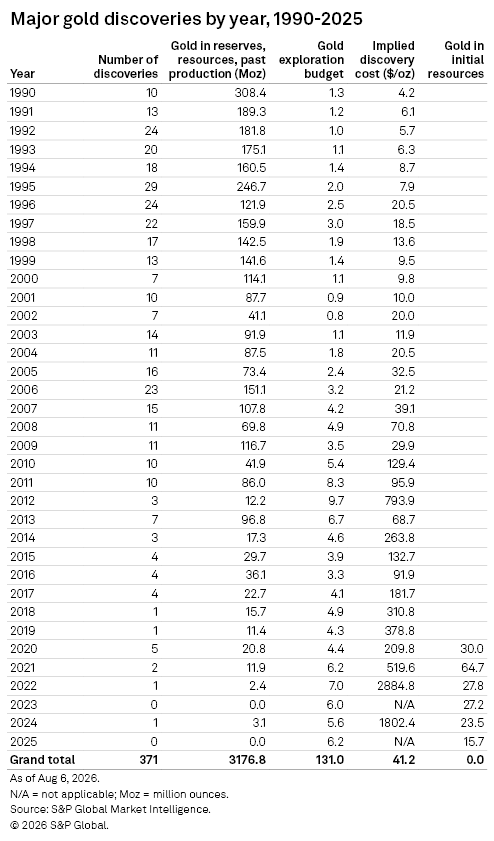
The scarcity comes despite a much stronger gold price environment. Gold has rallied sharply over 2023-26, surpassing $5,000/oz in early 2026. Although prices retreated during the June quarter, the year-to-date average remains more than double the 2023 average, when gold first sustained levels above $2,000/oz.
This cautious approach can also be observed in financing trends, with junior and intermediate companies entering new highs in capital raising. Much of this was allocated to project development, mine construction and production ramp-ups, however, rather than grassroots exploration. This means that the impact of stronger capital raising on the search for new discoveries was limited.
This shift toward lower-risk resource growth has been evident across the industry for much of the past decade and is not limited to gold. As companies prioritize resource expansion, mine-life extensions and projects with clearer development pathways, fewer funds are being directed toward greenfield exploration, where the next generation of major discoveries is most likely to emerge.
While the solution may seem simple — invest more in greenfield exploration — the reality is more challenging. Many of the world's most accessible, high-grade gold deposits have already been found, forcing today's explorers to search deeper underground, interpret more complex geology or venture into remote and underexplored regions with steeper logistical challenges. Consequently, recent major discoveries are getting smaller. The average size of a major gold discovery made since 2020 is 4.3 million oz, down sharply from the 7.3 million oz average of the 2010s. Notably, not a single discovery made in the past decade ranks among the 30 largest gold deposits ever found.
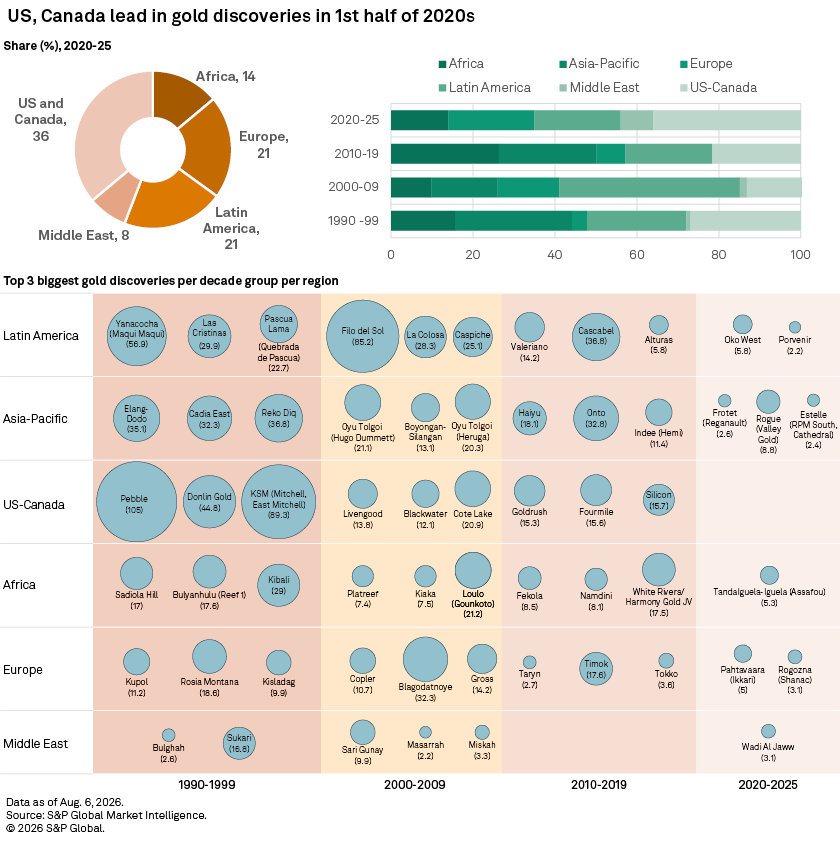
US, Canada, Australia dominate major gold discoveries since 1990
Explorers' preference for lower-risk jurisdictions remains clear. Since 1990, most major gold discoveries have been concentrated in the US, Canada and Australia. Their favorable geology, extensive historical data, established exploration ecosystems and mining-friendly regulatory frameworks have attracted sustained investment and enabled the discovery of larger deposits there than in regions with greater geological, logistical or regulatory challenges.
What does it mean for gold's future?
The discovery challenge has become increasingly technical and costly. Many of the most prospective and accessible terrains have already been extensively explored, requiring deeper drilling, more sophisticated geological models and exploration in jurisdictions with greater logistical and permitting challenges. As a result, high-quality gold discoveries are becoming harder, deeper, more expensive and riskier to find, while companies increasingly favor lower-risk resource growth at existing assets.
This trend has significant implications for future supply. Recent studies show that the average timeline from discovery to production has extended to 16 years, significantly longer than in previous decades, further constraining the industry's ability to replace depleted reserves quickly. The challenge is no longer just a question of where the next deposits will be found, but whether the industry is prepared to move them through the pipeline fast enough. While brownfield growth can extend mine life and protect near-term output, it cannot fully replace the long-term value created by new, large-scale discoveries.
While low discovery rates do not pose an immediate threat to global gold supply, they increase the risk of a future production shortfall. As the pipeline of large, high-quality deposits shrinks, existing supply becomes more valuable. This growing scarcity provides long-term support for gold prices and intensifies competition for advanced development projects and high-quality assets.
That leaves governments, producers, explorers and investors with a narrowing window to act. Without stronger support for discovery, permitting, financing and development, today's weak discovery pipeline could harden into a more persistent supply constraint, leaving the gold market increasingly dependent on aging assets at a time when demand for safe-haven reserves remains strong.
This article was published by S&P Global Market Intelligence and not by S&P Global Ratings, which is a separately managed division of S&P Global.