Research — October 13, 2026
Dow Jones Industrial Average Monitor update – A look at 30 US large-caps

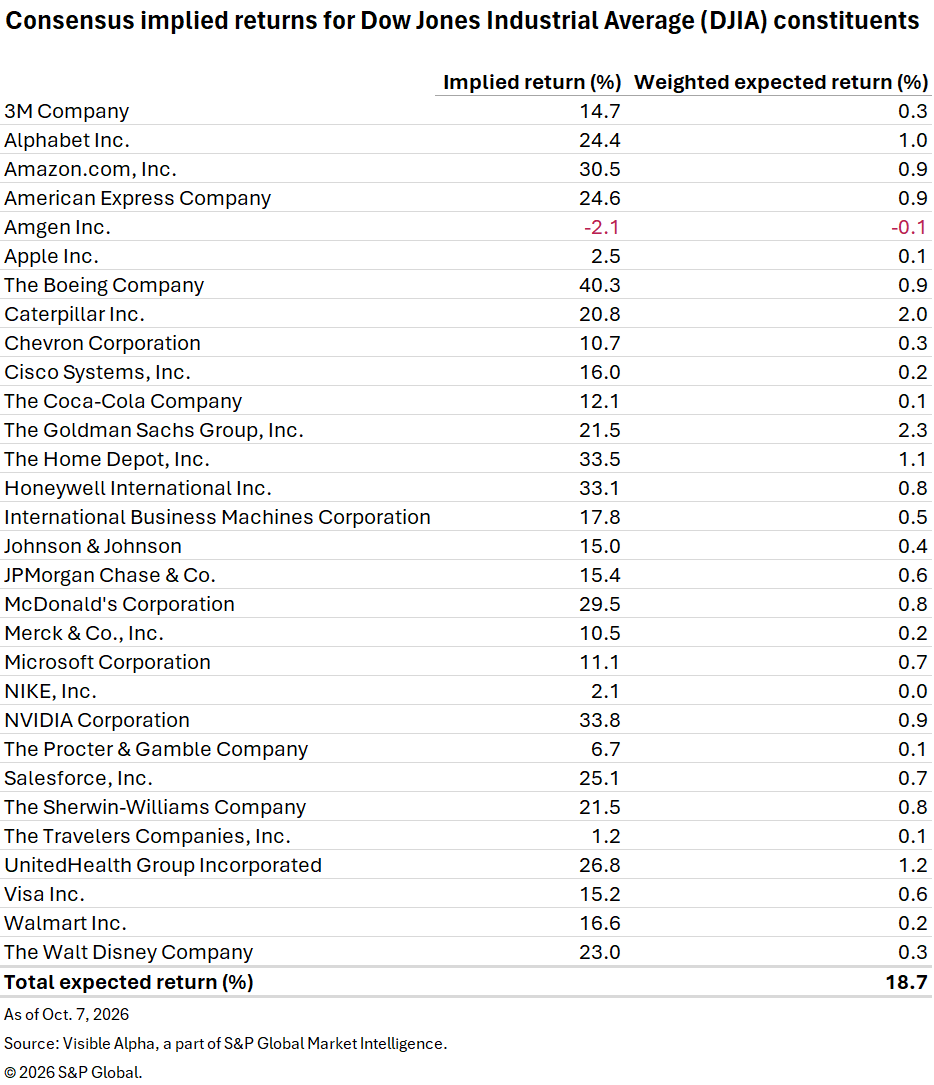
Visible Alpha consensus expects the Dow Jones Industrial Average (DJIA) to deliver an 18.7% weighted price return in the medium term, based on the post-earnings-season direction of consensus for the index's 30 companies. The sector-specific issues vary significantly, and stock selection has been rewarded year-to-date. The index is being driven by solid earnings growth, particularly in the AI trade, energy and health care, as consumer discretionary and software companies have struggled. Questions remain about the full impact of the Middle East tension and the rising-rate environment, and companies and investors have been forced to adjust to a rapidly changing landscape.
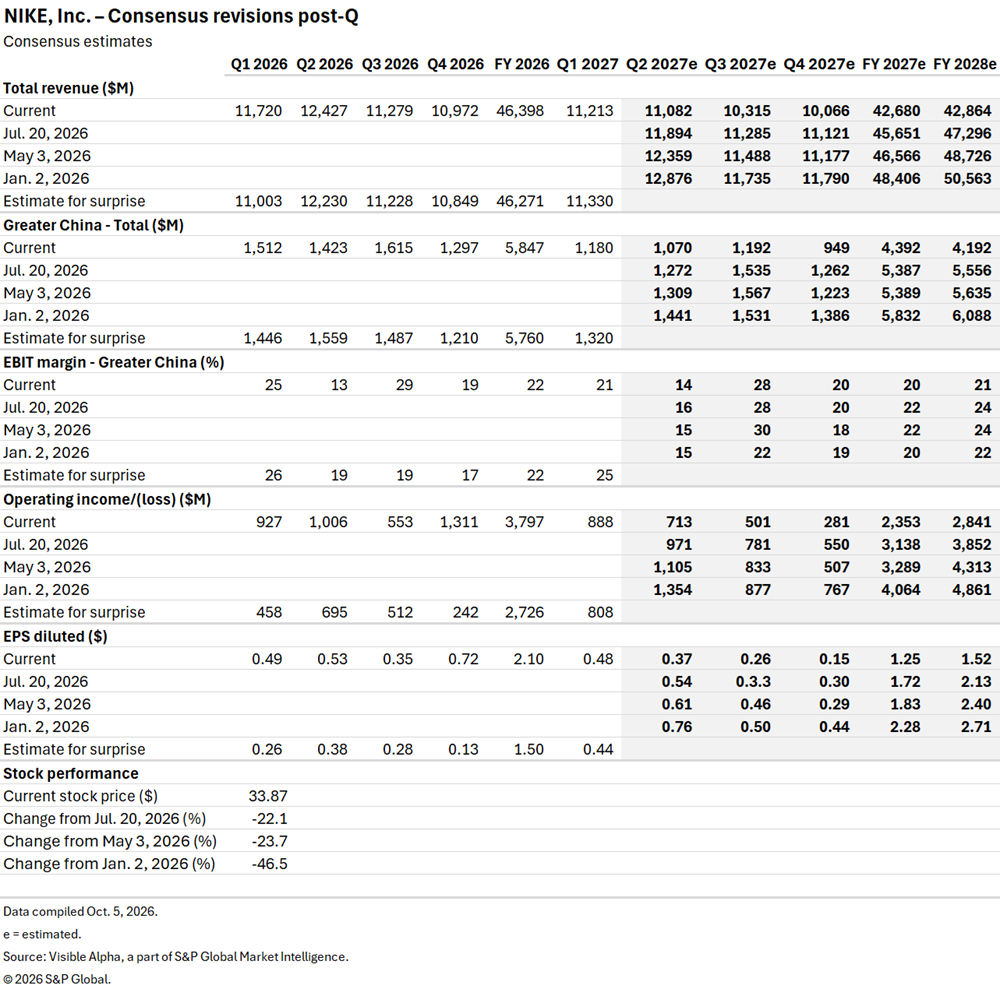
Nike Inc. was the worst performer in the DJIA in the past 12 months, due to a slower-than-expected turnaround. Consensus for 2028 EPS has been revised down to to $1.52 in 2028 from $2.71 per share. McDonald's Corp.’s and The Home Depot Inc. have also underperformed and been a drag on the overall index, but downward revisions to 2028 have been less severe. Looking toward 2027, consumer stocks that successfully navigate a turnaround may be an opportunity.
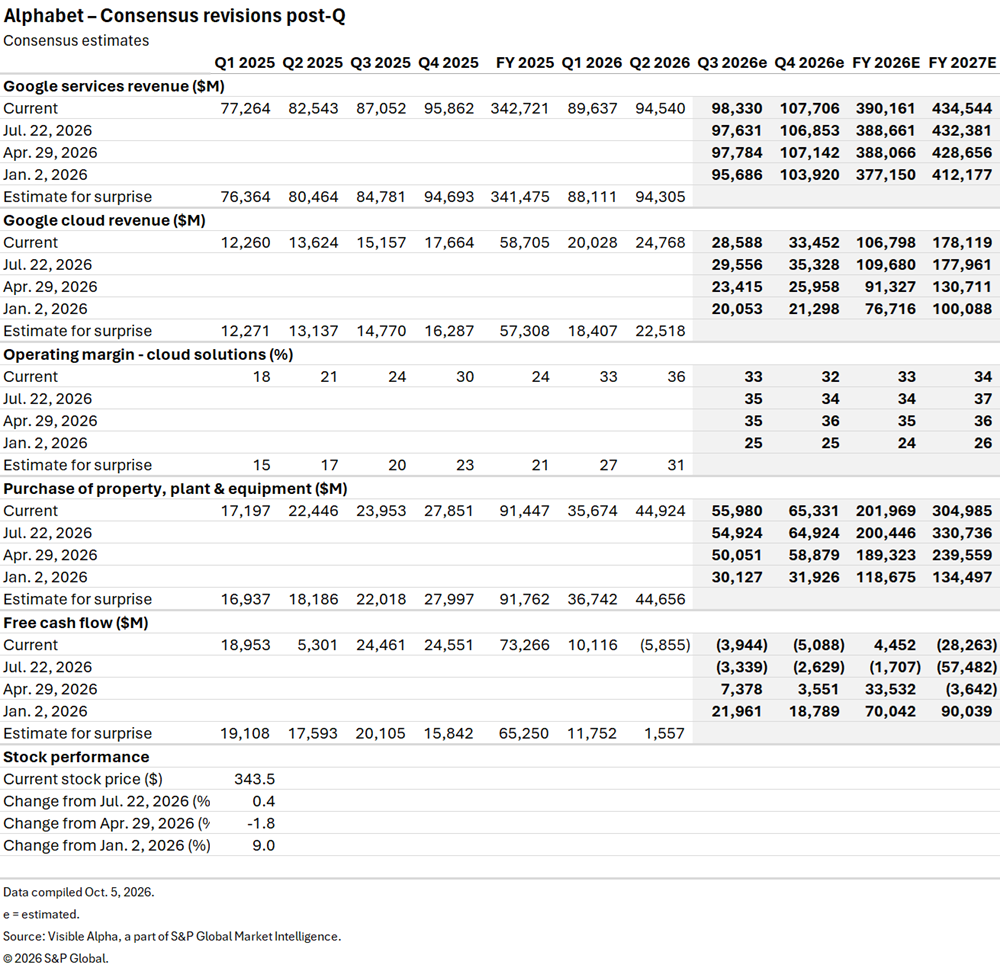
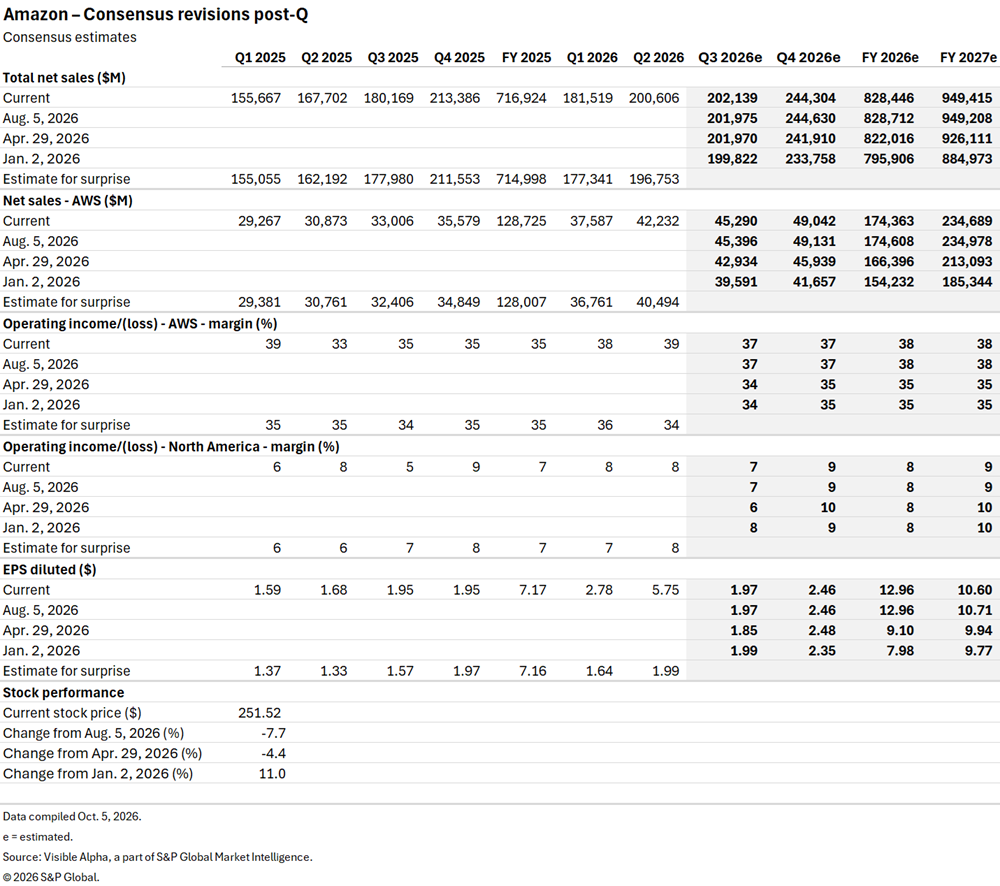
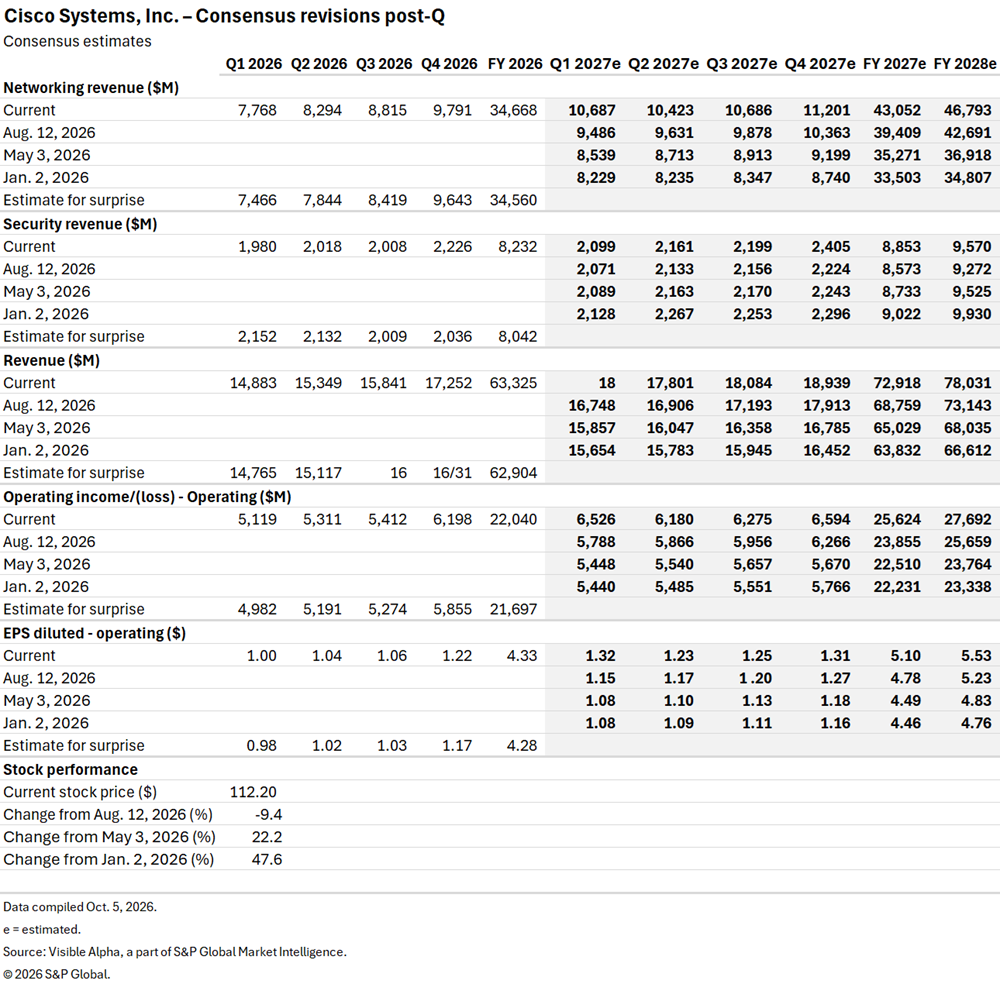
Alphabet Inc., Amazon.com Inc. and Microsoft Corp. have underperformed the index in 2026 to-date. This is due in part to the high capex spending for AI infrastructure build-out. Alphabet and Amazon are expected to generate negative free cash flow this year and next. The increasing levels of capex on AI investments by these companies have not yet been matched by equal increases in revenue or returns. With capex for AI infrastructure expected to increase this year, capex beneficiary, NVIDIA Corp., has been outperforming due to the company’s massive share buyback and dividend plan. Cisco Systems Inc. has also seen strong price appreciation.
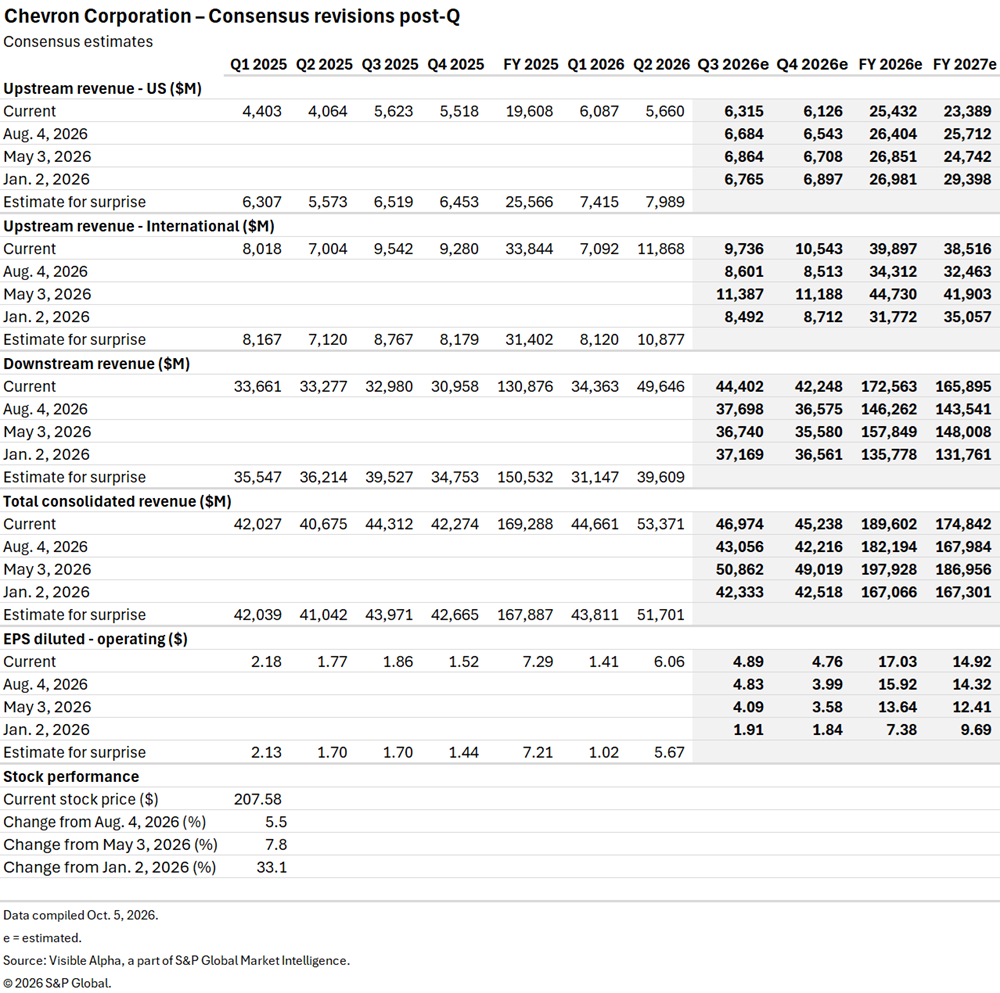
Industrial and energy companies, Caterpillar Inc. and Chevron Corp., have been notable outperformers year-to-date due to upward revisions to consensus. Health care companies, Johnson & Johnson, Amgen Inc. and Merck & Co. Inc., have collectively driven increases in the index year-to-date, due to increases to consensus. A rotation is apparent, supported by continued increases in expectations in non-technology market areas.
A prolonged increase in energy prices, due to the conflict in the Middle East, may continue to weigh on consumers. S&P Global Market Intelligence Inc. expects the Fed to retain a strong tightening bias, at least in the near term, but ultimately remain on hold as inflation gradually cools. The Fed resumes the easing cycle late next year, with cuts in September and December, followed by one more in June 2028, bringing the policy rate to our estimate of neutral. The outlook for Q4 2026 and FY 2027 may support a broader set of sectors, depending on growth and the severity and sustainability of the Middle East conflict on the macro backdrop. The consumer sector may be well-positioned for a mean-reversion move.

Alphabet
Post Q2 commentary
Alphabet Inc. raised its FY2026 capex guidance to $195 billion–$205 billion, from the previous $180 billion–$190 billion, and well above the pre-results Visible Alpha consensus of $187.8 billion. Around 60% of planned spending is said to be directed toward servers, with the remaining 40% allocated to data centers and networking equipment. Management also indicated that capex is expected to increase further in 2027 as Alphabet expands AI compute capacity.
The company cautioned that Q3 operating margins will face modest pressure as it supplements its own infrastructure with higher-cost third-party cloud capacity to address supply constraints. Management also flagged tougher year-over-year Search comparisons and a modest foreign exchange headwind affecting Search and YouTube advertising revenue.
Free cash flow is also expected to remain under pressure as AI infrastructure investment remains elevated.
Alphabet at Goldman Sachs Communacopia + Technology conference 2026
AI is moving from experimentation toward scaled adoption, with Google Cloud seeing larger deals, more customer wins and deeper wallet share. Its differentiation is the full-stack AI offering - TPUs/GPUs, Gemini, data, cybersecurity and enterprise applications, which allows it to monetize AI across multiple layers. Gemini Enterprise and AI agents are also increasing product usage and customer lifetime value, suggesting AI could become a meaningful accelerator for cloud growth.
Amazon
Post Q2 commentary
Amazon.com Inc. expects Q3 net sales of $197 billion–$202 billion, implying 9%–12% year-over-year growth and below the pre-quarter Visible Alpha consensus of $203.9 billion. Q3 operating income is expected at $22.5 billion–$26.5 billion, versus the pre-quarter consensus of $25.4 billion, partly reflecting the shift of Prime Day from Q3 to Q2.
Capex is the bigger strategic signal. Amazon raised its FY2026 capital expenditure outlook to approximately $220 billion, above Visible Alpha preQ consensus of $206.1 billion. Management attributed the higher spending primarily to continued AI infrastructure investments, including data centers, servers and networking equipment.
American Express
Post Q2 commentary
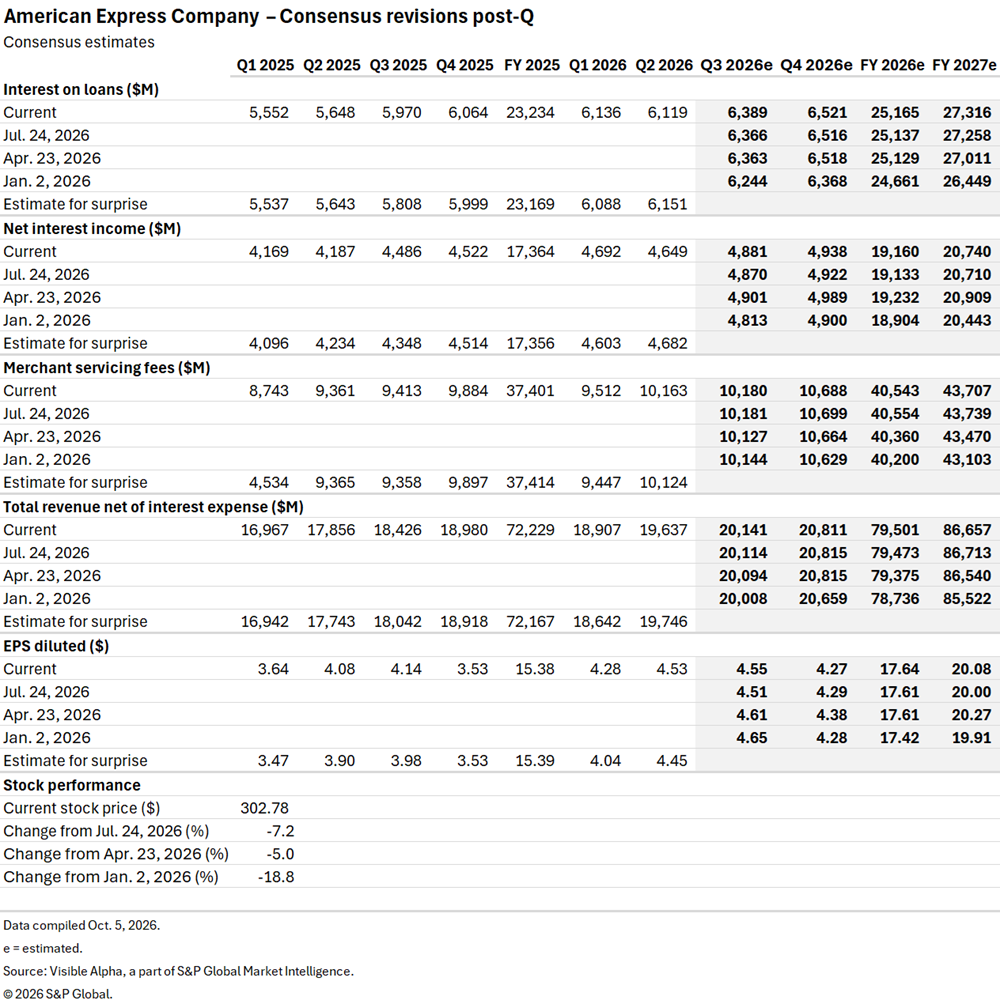
American Express Co. management raised its full-year revenue growth outlook to approximately 10%, broadly in line with the 10.2% pre-quarter Visible Alpha consensus expectations, and reaffirmed diluted EPS guidance of $17.30-$17.90, consistent with the $17.72 pre-quarter Visible Alpha consensus.
Amgen
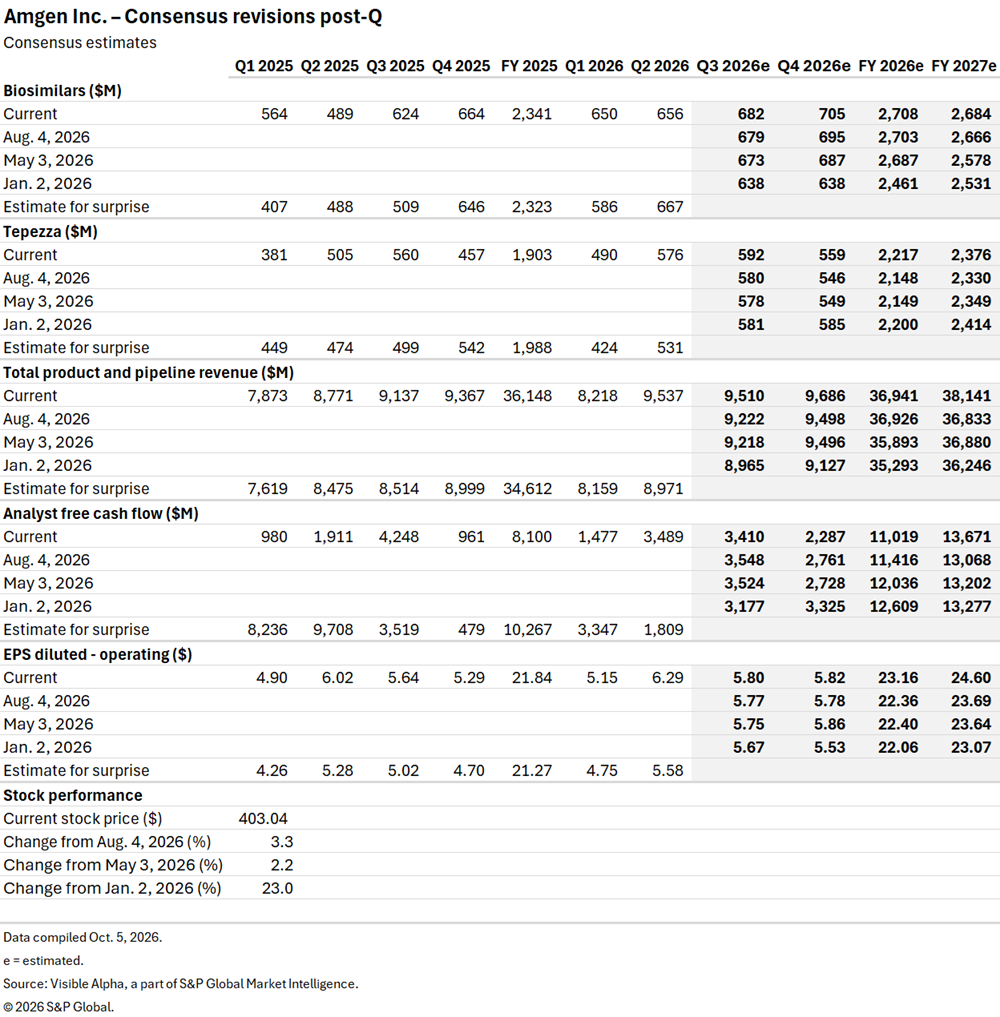
Post Q2 commentary
Following Q2 2026 results, Amgen Inc. management maintained its FY2026 outlook, expecting total revenue of between $38.2 billion and $39.4 billion, above pre-quarter Visible Alpha consensus of $37.8 billion, and GAAP EPS of $15.80–$17.08, above pre-quarter consensus of $15.08. Non-GAAP EPS guidance of $22.30–$23.50 is broadly in line with the $22.36 consensus, while capital expenditure of approximately $2.6 billion is above the $2.4 billion pre-quarter consensus.
Amgen at Morgan Stanley’s 24th Annual Global Healthcare Conference 2026
Management highlighted continued portfolio momentum, with Q2 revenue up 10% year over year to more than $10 billion. This was driven by six key growth products, which grew 26%.
Management identified IMDELLTRA as a major oncology catalyst following positive Phase III data and reduced FDA monitoring requirements. The pipeline is also supported by MariTide, olpasiran and dazodalibep. MariTide could differentiate through durable efficacy and less-frequent dosing, potentially every 8–12 weeks, while biosimilars targeting KEYTRUDA, OPDIVO, OCREVUS and EYLEA HD offer additional growth opportunities. Capital allocation is focused on internal innovation, commercial investment, and manufacturing, with selective external deals under consideration.
Apple
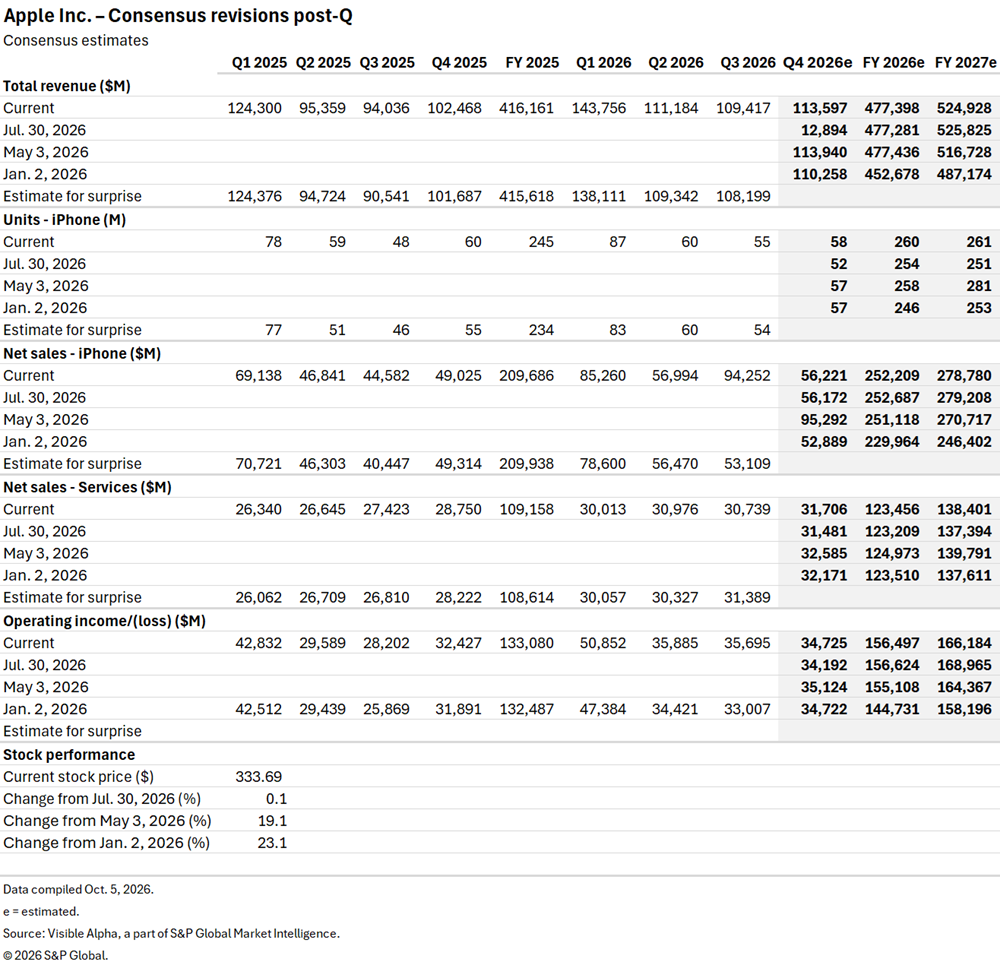
Post Q3 commentary
Apple Inc. management expects Q4 revenue growth of 9%–11% year-on-year, including mid-teens iPhone revenue growth, despite an approximately 2.5 percentage-point foreign-exchange headwind.
The more important signal for investors is the supply outlook. Apple expects significantly higher supply constraints across iPhone, Mac and iPad because of limited availability of advanced-node chips.
Services growth is expected to remain broadly in line with Q3 at approximately 12%.
Q4 gross margin is expected at 47%–48%, including an approximately one percentage-point benefit from tariff refunds. The sequential margin decline reflects, in part, rising memory costs, which management expects to remain a significant headwind into the September quarter and beyond.
Apple product event
Apple’s event centered on making the iPhone an “intelligent personal hub,” with AI and personal context increasingly integrated across its ecosystem. The company launched iPhone 18 Pro/Pro Max with the A20 Pro chip, improved battery/thermal performance and a 48MP variable-aperture camera, while expanding Siri AI to understand personal context and take action across apps. AirPods 5 added ANC, improved audio (noise cancellation), Siri AI and Live Translation, while Apple Watch Series 12/Ultra 4 introduced more advanced health sensing, Readiness and new Audio Intelligence features.
The biggest announcement was iPhone Duo, Apple’s first foldable iPhone, combining a 7.6-inch inner display with a 5.4-inch outer display and a redesigned iOS 27 experience focused on multitasking and the foldable form. It also brings A20 Pro performance, new camera capabilities and Apple Pencil support.
Boeing
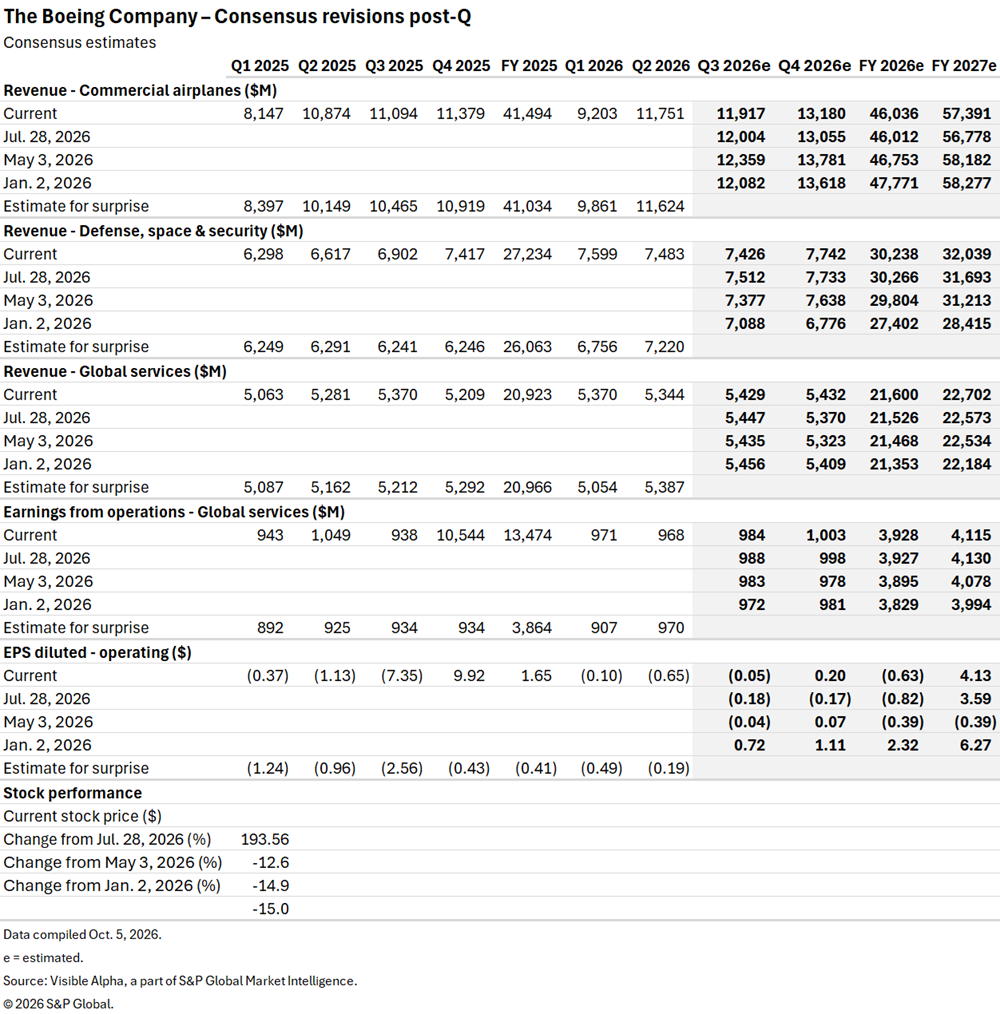
Post Q2 commentary
Following Q2 2026 results, The Boeing Co. management did not provide formal full-year financial guidance, instead highlighting execution on production and certification programs. The company is focused on improving operational stability and delivering against its record $715 billion backlog.
Boeing at Morgan Stanley’s 14th Annual Laguna Conference 2026
Boeing highlighted improving operational stability and progress across its commercial and defense businesses. 737 MAX production is at 47 aircraft per month, with a target of 52 per month in 2027. 787 production remains at eight per month due to engine constraints, and is expected to reach 10 per month toward year-end. MAX 10 certification is nearing completion, with 777X deliveries targeted for 2027, though certification remains a risk.
Management maintained its 2026 free cash flow guidance of $1 billion–$3 billion and expects cash flow to improve in 2027, supported by higher commercial deliveries, improved profitability in Boeing Defense, Space & Security (BDS), and growth in Boeing Global Services (BGS). Longer term, Boeing reiterated its path toward approximately $10 billion of free cash flow at normalized production rates, while defense margins are expected to improve toward the high single digits by the end of the decade.
Caterpillar
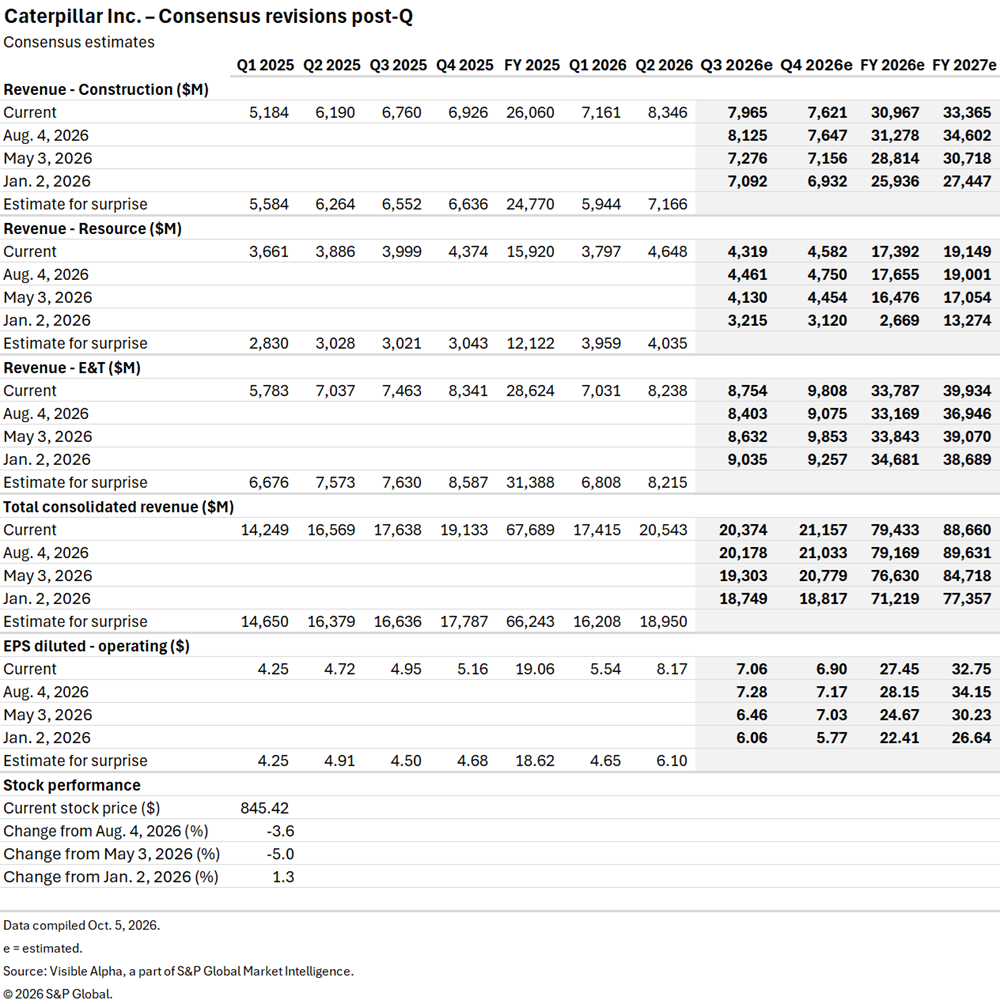
Post Q2 commentary
Following Q2 2026 results, Caterpillar Inc. management raised its FY2026 outlook, now expecting sales and revenue to grow in the mid-to-high teens, supported by strong demand across its three primary segments and increased capacity throughput.
For Q3 2026, management expects strong year-over-year sales and revenue growth, driven by higher volumes and favorable price realization.
Special call
Caterpillar's outlook is strongly constructive. The most significant near- to medium-term growth driver is the power-generation cycle associated with AI and data centers, but management emphasized that the opportunity is much broader—covering natural gas infrastructure, oil & gas, mining, construction rental and services. CAT has strong visibility beyond the reported backlog, is expanding capacity in a measured way, and believes its diversified engine applications and premium positioning reduce the risk of an eventual power market oversupply. At the same time, commercial excellence, rental, services and technology adoption are intended to make the broader CAT franchise more resilient and improve returns through the cycle.
Chevron
Post Q2 commentary
Following Q2 2026 results, Chevron Corp. management maintained its FY2026 organic capital expenditure guidance of $18 billion–$19 billion, with spending expected at the low end of the range. Permian capital spending is expected to remain below $3.5 billion. Management also expects $3 billion–$4 billion in annual structural cost reductions and anticipates 150–200 MBOED (thousand barrels of oil equivalent per day) of upstream turnaround and downtime impacts, along with $175 million–$225 million of after-tax downstream turnaround impacts, in Q3 2026.
Chevron at JP Morgan's Natural Resources Conference 2026
Chevron reiterated that its long-term strategy is unchanged despite geopolitical and market volatility, emphasizing disciplined capital allocation and consistency.
In the Q&A, management said New Energies investment will be guided by scalability, customer demand, and shareholder returns, with greater focus on power infrastructure and lithium, and a measured approach to hydrogen and CCS. The company expects to make a final investment decision on its Microsoft-backed West Texas power project before the end of 2026 and provide additional details during its Q2 earnings call.
Management also highlighted AI's growing role in exploration, where it is reducing seismic interpretation times and improving exploration success rates, and expressed confidence in Chevron's long-term production growth and free cash flow outlook following the Hess acquisition.
Cisco
Post Q4 commentary
Following Q4 FY2026 results, Cisco Systems Inc. management initiated FY2027 guidance, expecting revenue of $72.2 billion–$73.4 billion and non-GAAP EPS of $5.05–$5.11, both above pre-quarter Visible Alpha consensus. For Q1 FY2027, management expects revenue of $18.0 billion–$18.2 billion and non-GAAP EPS of $1.32–$1.34, also above pre-quarter consensus.
Cisco at Goldman Sachs Communacopia + Technology conference 2026
Cisco sees AI driving a multiyear networking supercycle, as AI workloads require substantially more network bandwidth and infrastructure upgrades. Hyperscaler AI orders increased to $9.3B from from $2.3B over the past two years, including $4B in Q4 alone. Importantly, demand is broadening beyond hyperscalers into neoclouds, sovereign clouds, service providers and enterprises, while the installed base creates a significant refresh opportunity. Cisco is also becoming more integrated across networking, Silicon One, security, observability and AI, positioning the company to capture both infrastructure spending and the growing need to secure AI-driven networks.
Coca Cola
Post Q2 commentary
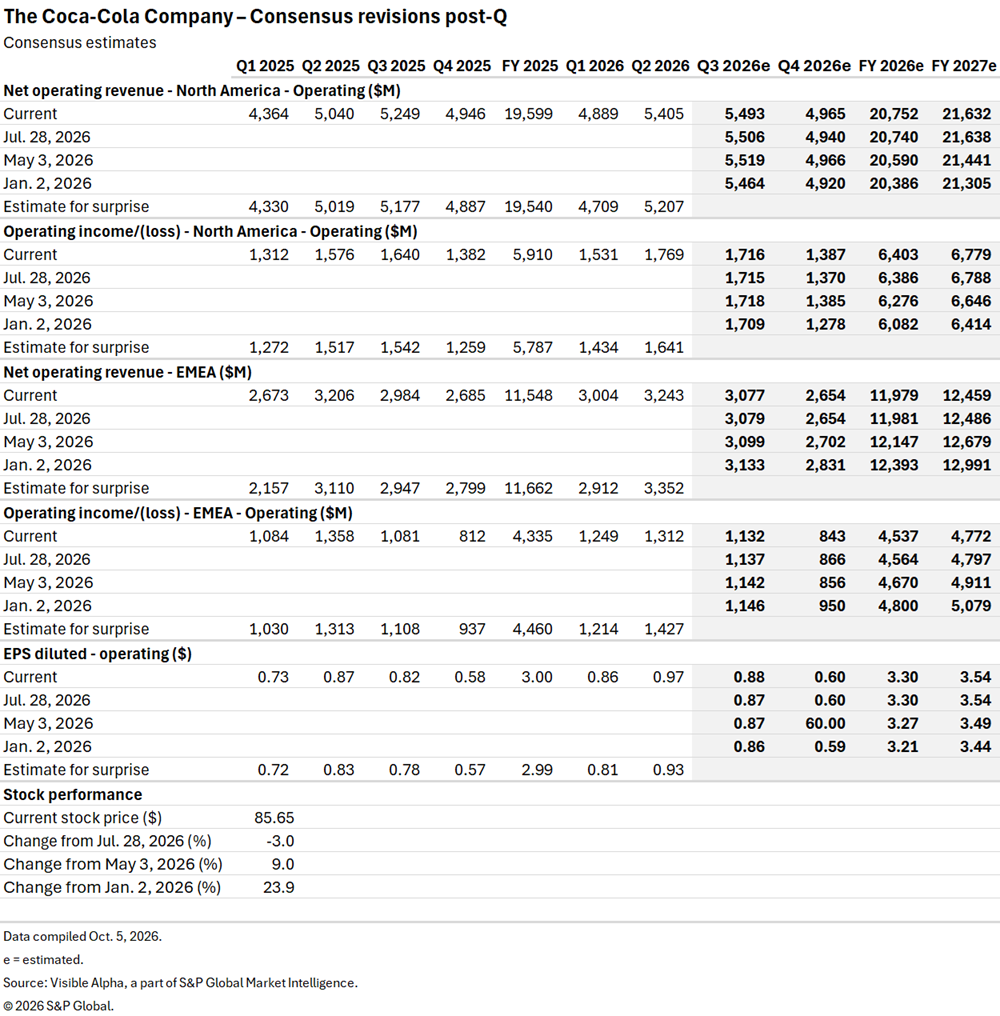
Following Q2 2026 results, The Coca-Cola Co. management raised its FY2026 outlook, and now expects organic revenue growth of approximately 5% and comparable EPS growth of 9% to 10%, up from previous guidance of 4% to 5% and 8% to 9%, respectively. Management also raised its free cash flow guidance to approximately $12.4 billion.
Coca-Cola at Barclays’ 19th Annual Global Consumer Staples Conference 2026
Coca-Cola reiterated its focus on balanced volume and price/mix growth, supported by disciplined revenue growth management, targeted innovation and market-specific affordability initiatives.
Disney
Post Q3 commentary
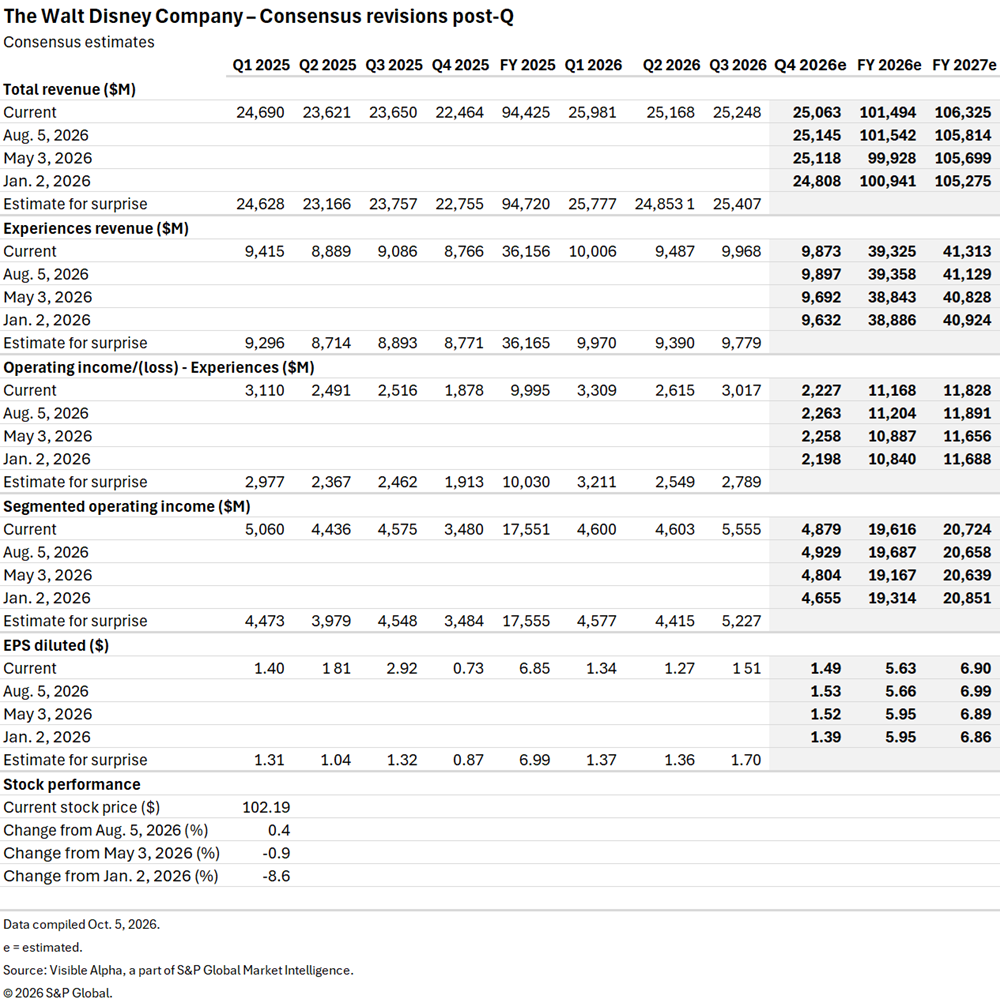
For guidance, Walt Disney Co. projected Q4 segmented operating income of approximately $4.9 billion, slightly below the pre-quarter Visible Alpha consensus expectations of $5.0 billion. It reaffirmed approximately 12% adjusted EPS growth for fiscal 2026 (16% including the 53rd week) and raised its fiscal 2026 share repurchase target to at least $9 billion.
Goldman Sachs
Post Q2 commentary
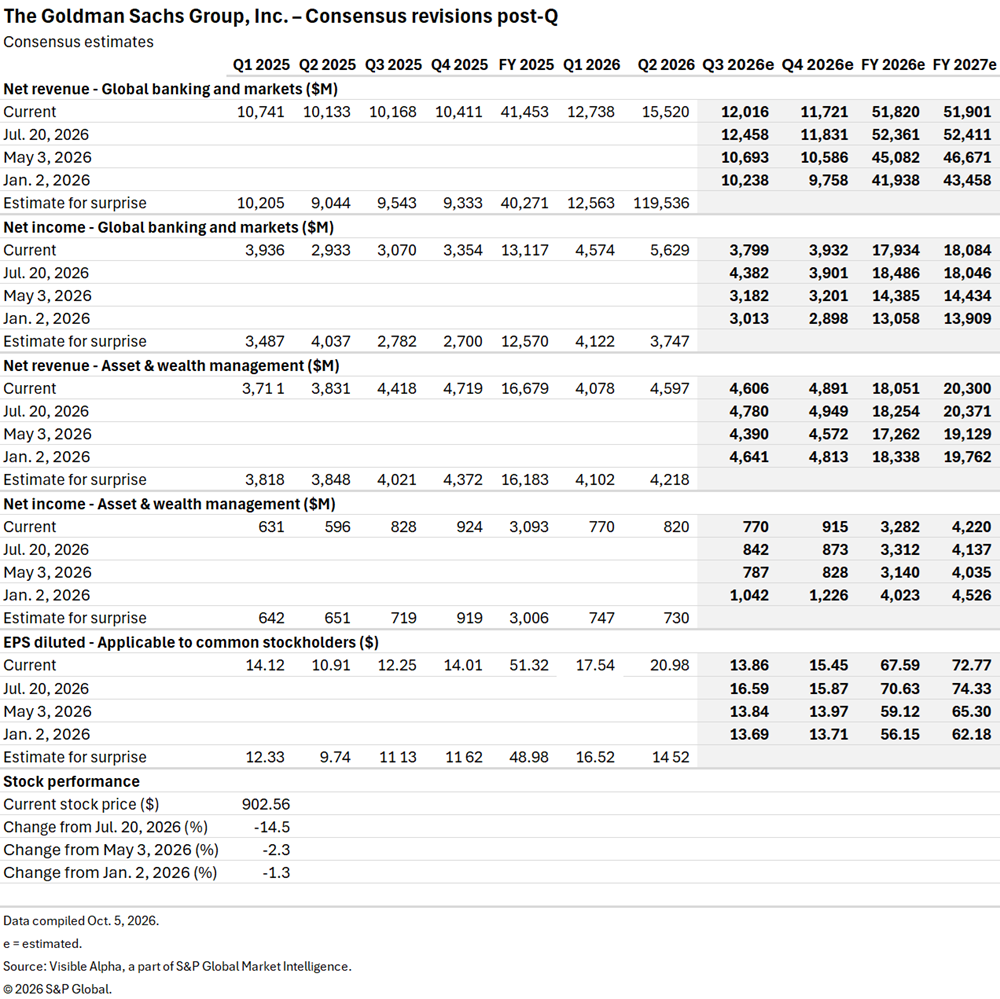
Following Q2 2026 results, management of Goldman Sachs Group Inc. did not provide formal Q3 or FY2026 revenue or EPS guidance, but highlighted continued strong client activity and business momentum. Robust pipelines across M&A, capital formation and Asset & Wealth Management were said to support the outlook for the second half of 2026.
Goldman at Barclays’ 24th Annual Global Financial Services Conference 2026
Goldman Sachs highlighted stronger and more diversified earnings, with Asset & Wealth Management emerging as a major growth engine. Management is targeting high-single-digit growth, 30% margins, and high-teens returns in the business. Alternatives fundraising is expected to exceed $125 billion this year, well above the prior $75 billion–$100 billion target, while M&A activity remains strong, and AI infrastructure presents a significant financing opportunity. Management also highlighted technology-driven productivity through its GS 3.0 initiative, which is expected to support operating leverage and higher returns over the next three to five years.
Home Depot
Post Q2 commentary
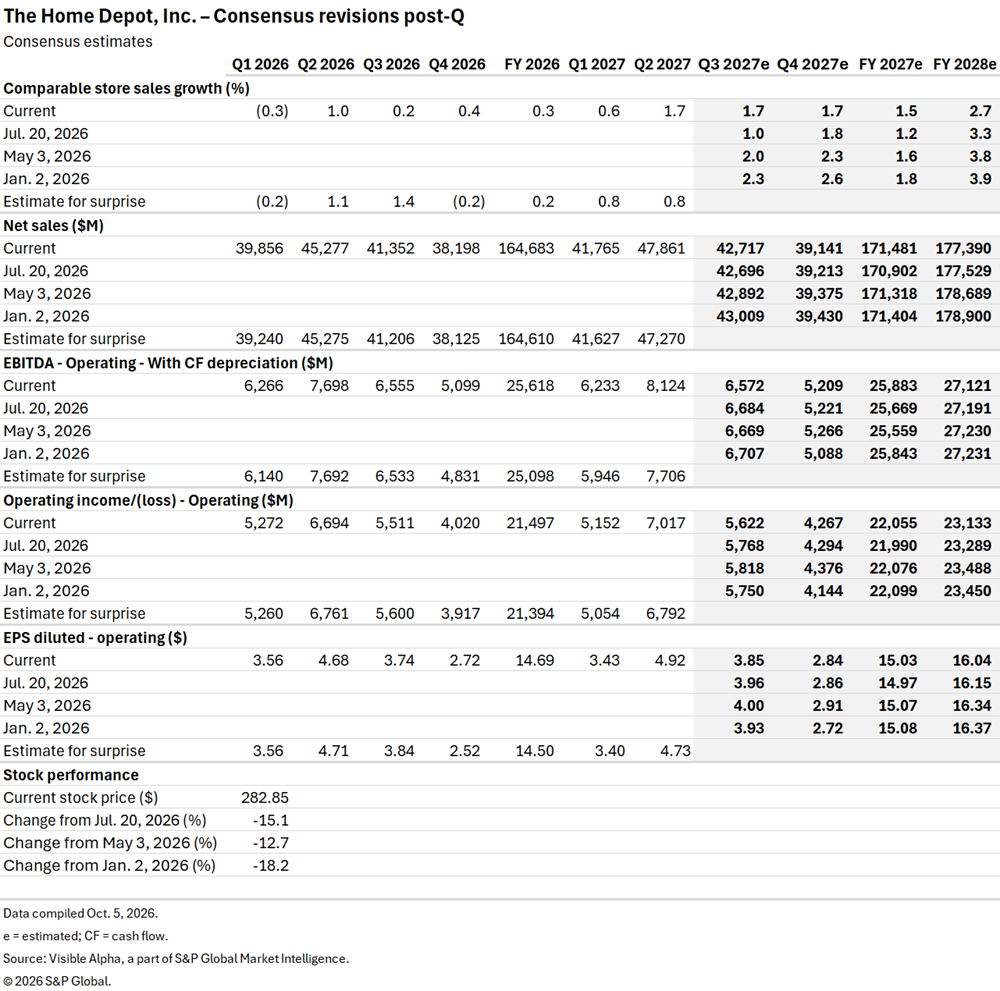
For FY2026, Honeywell International Inc. management maintained its outlook for total sales growth of 2.5%–4.5%, comparable sales growth of flat to 2.0% and diluted and adjusted EPS growth of 0%–4.0%. Operating margin is expected at 12.4%–12.6%, adjusted operating margin at 12.8%–13.0% and gross margin at approximately 33.1%, with plans to open around 15 new stores and 40–50 SRS branches. Management said Q3 demand is tracking broadly in line with Q2 but is cautious on the housing backdrop, while 13 of 16 categories posted positive comps and Pro/SRS continued to outperform.
Honeywell
Honeywell at Deutsche Bank Industrials Summit 2026
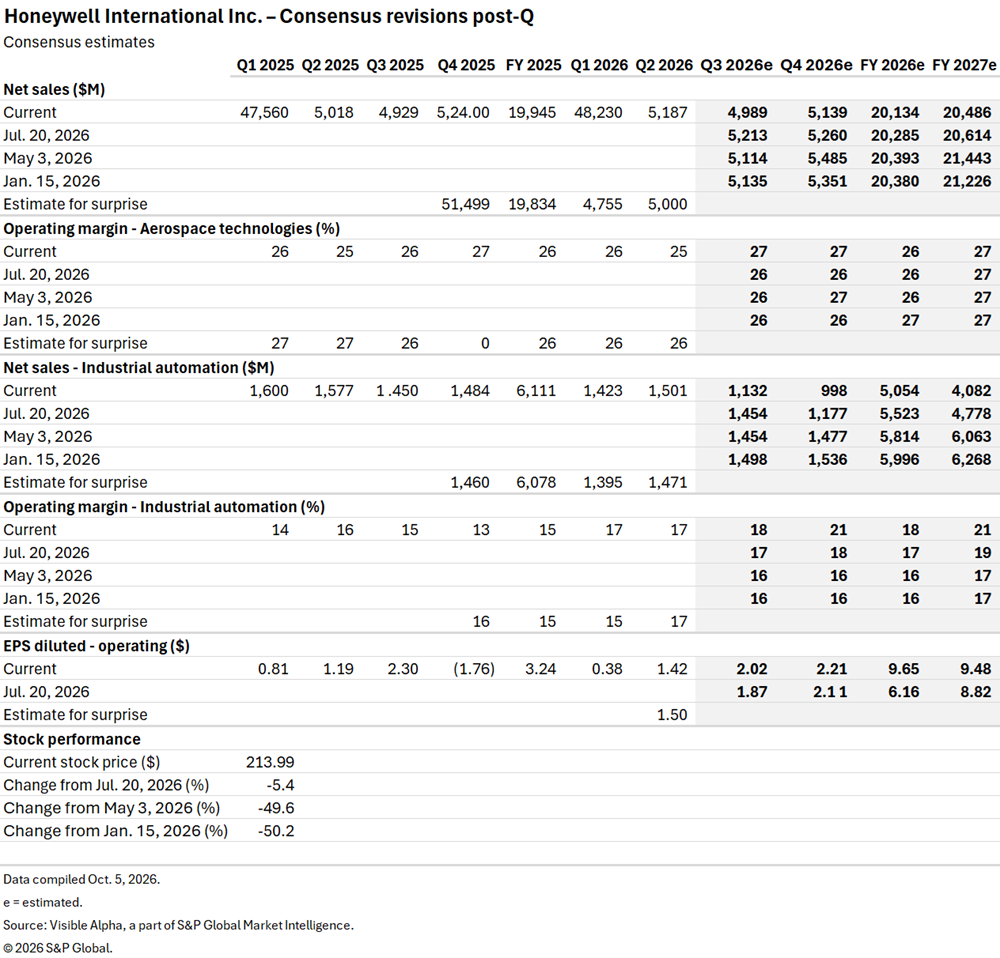
Honeywell sees strong, broad-based demand, with July orders healthy and second-half momentum supporting 4%–6% organic growth and 15% EPS growth in 2027. Building automation should sustain mid-single-digit+ growth, with data centers targeted to double to >$1B in three years, while P&AT benefits from LNG, oil & gas and Middle East demand. Industrial Automation is improving on delivery, NPI and cost actions, with management 100% confident in reaching 25% margins by 2029; overall margin expansion should accelerate in 2026–27. AI/Forge, NPI and $2B–$4B bolt-on M&A, particularly in IA, remain key growth levers.
IBM
Post Q2 commentary
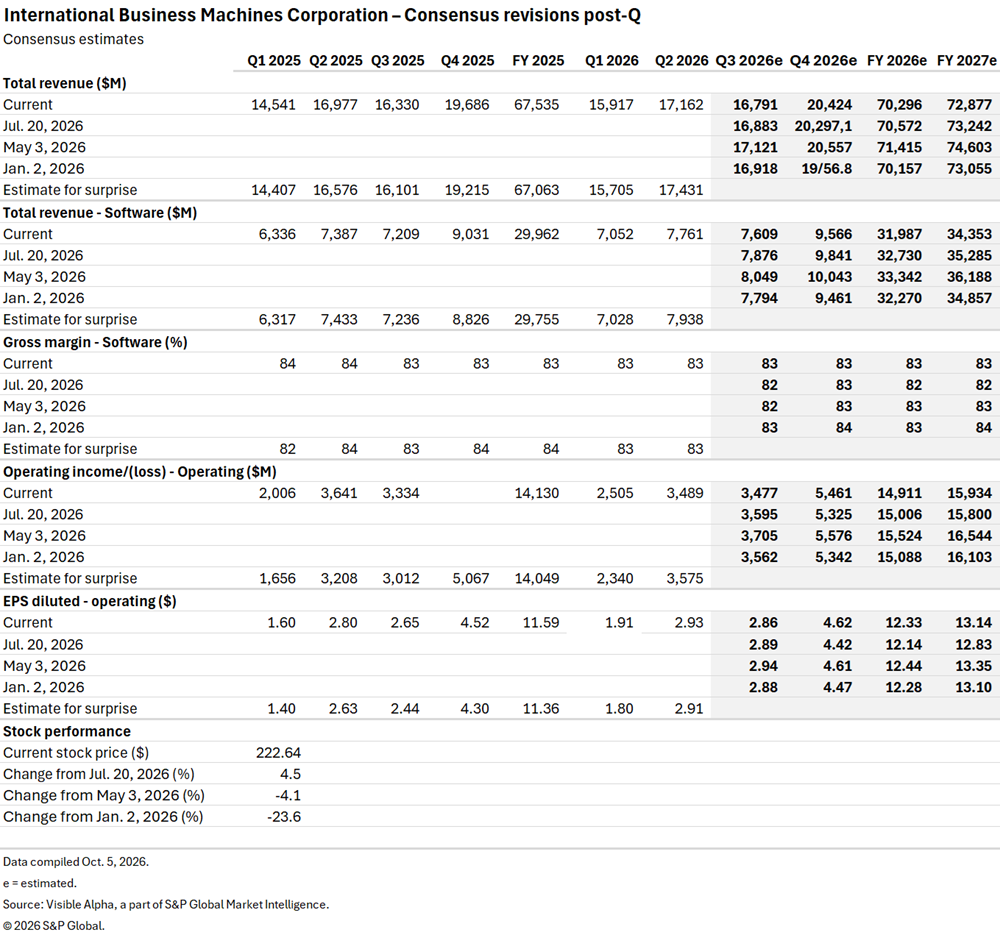
International Business Machines Corp. lowered its FY2026 constant-currency revenue growth guidance to 4%–5% (from >5% previously), guided Software growth of 6%–8%, Infrastructure to low-single-digit growth, Consulting to low- to mid-single-digit growth, reaffirmed its ~100 bps operating pretax margin expansion target and around $1 billion year-on-year free cash flow increase outlook.
Johnson & Johnson
Post Q2 commentary
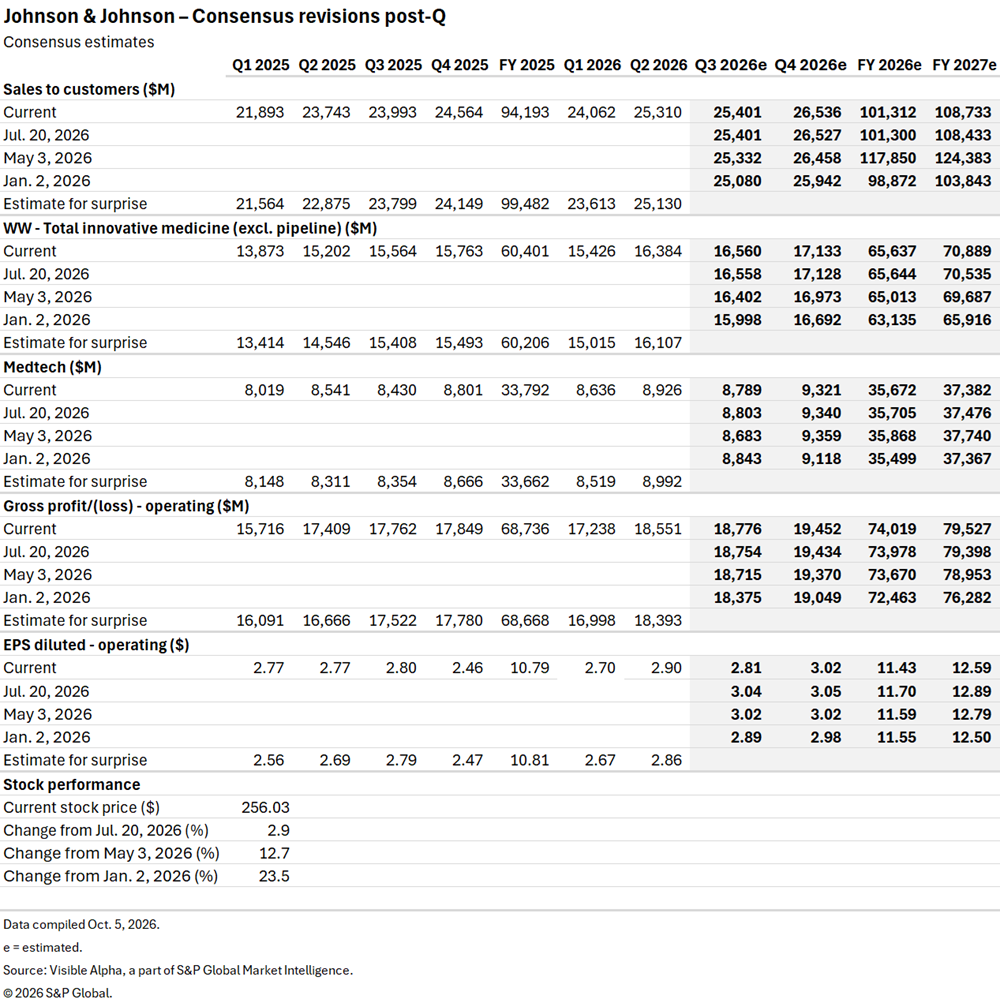
Following Q2 2026 results, Johnson & Johnson management modestly raised its FY2026 outlook, now expecting revenue of $100.8 billion–$101.4 billion, up from $100.5 billion–$101.1 billion and broadly in line with pre-quarter Visible Alpha consensus of $101.1 billion. Adjusted diluted EPS guidance was also raised to $11.60–$11.75, from $11.45–$11.65, and is broadly in line with the pre-quarter consensus of $11.58, reflecting stronger-than-expected operational performance.
Johnson & Johnson at Morgan Stanley 24th Annual Healthcare Conference
J&J is positioning itself for a new multiyear growth cycle, supported by a streamlined portfolio, a deep late-stage pipeline, earlier use of advanced myeloma therapies, oral immunology innovation and a major push into surgical robotics. The key investor message is that growth through 2030 is increasingly visible, while December's Investor Day is intended to establish confidence that the growth can continue beyond 2030.
JP Morgan
Post Q2 commentary
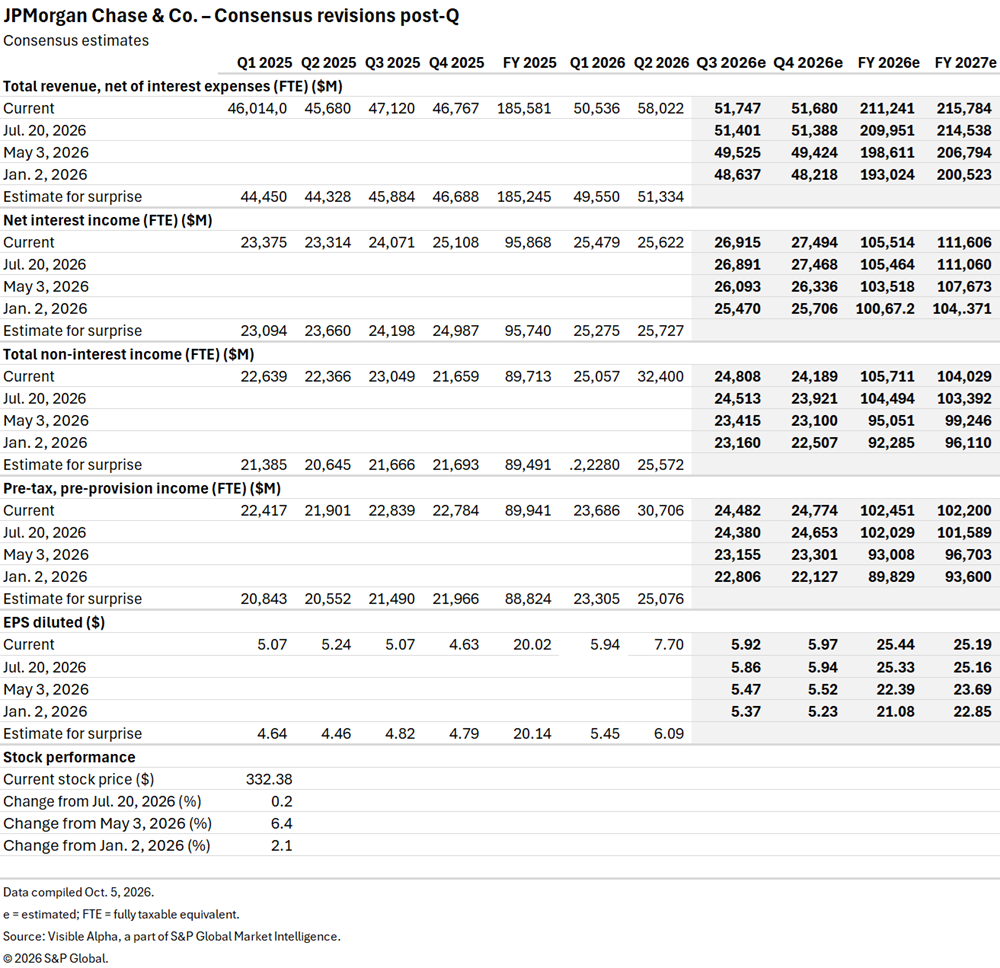
Following Q2 2026 results, JPMorgan Chase & Co. management raised its FY2026 outlook, forecasting net interest income (NII) excluding markets of approximately $96.5 billion and total NII of approximately $105.5 billion, supported by higher market-related income. The bank also raised its adjusted expense outlook to approximately $107.5 billion, reflecting higher business activity, while lowering its expected card net charge-off rate to approximately 3.2% amid improving consumer credit trends. The bank announced plans to raise its quarterly dividend to $1.65 per share beginning in Q3.
JP Morgan at Barclays 24th Annual Global Financial Services Conference
JP Morgan described a strong operating environment across CIB, with particularly robust Investment Banking, Markets, payments and financing activity. Management sees several structural growth drivers - AI, reshoring, infrastructure, defense spending and private-capital activity; supporting revenue, while maintaining disciplined underwriting and capital allocation.
McDonalds
Post Q2 commentary
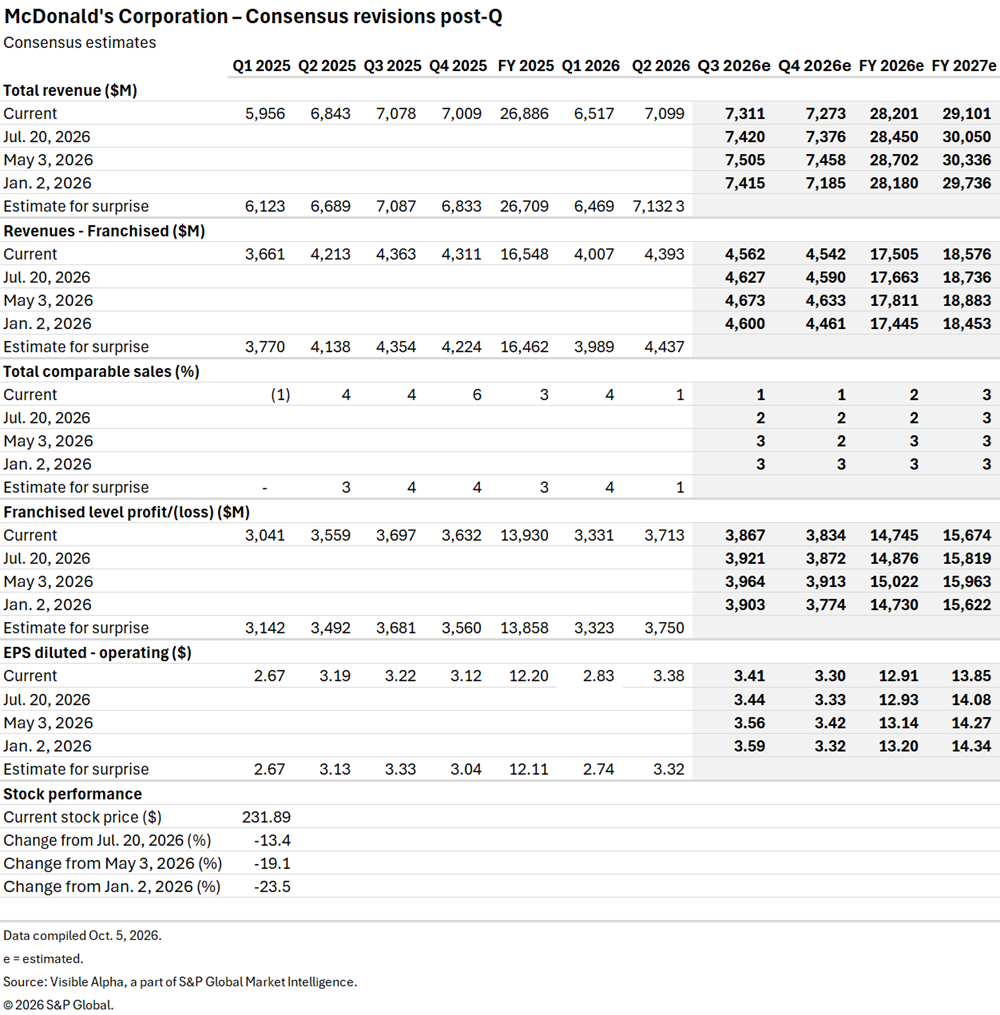
McDonald's Corp. management guided to a “meaningful deceleration” in Q2 comparable sales following softer April trends, below pre-quarter consensus expectations of ~2.8%.
However, the broader FY26 framework was broadly reaffirmed:
- Net restaurant additions of ~2,100, implying ~4.5% unit growth
- Operating margin: mid-to-high 40% range (vs ~47% pre-quarter consensus expectations)
- Capex: $3.7 billion–$3.9 billion
- Free cash flow conversion: low-to-mid 80%
- FX tailwind: ~$0.20–$0.30 to EPS
Management also signaled sequential improvement in comp trends through May and June, aided by easier comparisons.
Merck
Post Q2 commentary
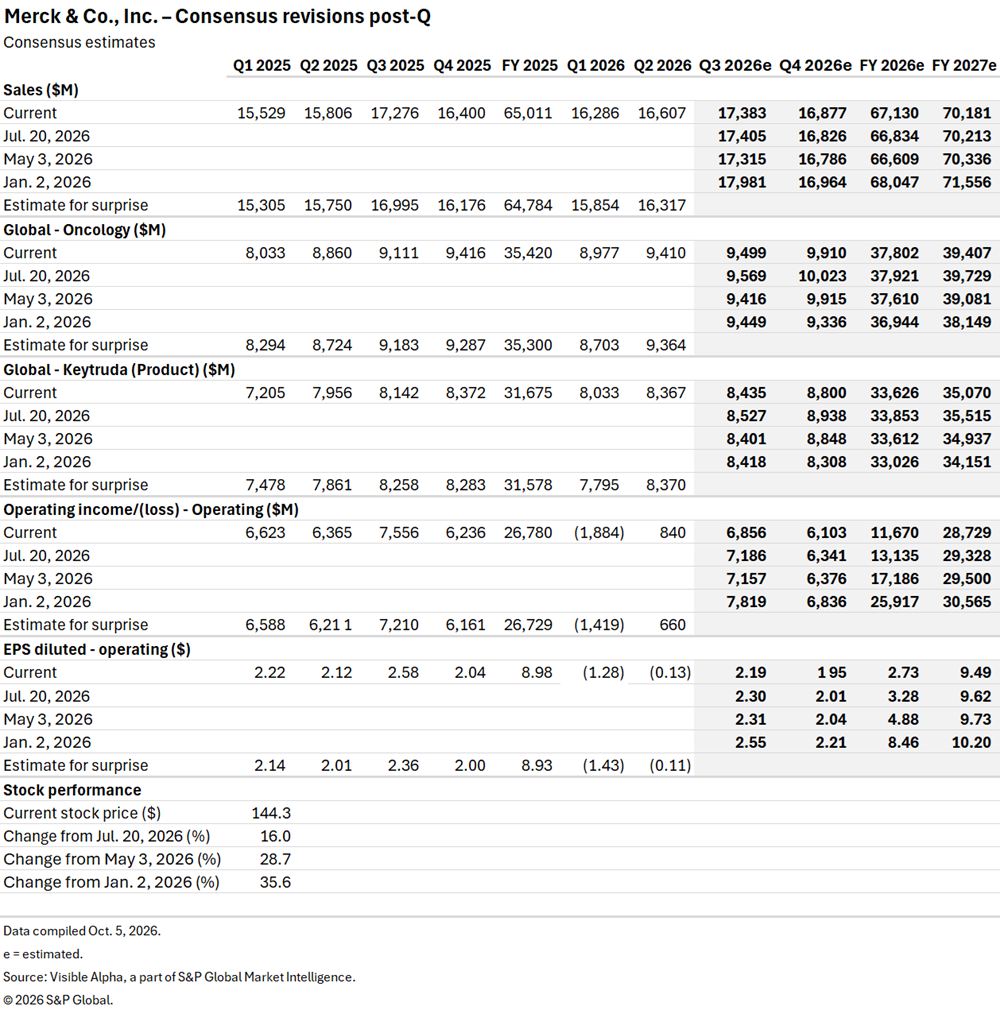
Following Q2 2026 results, Merck & Co. Inc. management raised and narrowed its FY2026 sales outlook to $66.3 billion–$67.3 billion, broadly in line with pre-quarter Visible Alpha consensus of $66.9 billion. Non-GAAP EPS guidance of $2.66–$2.76 is below the $3.08 pre-quarter consensus, reflecting acquisition-related charges associated with Cidara and Terns.
Merck at Morgan Stanley’s 24th Annual Global Healthcare Conference 2026
Merck highlighted a pipeline transformation progressing ahead of expectations, with multiple positive clinical readouts and launches providing near-term catalysts. Management sees upside to its $70 billion mid-2030s pipeline opportunity and plans to raise the target. INT/mRNA cancer vaccine, sac-TMT, enlicitide and tulisokibart represent key growth opportunities across oncology, cardiovascular disease and immunology. Merck also expects Animal Health to more than double over the next decade, while AI-driven drug discovery and targeted business development are increasingly supporting pipeline productivity and long-term growth.
3M
Post Q2 commentary
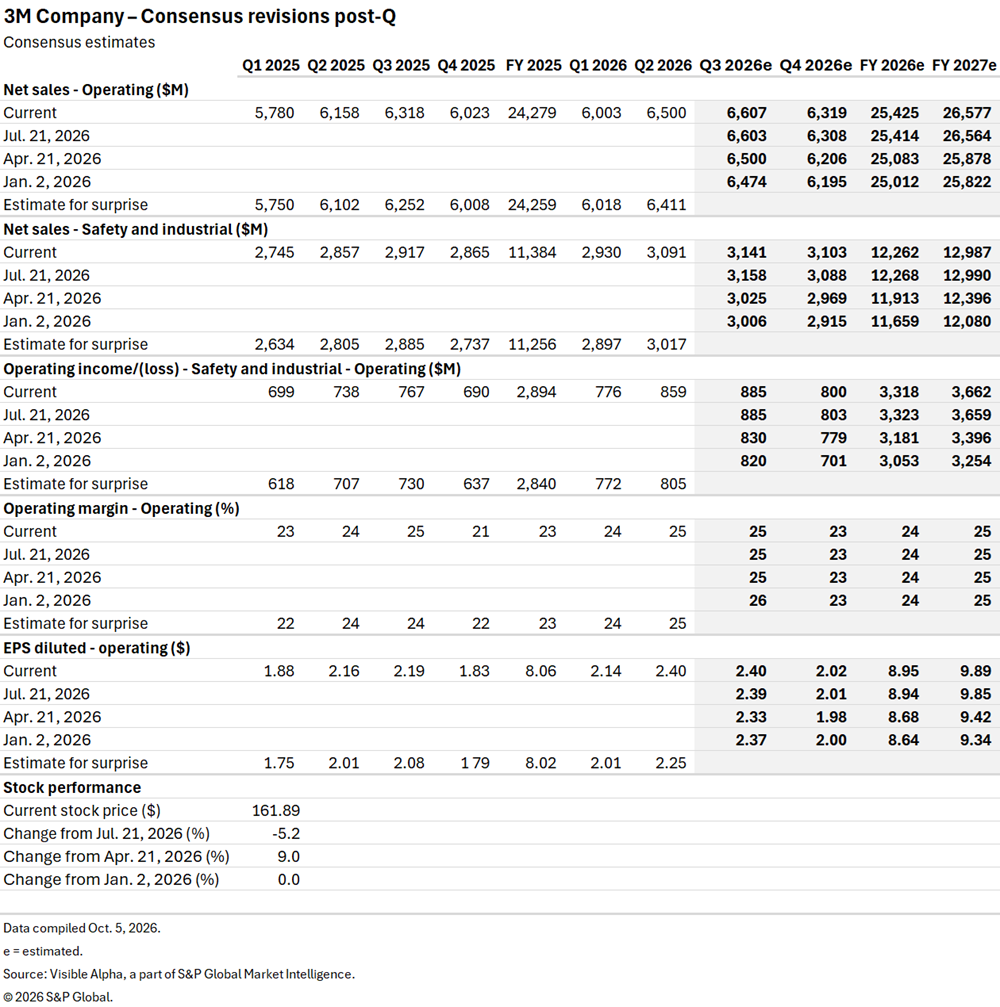
Following Q2 2026 results, 3M Company management raised its FY2026 outlook, and now expects adjusted total sales growth of more than 4.5%, adjusted organic sales growth of more than 3.5%, operating margin expansion of 70–80 bps and adjusted EPS of $8.80–$8.95, above pre-quarter Visible Alpha consensus of $8.75.
3M at Morgan Stanley’s 14th Annual Laguna Conference 2026
3M highlighted improvement in operational execution, commercial performance and innovation, with Q2 organic growth of 5.4% and full-year organic growth expected to exceed 3.5%. Management is focused on structural cost reduction and portfolio transformation, targeting operating margins above 25% by 2027 while prioritizing higher-growth opportunities such as data centers. Its Beam Optics technology could serve an addressable market of nearly $2 billion by 2028. AI, R&D productivity and further portfolio optimization should provide additional growth and margin opportunities.
Microsoft
Post Q4 commentary
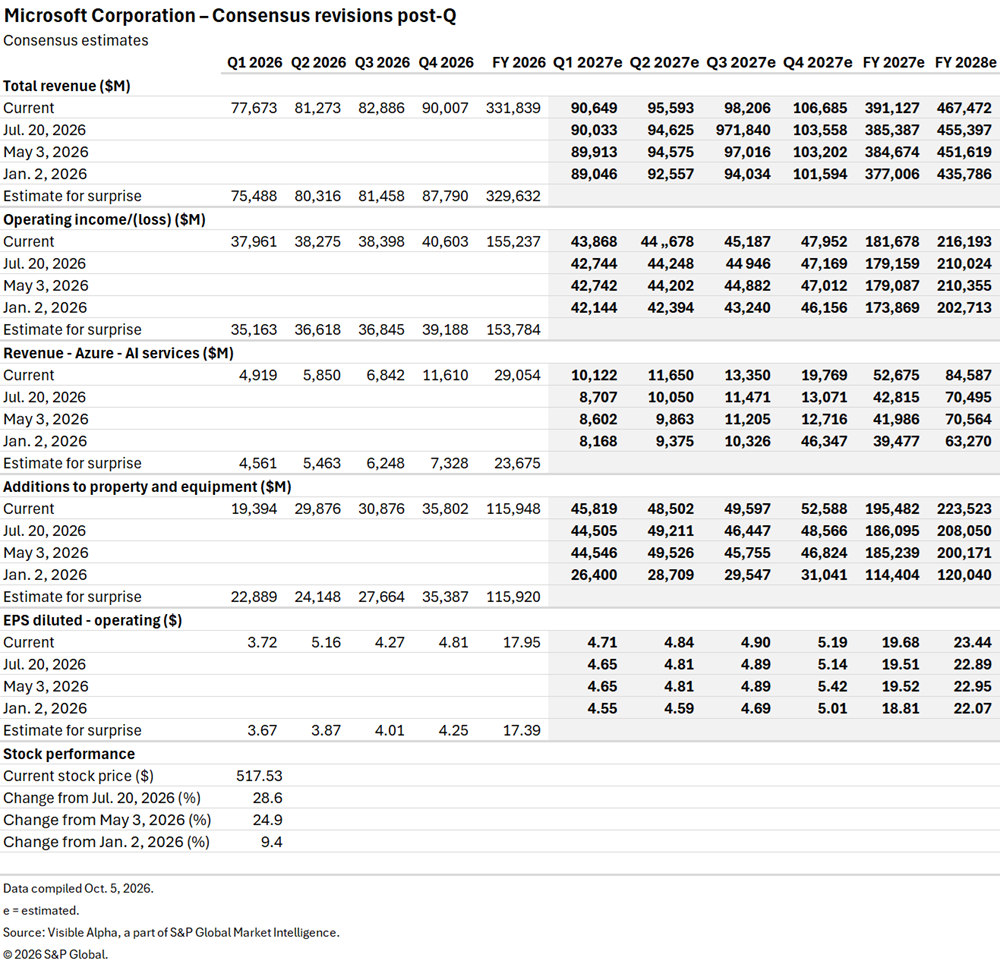
Microsoft Corp. expects another year of double-digit growth. For FY2027, management anticipates revenue and operating income to grow at double-digit rates, with operating margin declining by less than one percentage point as AI investments continue.
Q1 FY2027 revenue guidance of $89.85 billion–$90.95 billion was broadly in line with the pre-quarter Visible Alpha consensus of $89.9 billion. Intelligent Cloud revenue guidance of $40.95 billion–$41.25 billion was above consensus, supported by approximately 45% constant-currency Azure growth.
Productivity and Business Processes guidance was broadly in line with expectations, while More Personal Computing guidance was below consensus, reflecting softness in the PC market.
Management expects Q1 capital expenditure to exceed $50 billion. FY2027 capital spending should increase year over year in line with customer demand, while free cash flow is expected to remain positive.
Nike
Post Q1 commentary
Nike Inc. management guided FY2027 revenue to decline by a high-single-digit percentage, versus preQ consensus expectations of -2.4%, and adjusted EPS of $1.15–$1.35 versus preQ consensus expectations of $1.56, excluding $0.15 of Pace program charges, with the effective tax rate expected in the mid-20% range.
Management said China’s reset, Sportswear and Jordan repositioning would weigh on results through FY2027 and potentially into early FY2028, while supply-chain savings are expected to build through FY2029–FY2030; a five-year financial framework is planned for the November Investor Day.
Nvidia
Post Q2 commentary
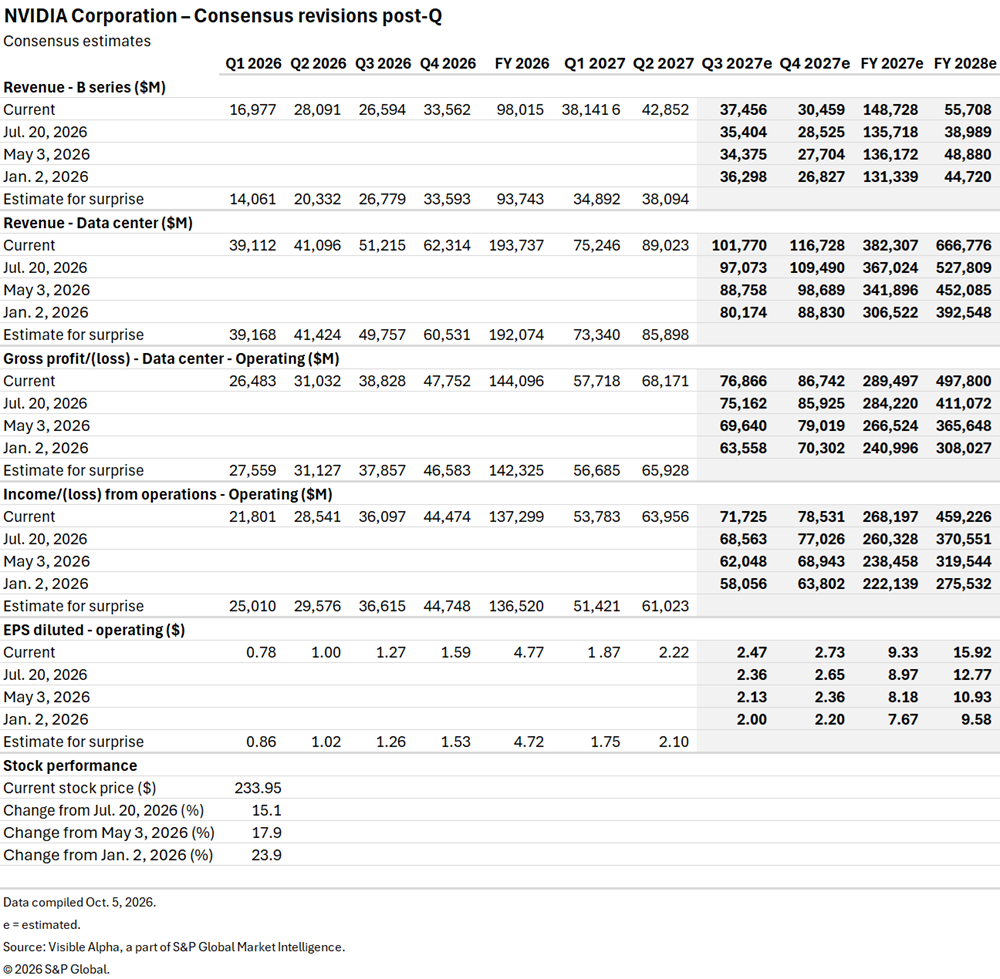
For Q3 FY2027, NVIDIA Corp. guided revenue to $108 billion ±2%, above pre-quarter Visible Alpha consensus of $105.4 billion. GAAP gross margin guidance of 74% ±50 bps and non-GAAP gross margin of approximately 74% were below consensus, while GAAP operating expenses of approximately $9.2 billion were below, and non-GAAP operating expenses of $9.0 billion were above consensus. FY2027 tax rate guidance was 16%–18%, while management expects approximately 70% revenue growth in FY2028, above Visible Alpha's consensus of 44%.
Management highlighted a significant increase in revenue opportunity per gigawatt, with Vera Rubin at $40 billion/GW versus $25 billion/GW for Grace Blackwell. Supply commitments are already being secured to support the Rubin ramp through next year.
NVIDIA at Advancing Infrastructure for the Agentic Era
NVIDIA highlighted agentic AI as a major driver of data center infrastructure demand, with increasing requirements for context, reasoning, tool calls and continuous inference. The company is addressing this through Vera Rubin, dedicated CPUs, Groq inference technology, NVLink/NVLink Fusion, advanced HBM and DSX power-management software, and a focus on maximizing tokens and revenue per megawatt while lowering cost per token.
P&G
Post Q4 commentary
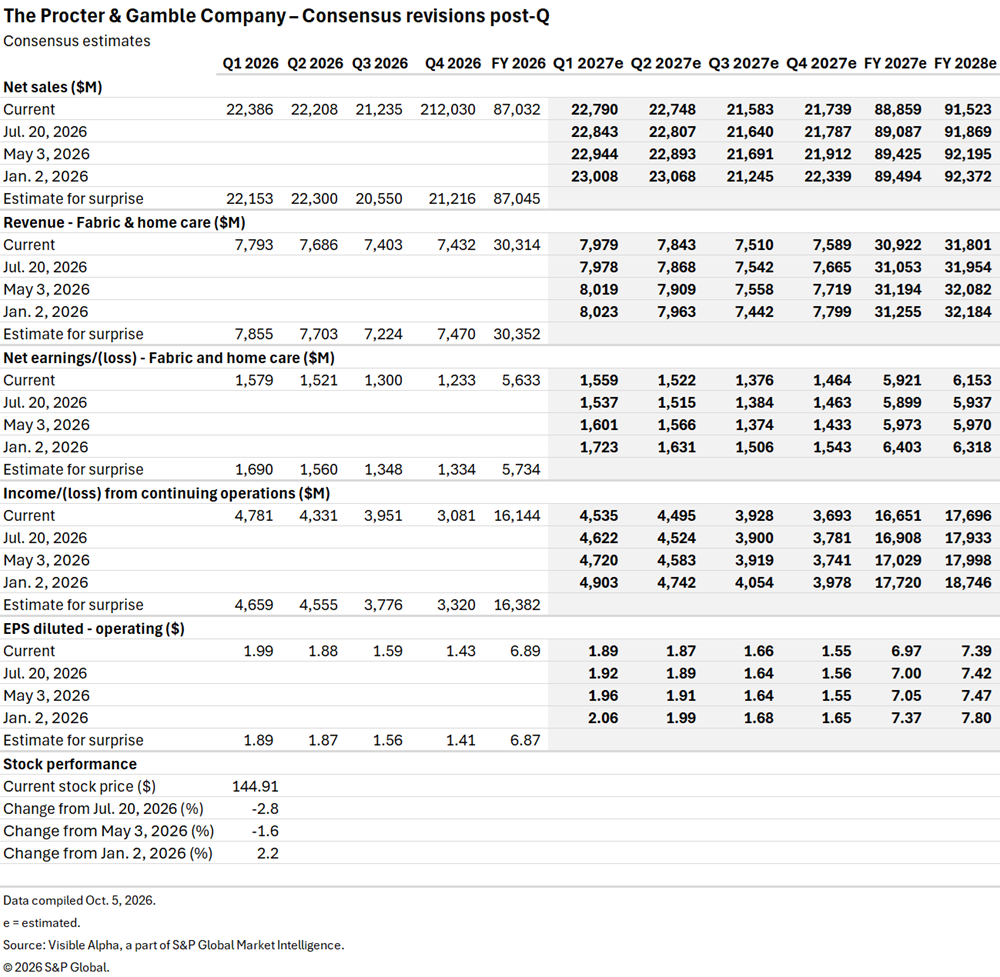
Following Q4 FY2026 results, The Procter & Gamble Co. management initiated FY2027 guidance, expecting all-in and organic sales growth of 1% to 3%, diluted EPS growth of 1% to 5%, and core EPS growth ranging from in line to 3%, equivalent to $6.89–$7.11 per share. Management also expects approximately $1 billion in after-tax headwinds from higher raw material, energy and transportation costs.
P&G at Barclays 19th Annual Global Consumer Staples Conference 2026
P&G reiterated that its strategy is unchanged, and the focus is shifting to stronger execution through faster consumer insights, clearer accountability and greater use of AI and technology. Management expects a recovery in US growth within 12–18 months, supported by improving market share, pricing actions and productivity, while China’s turnaround provides a blueprint for other markets. Technology-led productivity, supply-chain automation and disciplined bolt-on M&A remain key priorities, with Investor Day expected to outline the path toward stronger innovation and growth.
Salesforce
Post Q2 commentary
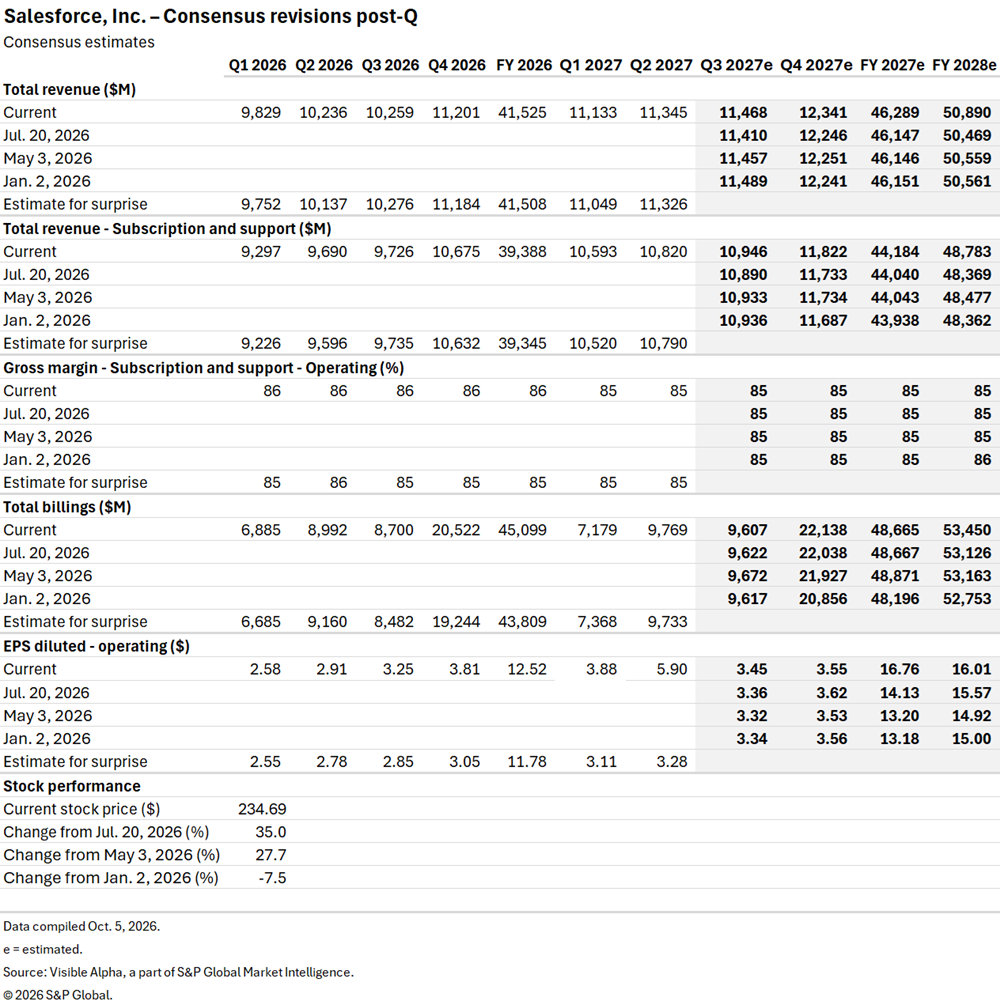
Following Q2 FY2027 results, Salesforce Inc. management raised FY2027 revenue guidance to $46.1 billion–$46.4 billion, from $45.9 billion–$46.2 billion, broadly in line with pre-quarter Visible Alpha consensus. For Q3 FY2027, management expects revenue of $11.42 billion–$11.50 billion and non-GAAP EPS of $3.42–$3.44, with current remaining performance obligations expected to grow approximately 14% year-over-year. FY2027 non-GAAP EPS guidance of $16.67–$16.71 and GAAP EPS guidance of $10.21–$10.25 are both above pre-quarter consensus.
Salesforce at Dreamforce: Marc Benioff and Sam Altman
Altman said AI is moving from chatbots to persistent agents that can continuously understand work and act proactively, while emphasizing the need for stronger AI safety, cybersecurity and monitoring.
Sherwin Williams
Post Q2 commentary
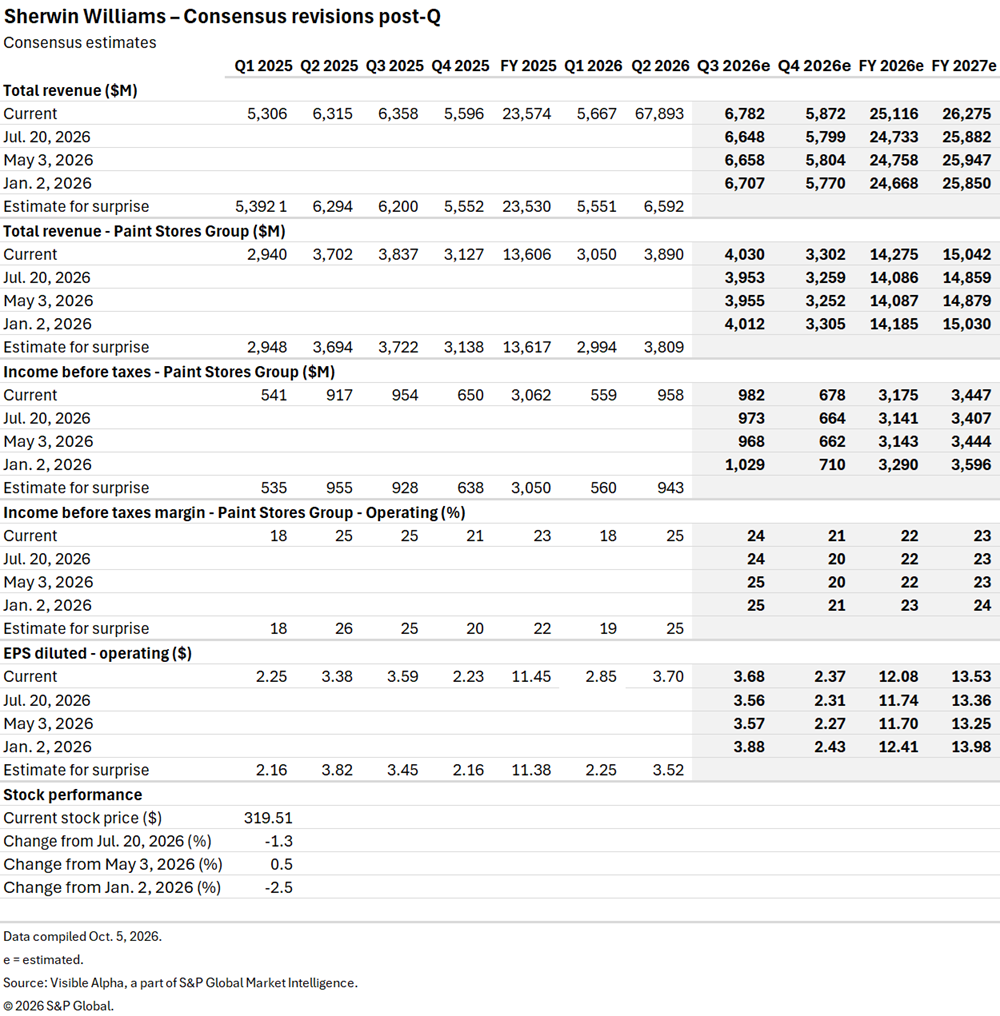
Following Q2 2026 results, The Sherwin-Williams Co. management raised its FY2026 outlook, and now expects consolidated net sales growth in the mid- to high-single digits, diluted EPS of $10.92–$11.32, above the pre-quarter Visible Alpha consensus of $10.78, and adjusted diluted EPS of $11.80–$12.20, also above pre-quarter consensus of $11.75. For Q3 2026, management expects consolidated net sales growth in the mid- to high-single digits.
The Travelers Companies
Post Q2 commentary
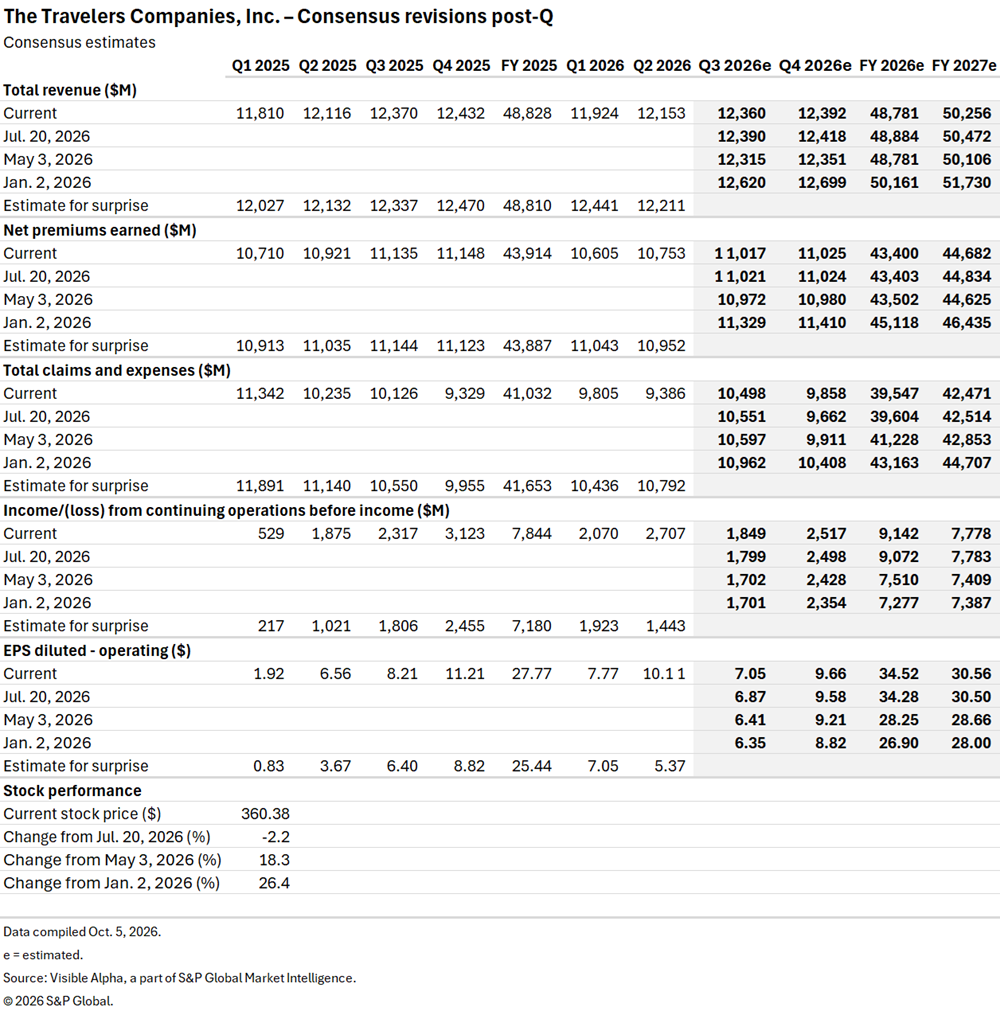
Following Q2 2026 results, The Travelers Cos. Inc. management maintained its FY2026 guidance, expecting a full-year underwriting expense ratio of approximately 28.5%. For Q3 2026, management expects after-tax net investment income from its fixed-income portfolio of approximately $840 million.
United Healthcare
Post Q2 commentary
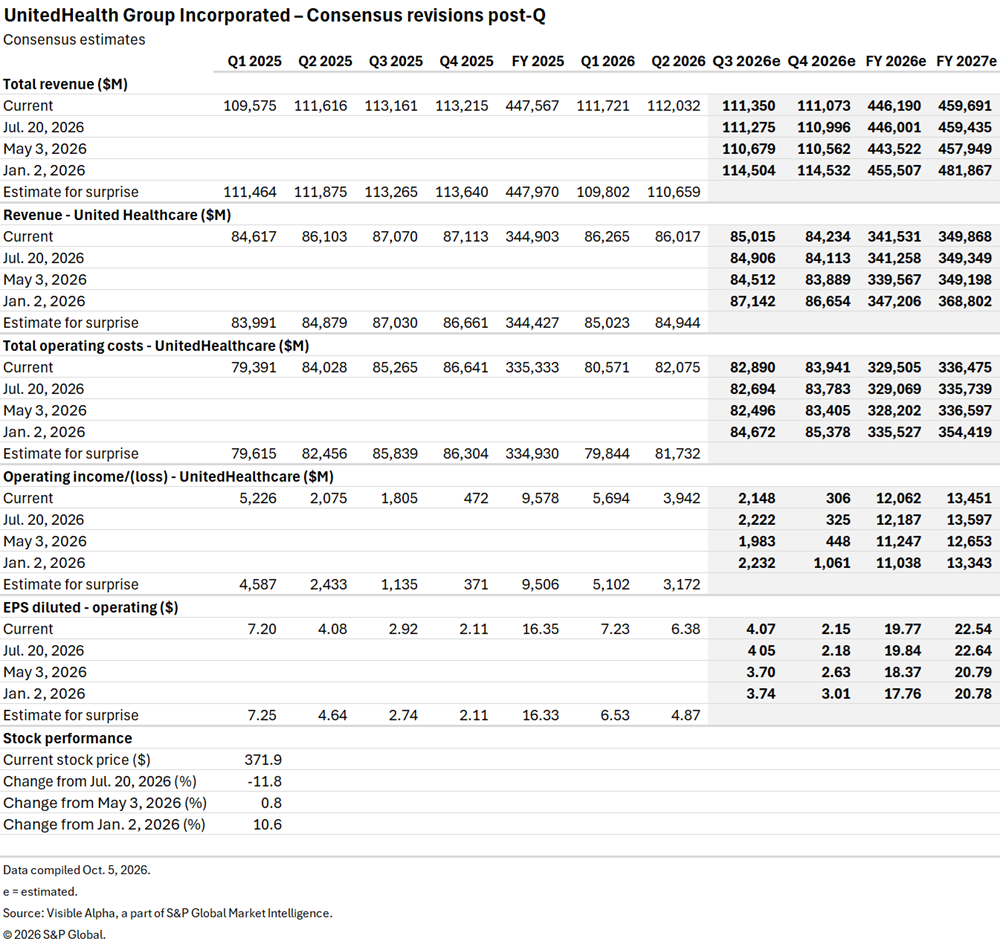
For full-year 2026, UnitedHealth Group Inc. management raised adjusted EPS guidance to $19.50-$20.00, above the pre-quarter Visible Alpha consensus of $18.51. UnitedHealthcare's operating earnings guidance was increased to at least $12.0 billion (versus $11.4 billion consensus), Optum Health operating earnings guidance to at least $2.2 billion (versus. $2.0 billion), and the medical loss ratio guidance was improved to 88.1% (±25 bps) from the 88.9% pre-quarter Visible Alpha consensus.
Visa
Post Q3 commentary
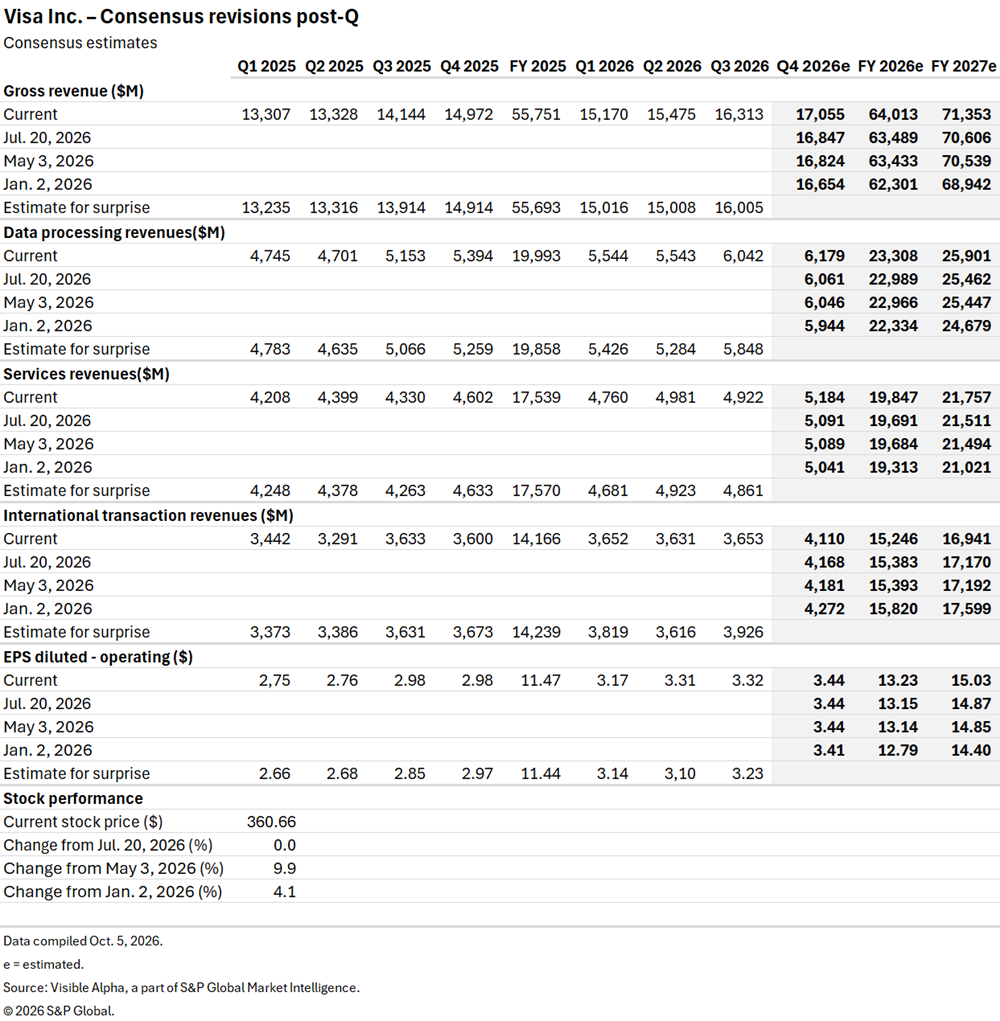
Following the results, Visa Inc. raised its FY2026 outlook, now expecting net revenue and operating expense growth at the low end of the low teens and EPS growth at the low end of the mid-teens, while guiding Q4 revenue growth at the high end of the low double digits and continued low-end of mid-teens EPS growth.
Walmart
Post Q2 commentary
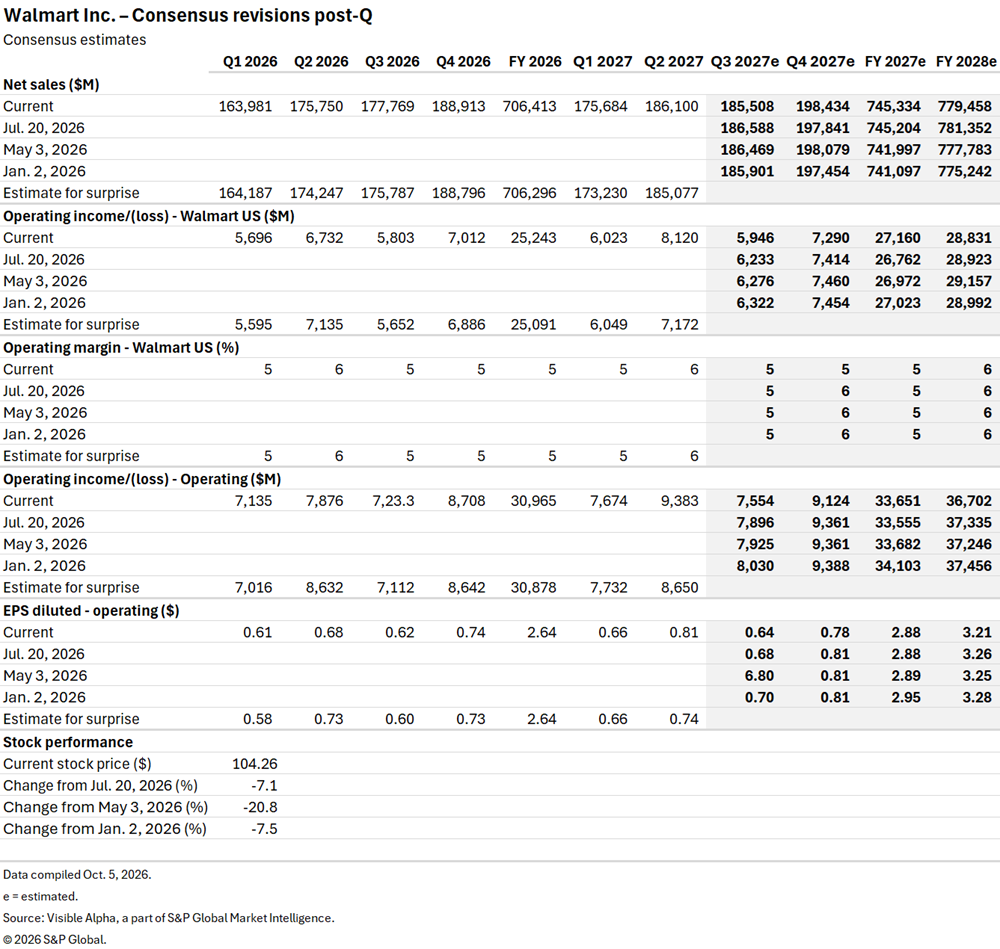
Walmart Inc. management guided Q3 to constant-currency net sales growth of 3.0%–3.75%, adjusted operating income growth of 2.0%–4.0% and EPS of $0.62–$0.64, while raising FY2027 guidance for sales growth to 4.0%–5.0%, operating income growth to 7.0%–8.5% and EPS to $2.80–$2.87.
Walmart at Piper Sandler 5th Annual Growth Frontiers Conference
Marketplace is becoming an ecosystem that connects Walmart's assortment, stores, fulfillment network, advertising business and international operations, rather than just an e-commerce channel. The key growth opportunity is increasingly the combination of Marketplace + WFS + advertising + store fulfillment, rather than Marketplace GMV alone.
This article was published by Visible Alpha, part of S&P Global Market Intelligence and not by S&P Global Ratings, which is a separately managed division of S&P Global.
Content Type
Products & Offerings