ECONOMICS COMMENTARY — 06 Oct, 2026
Australia PMI points to mix of elevated inflation and softer growth, hinting at cautious rate setting

By Jingyi Pan
The latest S&P Global PMI data pointed to slowing growth in Australia at the end of the third quarter, driven by a deepening downturn in the manufacturing sector while services activity rose at a weakened pace.
The easing of overall growth momentum was underpinned by slowing demand growth, but that did little to alleviate pressure on prices, as both input cost and output price inflation remained elevated by historical standards on the back of energy prices and supply constraints.
The September data were released just as the Reserve Bank of Australia (RBA) raised its cash rate to a 15-year high, though the meeting had followed the earlier flash PMI data. While the elevated price signals from the flash and final PMIs had indicated a high probability of rates being hiked, the slowdown in economic growth signalled by the survey underscored how policymakers see prior rate hikes already having a material impact and hence leading markets to take a more dovish view on the outlook for further rate hikes. As such, October’s upcoming flash PMI data will add fresh insights into the dilemma over whether further hikes will be necessitated.
Australia’s manufacturing sector downturn deepens
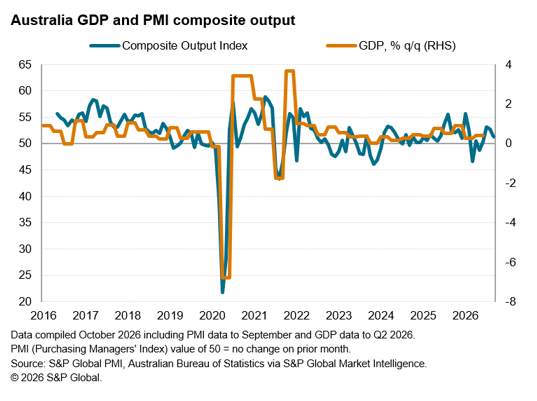
The latest S&P Global Australia Composite PMI posted 51.3 in September and signalled a modest increase in business activity across Australia’s private sector. The latest reading was also the lowest in three months and reflected a slowdown in growth following signs of stabilisation observed earlier in the quarter.
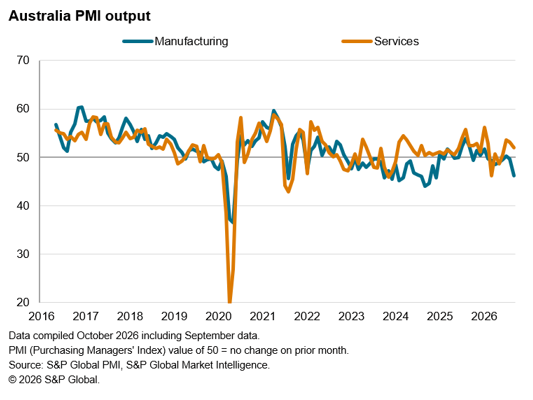
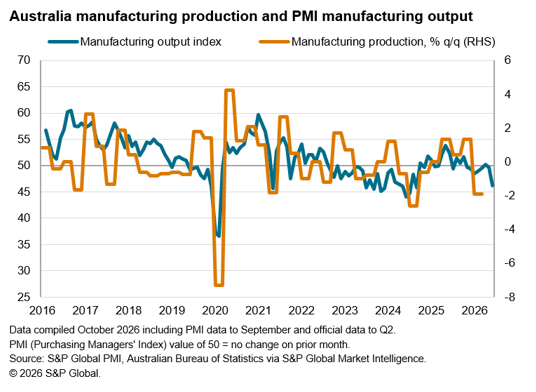
Central to the latest downturn was a deepening contraction in manufacturing output in September. The pace at which production contracted was the sharpest in 21 months, dragged down by a fresh fall in goods new orders. The latest reduction in new work inflows for manufacturers in Australia was in line with the global trend, which showed that economies with a high concentration of basic materials producers were typically struggling as they were left behind while other technology-focused manufacturing sectors improved. Strong competition, subdued underlying demand and rising prices have reportedly been factors affecting the goods producing sector. The reduction in the scale of production further limited purchasing and hiring activities among manufacturing firms in Australia.
The latest manufacturing output index therefore pointed to weak manufacturing production in Australia in the third quarter following an already subdued second quarter.
Meanwhile, Australia’s service sector growth also eased in the latest survey period, reflecting the impact of higher prices on demand and relatively less robust market conditions. The latest increase nevertheless rounded off a full quarter of growth for the service sector after business activity declined for four straight months earlier in the year, representing the longest stretch of contraction seen since late-2023.
Altogether, the latest PMI data are indicative of GDP rising by around 1.0% in the third quarter of the year, which is broadly in line with our forecast for full year growth at 1.0%.
Elevated price pressure in focus
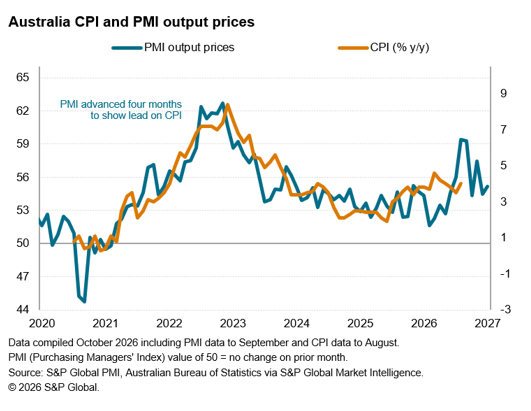
In addition to the softening growth picture, elevated price pressures featured prominently in the latest PMI release for Australia. Rates of input cost and output price inflation both climbed again during September, driven mainly by rising service sector price inflation, though manufacturing price increases also remained steep by historical standards.
Notably for the manufacturing sector, supplier delivery times lengthened again at one of the most pronounced paces seen since the COVID-19 pandemic and outlined the degree to which supply conditions deteriorated at the end of the quarter. The worsening supply conditions, coupled with reports of shortages, added to higher raw material, oil and shipping costs, altogether pushing up average input prices at a marked pace again. The picture was largely similar for the service sector in September.
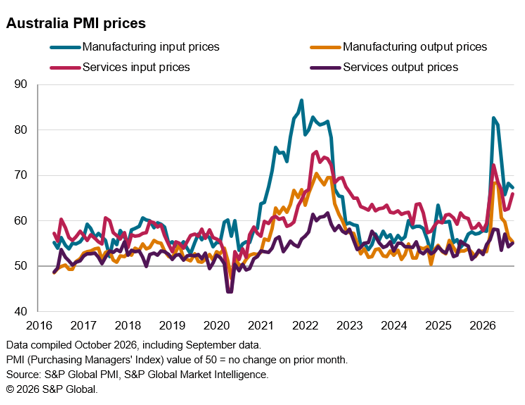
Comparison of the output prices data with Australia’s CPI therefore suggested that inflation is likely to remain elevated at around 3.5-4.0% in the coming months, with PMI prices data acting as a leading indicator of official inflation data. This is in line with our forecast for CPI inflation to average 3.6% in 2026 before easing to 2.5% in 2027.
Subdued outlook
The PMI’s price data corroborate the RBA’s fourth rate hike of the year, which took latest cash rate to a 15-year high of 4.6% in September. The sustained price pressures also mean a further hike in November has not been ruled out, though RBA head Michele Bullock noted how they are already seeing demand growth slow in response to prior rate hikes.
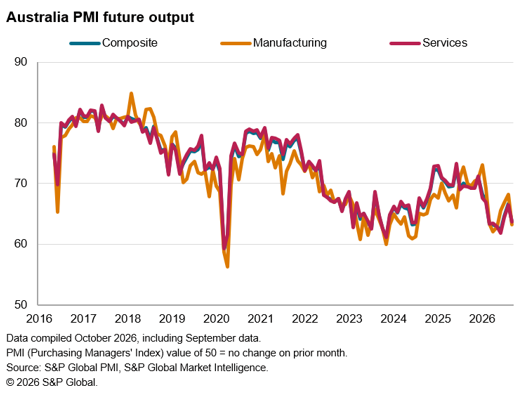
This caution about the underlying strength of demand in the economy corresponds with the weakness of the PMI’s output index and fall in the future output index, which had been trailed in advance by the earlier flash PMI’s release ahead of the central bank meeting. Not only has growth slowed, but business confidence has fallen back to one of the lowest levels seen since the pandemic, with both manufacturers and service providers less optimistic regarding output growth in the next 12 months.
Importantly, sluggish growth and a dearth of optimism will reduce scope for second-round inflationary pressures to gain traction. Markets will therefore be eager to see how these inflation and growth signals will change ahead of the next RBA meeting on November 3rd via the October flash PMI for Australia, which will be released on October 22nd.
Access the full press release here.
© 2026, S&P Global. All rights reserved. Reproduction in whole or in part without permission is prohibited.
Purchasing Managers' Index™ (PMI®) data are compiled by S&P Global for more than 40 economies worldwide. The monthly data are derived from surveys of senior executives at private sector companies, and are available only via subscription. The PMI dataset features a headline number, which indicates the overall health of an economy, and sub-indices, which provide insights into other key economic drivers such as GDP, inflation, exports, capacity utilization, employment and inventories. The PMI data are used by financial and corporate professionals to better understand where economies and markets are headed, and to uncover opportunities.
Read our latest PMI commentary here.
This article was published by S&P Global Market Intelligence and not by S&P Global Ratings, which is a separately managed division of S&P Global.
Theme
Location
Products & Offerings