ECONOMICS COMMENTARY — 14 Sep, 2026
US leads developed economy growth to fastest rate for over four years

PMI survey data from S&P Global showed worldwide economic growth accelerating further in August, led by the fastest growth among the advanced economies since early 2022. Advanced economy growth was led by the US, but growth has improved in recent months both in Europe and in the developed APAC economies of Japan and Australia. In contrast, emerging market growth remained relatively subdued amid near-record lows of business confidence.
Advanced economies continue to outpace emerging markets
The J.P. Morgan Global Composite PMI Output Index rose in August to signal the fastest worldwide output growth since March 2024, but there was an even more impressive performance seen among the advanced economies. Collectively, the advanced, or developed, economies notched up the strongest output growth since April 2022.
While emerging markets also reported an improved performance in August, the rate of expansion lagged that of the advanced economies for a second consecutive month.
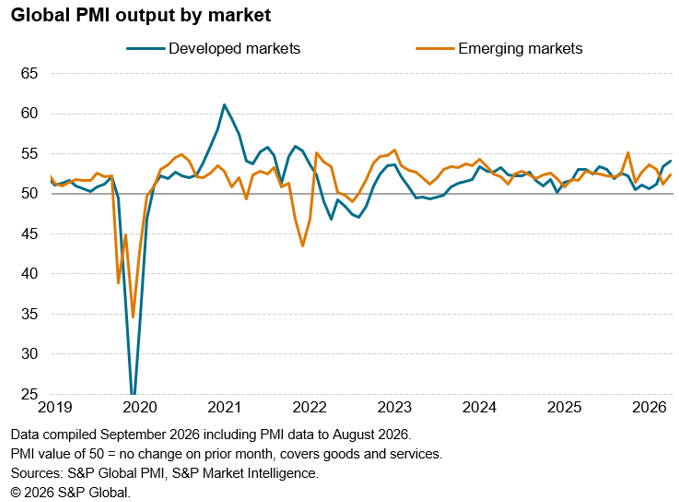
A key difference between the developed and emerging markets in August was the performance of the services economies. While in the advanced economies the service sector grew collectively at one of the strongest rates seen since the pandemic, emerging markets saw a second successive month in which growth remained at one of the slowest rates seen since the pandemic (albeit picking up slightly from July). Both advanced and emerging markets saw sustained manufacturing growth, though the advanced economies outperformed here as well, despite growth slipping lower.
US leads advanced economies
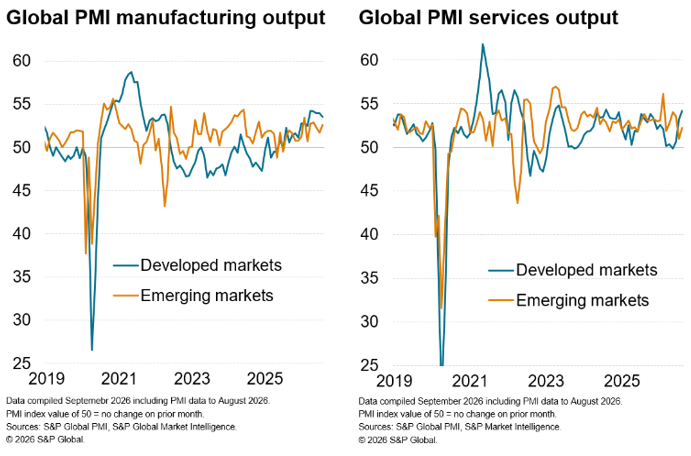
Leading the advanced economies’ expansion was a surge in US growth to the sharpest since April 2022, as a jump in services growth to a 20-month high offset a softening of the manufacturing sector’s recent strong expansion.
Notably robust growth was also reported in Japan, where output growth accelerated close to all-time survey highs. Japan’s services growth picked up pace but remained subdued compared to manufacturing, where the expansion was the second-quickest recorded since 2014.
Steady expansions continued to be seen in the eurozone and UK. The former saw the fastest manufacturing growth since February 2022, countering a slowing in services, while the UK’s expansion hit a six-month high on improved services performance.
Australia reported the second-sharpest output increase since January on the back of rising services output, but Canada saw a steepening downturn due to lower services activity.
Emerging markets growth dampened by low confidence
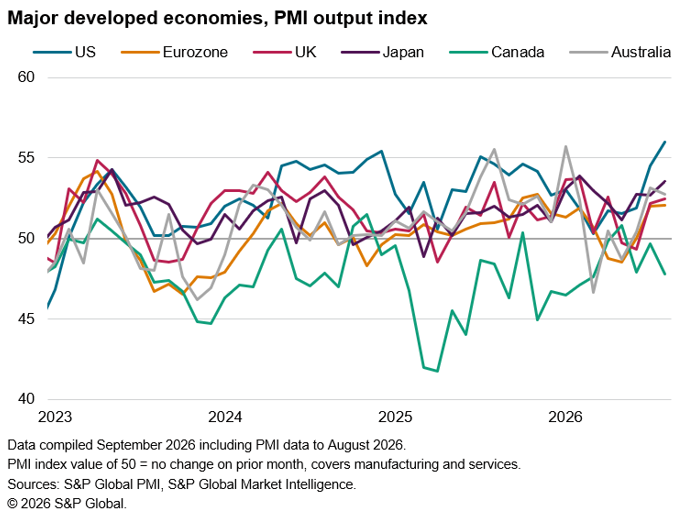
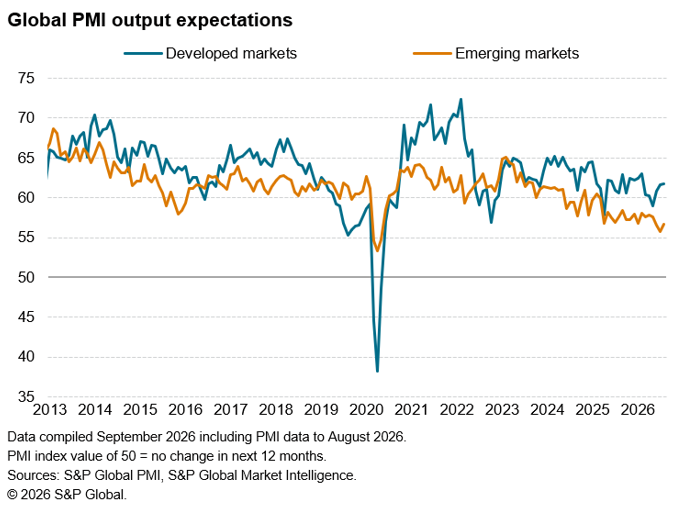
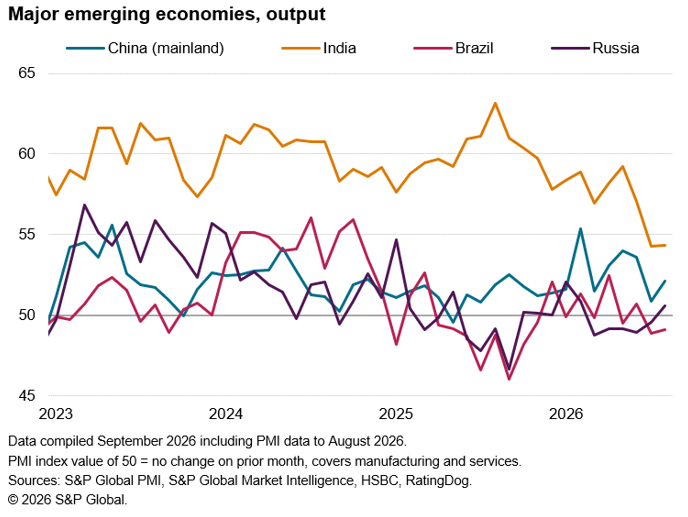
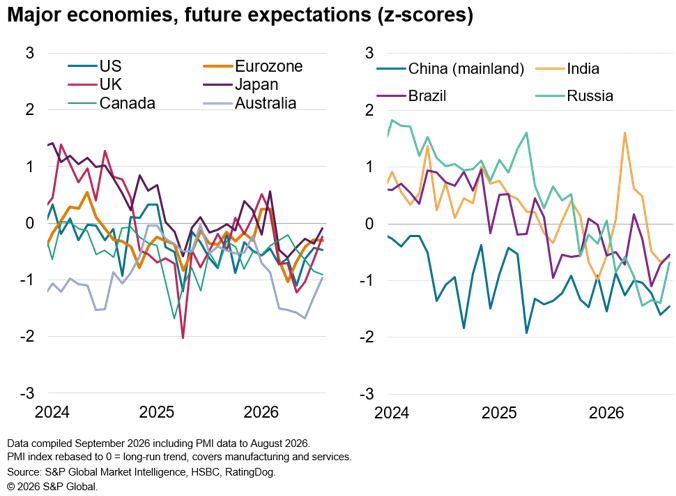
Emerging market growth picked up from July’s 14-month low, but remained one of the weakest seen over the past year. The sluggish expansion could be partly explained by a lack of confidence. Although future sentiment improved slightly, it remained close to all-time lows.
Although India remained the best performer among the four largest emerging economies, its growth rate was unchanged on July, which had seen the worst performance since March 2022. Both manufacturing and service sector growth rates have been subdued in India over the past two months.
Growth improved in mainland China but has also weakened so far in Q3 from that seen in Q2, albeit with manufacturing reporting one of the best output gains seen over the past two years in August. Services growth remained especially sluggish.
Brazil meanwhile reported a contraction of output for a second successive month, led by the steepest manufacturing downturn for over three years. In contrast, Russia returned to growth for the first time in six months thanks to rising service sector output.
In terms of future optimism, confidence remained especially subdued in mainland China, though in all cases sentiment remained below long-run averages across both advanced and emerging economies.
© 2026, S&P Global. All rights reserved. Reproduction in whole or in part without permission is prohibited.
Purchasing Managers' Index™ (PMI®) data are compiled by S&P Global for more than 40 economies worldwide. The monthly data are derived from surveys of senior executives at private sector companies, and are available only via subscription. The PMI dataset features a headline number, which indicates the overall health of an economy, and sub-indices, which provide insights into other key economic drivers such as GDP, inflation, exports, capacity utilization, employment and inventories. The PMI data are used by financial and corporate professionals to better understand where economies and markets are headed, and to uncover opportunities.
Read our latest PMI commentary here.
This article was published by S&P Global Market Intelligence and not by S&P Global Ratings, which is a separately managed division of S&P Global.
Theme
Location
Products & Offerings