ECONOMICS COMMENTARY — 28 Sep, 2026
Strong September Flash PMIs beat expectations, shaking bond markets

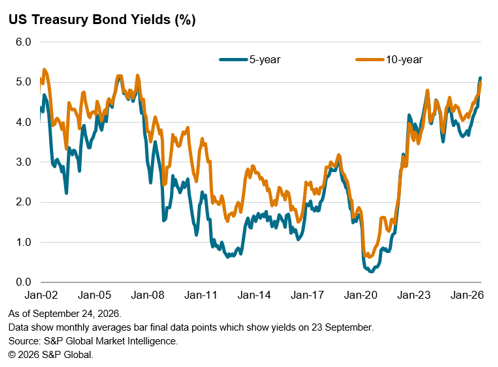
US ten-year and five-year Treasury yields have risen above 5%, hitting their highest levels since 2007, after S&P Global ‘flash’ PMI data showed the US economy gaining momentum in September alongside signs of stubbornly high inflation, defying economists’ expectations of a slowdown. The bond sell-off after the data was the sharpest since the US tariff announcements of April 2025, according to the Financial Times. Markets have grown increasingly concerned that further monetary policy tightening will be required from the US Fed and other central banks as economies continue to show resilience.
US growth surge
The US PMI showed output growth accelerating to the highest for over five years, since July 2021. Barring the rebound in economic activity seen after the COVID-19 lockdowns, September’s rise in output was the largest recorded since early 2015.
The surveys strengthen the view that the upturn is gaining momentum, corroborating Fed Chair Kevin Warsh’s recent remarks that the economy is heating up. A continuing upturn in services activity – with September among the strongest gains in the survey’s history – was accompanied by renewed manufacturing growth, among the strongest since the pandemic.
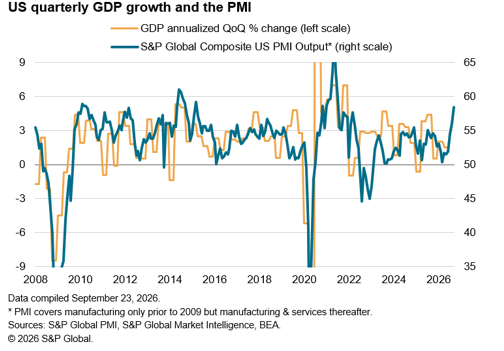
The September flash survey also showed US jobs being added at the fastest pace for over four years, and at a rate rarely exceeded since comparable data were first available in 2009, as firms across manufacturing and services sought to meet rising demand.
Broad upturn across the major advanced economies
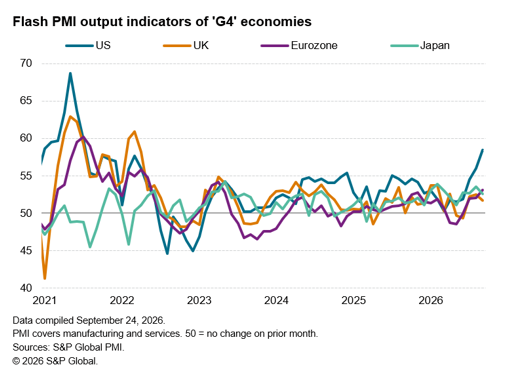
The US reported the fastest growth of the four largest developed economies (the ‘G4’) in the September flash PMI surveys, but other economies also remained resilient despite rising energy prices since the outbreak of war in the Middle East. The eurozone’s September flash PMI showed expansion reaching its highest since April 2023. While growth slowed in Japan, the headline PMI output index stayed firmly in growth territory. The UK was the weakest G4 performer, though its PMI also remained in expansion territory. Some of the UK’s slowdown could also be temporary, as some spending decisions were reportedly delayed ahead of October’s policy-setting Budget.
Collectively, the GDP-weighted output index for the G4 economies rose from 54.3 in August to 55.7 in September, its highest since March 2022.
Elevated cost growth
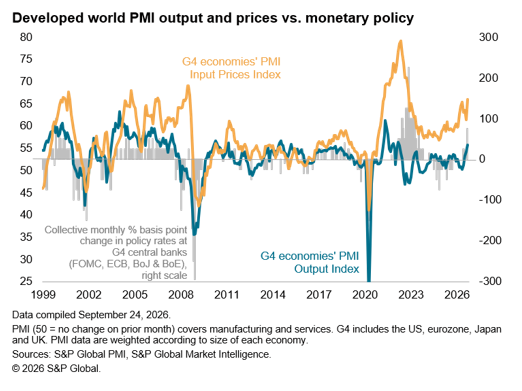
All four major advanced economies also saw sustained elevated cost pressures, with the rate of increase accelerating most markedly in the US to its highest since October 2022. Faster increases were also seen in the eurozone and the UK, the latter continuing to see the steepest cost growth of the G4. Cost growth slowed in Japan for a third month, but remained higher than at any time since early 2023.
Policy outlook turns more hawkish
The data suggest that, despite elevated oil prices and geopolitical uncertainty, the third quarter saw a robust rebound in major developed economies from the war-related slowdown in the second quarter, led by the US.
Survey contributors cite rising AI-related, defense and consumer spending as helping drive the expansion. Many companies also report that shocks such as US tariffs and the war in the Middle East have so far proven less damaging to their order books than feared earlier in the year.
September’s PMI data therefore send further hawkish signals for the FOMC, ECB, Bank of Japan and – to a lesser degree – the Bank of England, suggesting more interest rate hikes are imminent. The odds of a further rate rise at the October FOMC meeting, for example jumped after the flash September PMI, according to CME’s Fed Watch tool, up from 55% before the US flash PMI to above 70% after publication, with further hikes also priced as more likely.
© 2026, S&P Global. All rights reserved. Reproduction in whole or in part without permission is prohibited.
Purchasing Managers' Index™ (PMI®) data are compiled by S&P Global for more than 40 economies worldwide. The monthly data are derived from surveys of senior executives at private sector companies, and are available only via subscription. The PMI dataset features a headline number, which indicates the overall health of an economy, and sub-indices, which provide insights into other key economic drivers such as GDP, inflation, exports, capacity utilization, employment and inventories. The PMI data are used by financial and corporate professionals to better understand where economies and markets are headed, and to uncover opportunities.
Read our latest PMI commentary here.
This article was published by S&P Global Market Intelligence and not by S&P Global Ratings, which is a separately managed division of S&P Global.
Theme
Location
Products & Offerings