ECONOMICS COMMENTARY — 14 Sep, 2026
Manufacturing growth sustained globally by reviving expansions in Asia and Europe

Worldwide manufacturing continued to expand at a solid pace in August, sustaining the best year-to-date performance seen for five years.
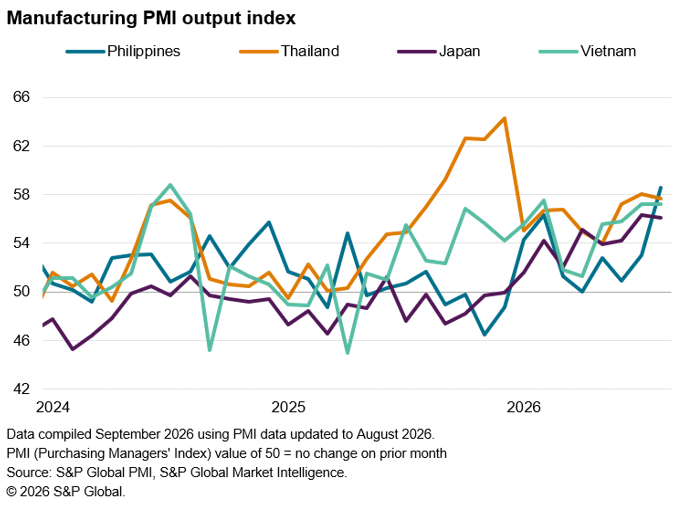
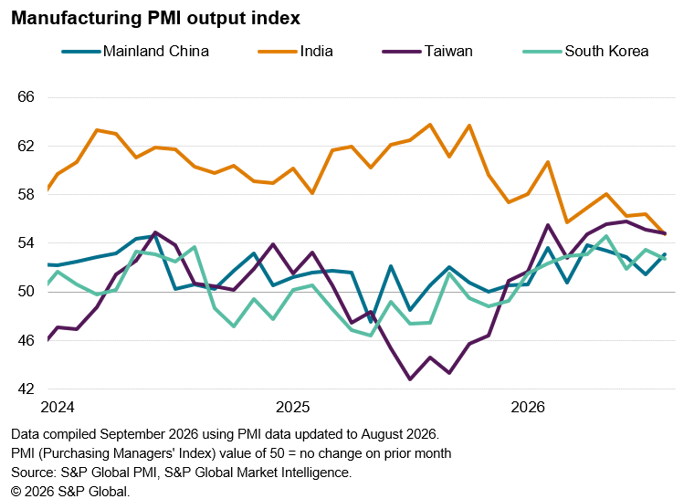
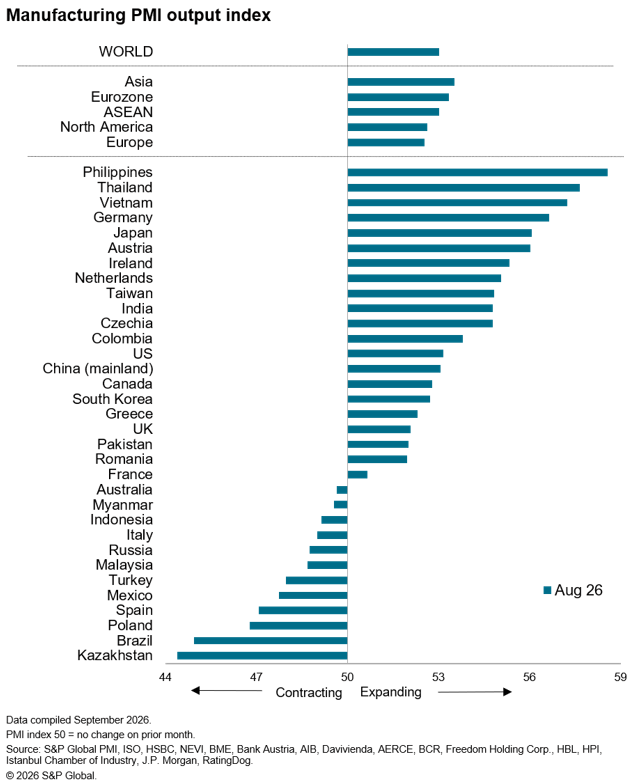
Trends have varied markedly around the world, however, so far this year. August notably brought welcome signs of reviving growth in many Asian manufacturing-oriented economies that had been especially hard hit earlier in the year by supply issues resulting from the war in the Middle East. The Philippines, Thailand and Vietnam led the August growth rankings. Japan followed in fifth place globally, with growth just below July’s 12-year high. The factory expansion also gained momentum again in mainland China.
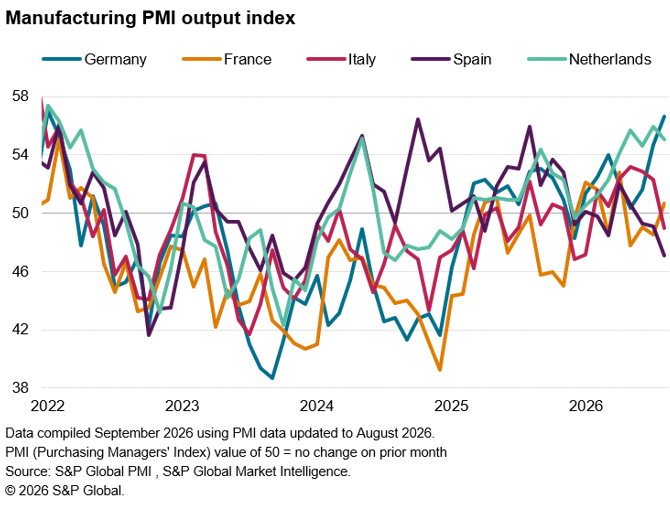
The good news was not confined to Asia, however, as Germany climbed to fourth place in the global rankings, propelling eurozone growth to the fastest since the start of 2022.
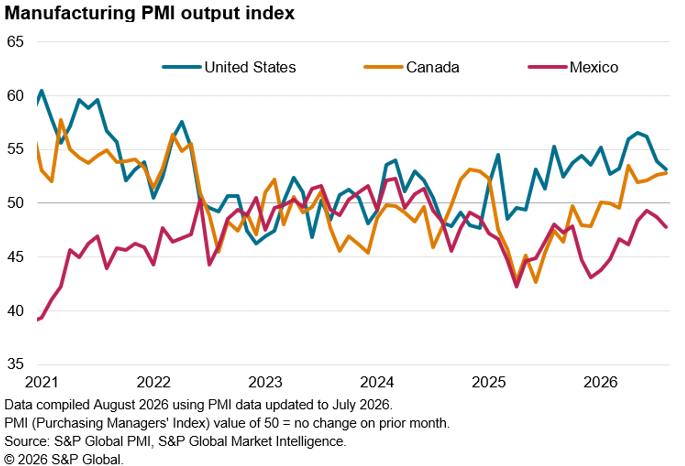
In contrast, growth slowed for a third successive month in the US, down to its slowest since February, contrasting with the growth spurt seen in the US earlier in the year.
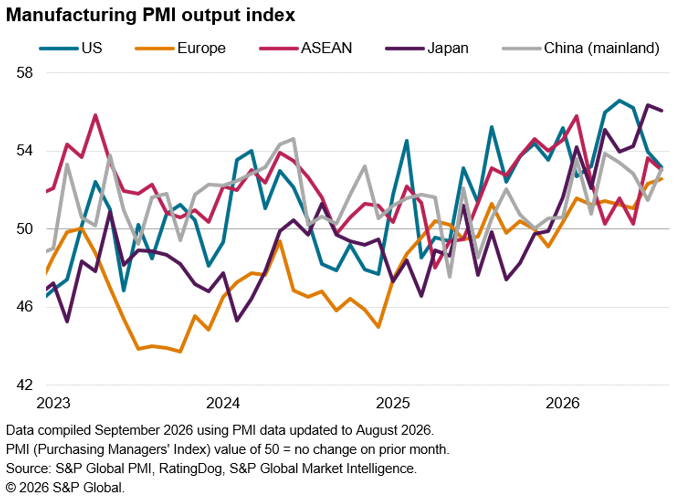
Manufacturing PMI remains in robust growth territory
Manufacturing output continued to expand at a solid pace in August, according to the Global PMI compiled by S&P Global on behalf of J.P. Morgan, enjoying its best year so far since 2021. The headline PMI rose to 52.3 from 52.1 in August, down only slightly from the second quarter average of 52.5.
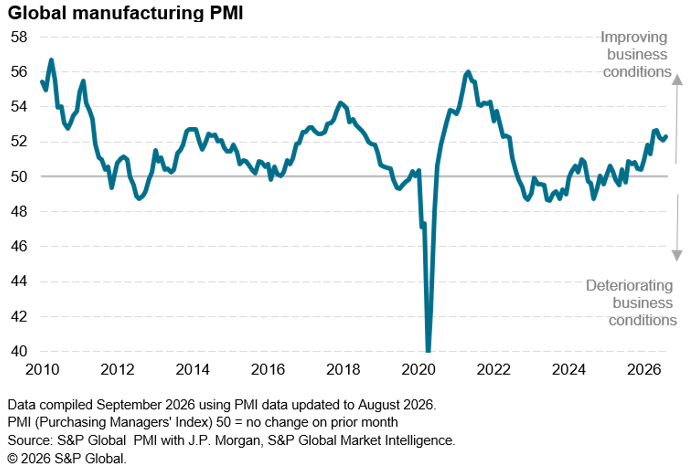
The slowdown in growth compared to the second quarter is in part due to fewer reports of safety, or buffer, stock building. Such stockpiling had been a key driver of factory growth in the early months of the war in the Middle East, but eased sharply in July and has picked up only slightly again in August.
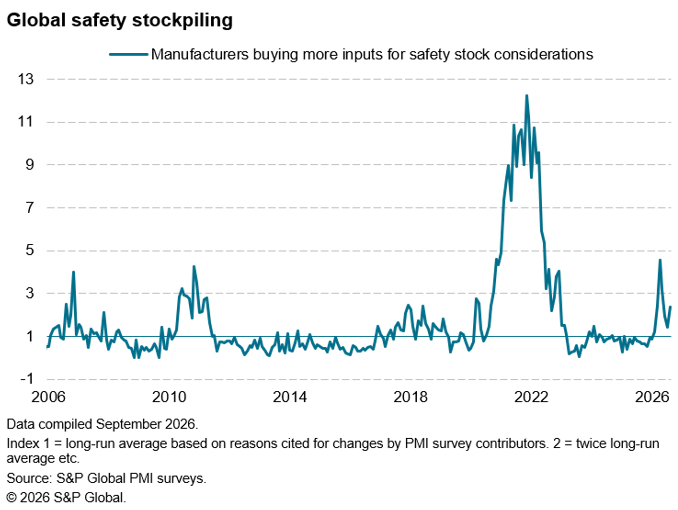
Hence inventories have provided a diminishing but positive contribution to the headline PMI in the past two months, though a welcome associated development has also been the easing of supply chain delays. Longer supplier delivery times have in fact been the strongest individual component of the PMI over the year to date.
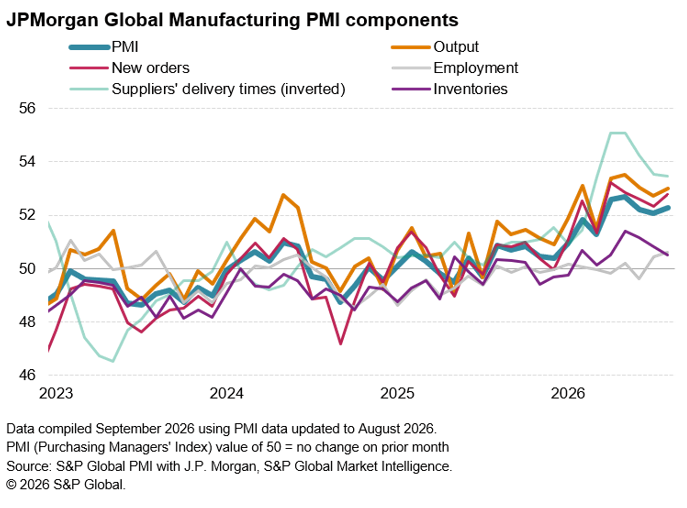
Focusing on production
Note that longer delivery times act as a positive contributor to the PMI as they are usually associated with welcome news of factories being busier. However, this means that supply shocks such as the pandemic and wars also cause suppliers’ delivery times to boost the PMI. Hence at such times we prefer to focus on the PMI’s output sub-index. This latter index measures monthly changes in production and therefore acts as a more reliable indicator of official industrial production numbers than the headline PMI. It also provides cleaner international comparisons of factory output.
Asian rebound
Comparisons of the PMI Output Index reveal that some of the economies hardest hit by the initial supply shock from the war in the Middle East have shown encouraging sign of revival, notably among Southeast Asian economies.
Hence the Philippines saw the fastest manufacturing output growth worldwide in August, enjoying its strongest gain since late-2016, followed by Thailand, where growth hit the second-highest so far this year, and Vietnam, where the expansion was the strongest since February.
Japan ranked in fifth place, with growth just below July’s 12-year high, though here the expansion could also be traced to the recent weakness of the yen, which has boosted competitiveness.
The factory expansion gained momentum again in mainland China (the fourth-strongest in over two years), but growth cooled in South Korea, Taiwan and India. While robust overall, August’s rise in Indian manufacturing output was notably the weakest since August 2021.
European resilience
The Asian dominance was broken, however, by Germany climbing to fourth place globally as growth reached the sharpest since January 2022. Strong gains were also seen in Austria, Ireland and the Netherlands, collectively propelling eurozone growth to the fastest since the start of 2022. UK factory growth slipped to a four-month low to dip below that of the eurozone, though remained in solid growth territory.
However, not all news out of Europe was good. Spain’s manufacturing sector contracted at the fastest rate since December 2023, and Italy slipped into decline alongside another sharp downturn in Poland.
US slowdown contrasts with Canadian upturn
There was also disappointing news in many American economies. However, as manufacturing output growth slowed for a third successive month in the US, down to its slowest since February, growth accelerated in Canada to its fastest since April – and one of the fastest rates seen over the past four years. Both US and Canadian growth rates were nonetheless robust, helping sustain overall North American output growth for the fifteenth successive month, offsetting an ongoing decline in Mexico, where output has fallen continually since July 2024.
The cooling of US manufacturing growth in part reflects an especially strong performance earlier in the year, when stock building and the AI build-out were reported as key drivers of the expansion in the second quarter.
The hardest hit
Kazakhstan and Brazil meanwhile suffered the steepest downturns among economies monitored by the global PMI surveys, the latter seeing the steepest decline since April 2023, followed by Poland, Spain and Mexico.
Access the latest global PMI press release here.
© 2026, S&P Global. All rights reserved. Reproduction in whole or in part without permission is prohibited.
Purchasing Managers' Index™ (PMI®) data are compiled by S&P Global for more than 40 economies worldwide. The monthly data are derived from surveys of senior executives at private sector companies, and are available only via subscription. The PMI dataset features a headline number, which indicates the overall health of an economy, and sub-indices, which provide insights into other key economic drivers such as GDP, inflation, exports, capacity utilization, employment and inventories. The PMI data are used by financial and corporate professionals to better understand where economies and markets are headed, and to uncover opportunities.
Read our latest PMI commentary here.
This article was published by S&P Global Market Intelligence and not by S&P Global Ratings, which is a separately managed division of S&P Global.
Theme
Location
Products & Offerings