ECONOMICS COMMENTARY — 08 Sep, 2026
Global PMI signals fastest employment growth for over three years

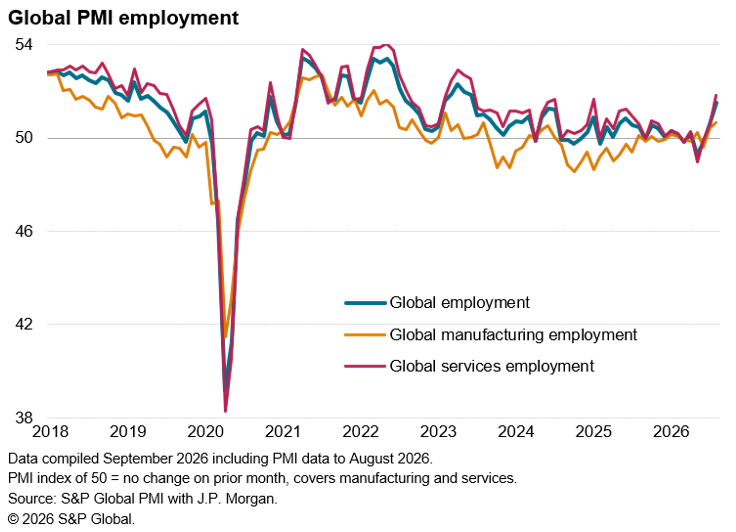
August, according to PMI survey data, with a jump in service sector payrolls accompanied by a further revival of factory jobs. The improvement was a reflection of the need to meet rising backlogs of work, with companies boosting productive capacity to meet customer demand amid an easing of corporate uncertainty.
Especially noteworthy jobs growth was reported in India and the US, but European and mainland China’s hiring trends have also improved in recent months. By sector, the labour market improvement is being led by financial services and technology firms.
Global jobs growth reaches three-year high
An especially welcome development in August was the revival of employment growth recorded by the Global PMI. Worldwide payrolls rose at a pace not seen since June 2023, according to the J.P. Morgan Global Composite PMI Employment Index, compiled by S&P Global.
The job gains were led by the service sector, where payrolls rose globally at a pace not beaten for over three years, with a more modest gain seen in the manufacturing sector. The latter was nonetheless the best seen in three-and-a-half years.
Business confidence edges higher
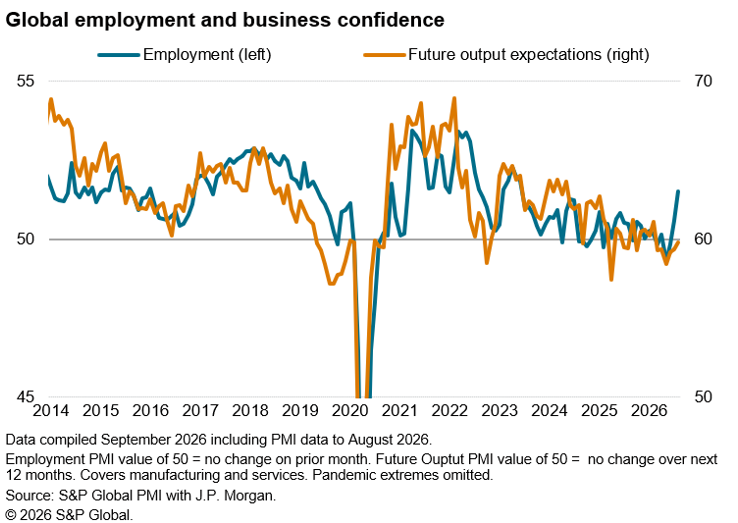
The improvement in hiring was also notable given that business confidence remained relatively subdued in August. Although output growth rose to its highest for over two years, business optimism improved only slightly. While year-ahead growth expectations edged up for a third straight month to reach their highest since the outbreak of the Middle East war back in February, growth expectations remain very subdued by historical standards and appear limited in respect to the upturn in employment.
Rising backlogs drive renewed hiring demand
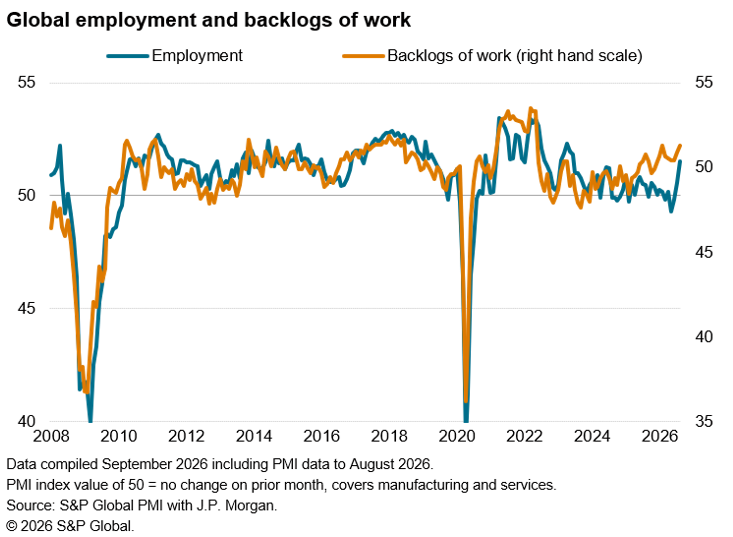
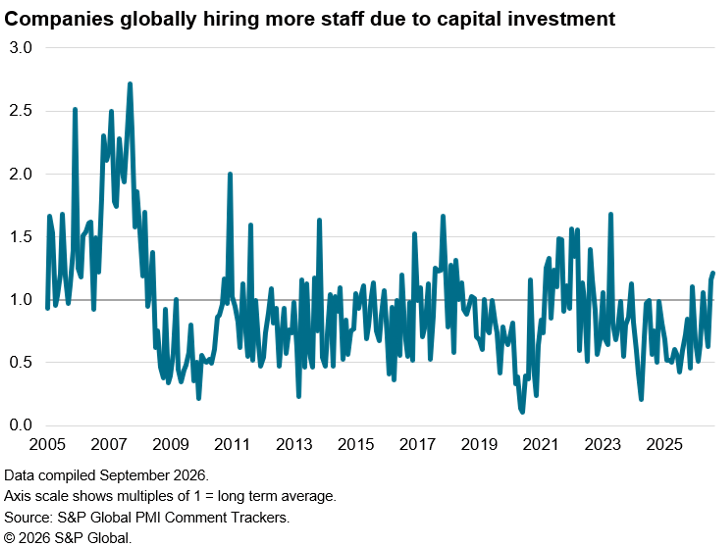
The August rise in business confidence was nonetheless sufficient to encourage more companies to take on staff to deal with accumulating backlogs of work, which have risen sharply worldwide in recent months. Employment has lagged output in recent months, registering very weak growth despite firms reporting consistently higher output, orders and backlogs of uncompleted work. This situation showed signs of changing in August, however. As global backlogs of work showed the joint-largest gain for over four years, it now seems that firms are re-entering the jobs market to expand operating capacity to meet this sustained increase in customer demand.
Reduced uncertainty supports the return to hiring
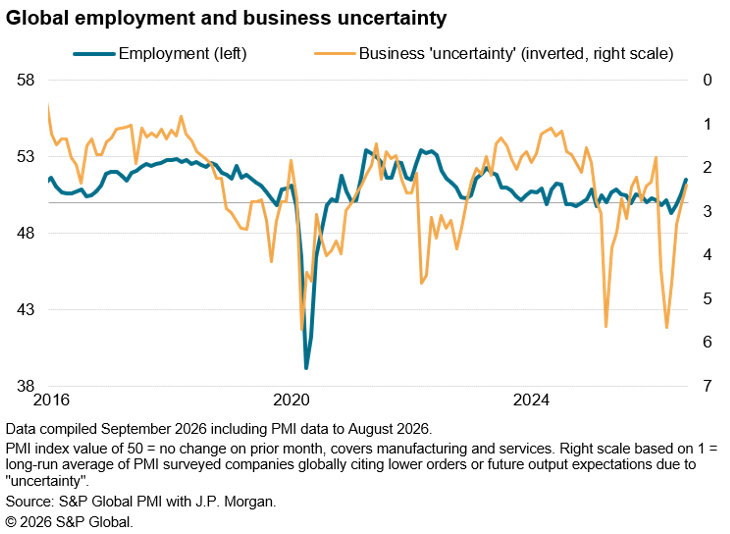
The return to hiring could in part also be linked to an easing of corporate uncertainty, which had spiked earlier in the year due to worries over the war in the Middle East. While still elevated by historic standards, uncertainty appears to have moderated back to levels which have encouraged the expansion of capacity after hiring freezes at many firms in prior months.
US payrolls surge and European job trends improve
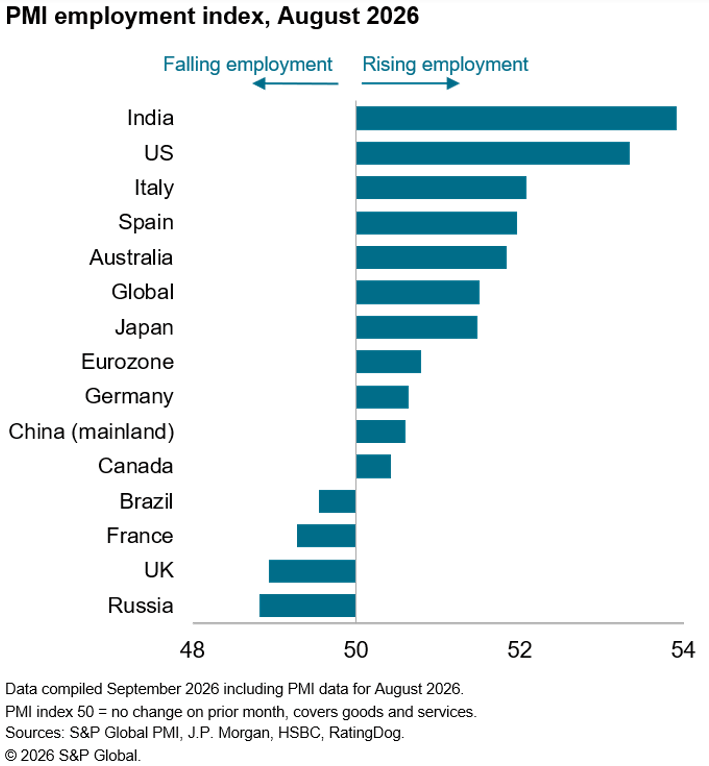
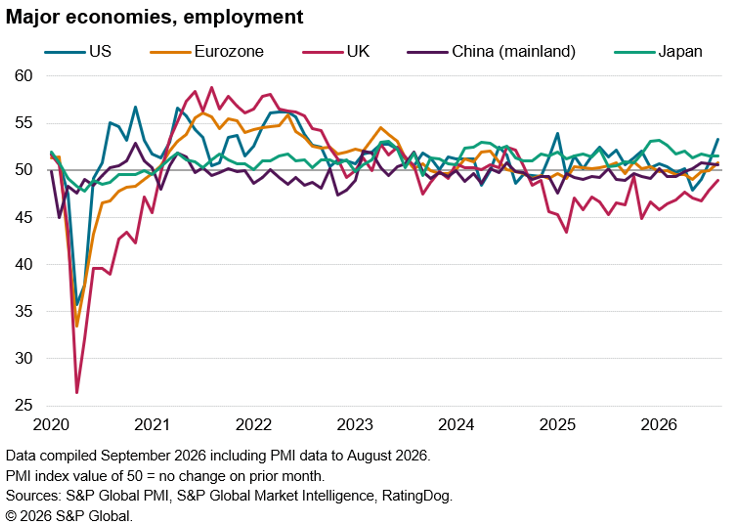
Among the major economies tracked by the PMI, the strongest jobs gain was reported in India during August, where the increase was the largest for 14 months, but the US was notable in reporting the second-strongest gain, with payroll growth advancing to its highest since July 2022 amid strengthening net job creation across both goods and services.
Mainland China meanwhile saw a fourth successive month of higher employment, sustaining its best jobs spell since early 2023, buoyed by rising service sector jobs.
While employment growth held steady in Japan, a cooling of job gains in services masked the better news of the largest rise in factory jobs since February 2018.
In Europe, the eurozone reported the first increase in employment since December, with a solid gain in service sector jobs accompanied by the first — albeit marginal — rise in factory jobs for over three years.
Although employment continued to fall in the UK, continuing the trend seen since the 2024 Budget, the pace of job losses moderated to a 10-month low.
Jobs growth meanwhile softened in both Canada and Australia, while job losses persisted in both Russia and Brazil.
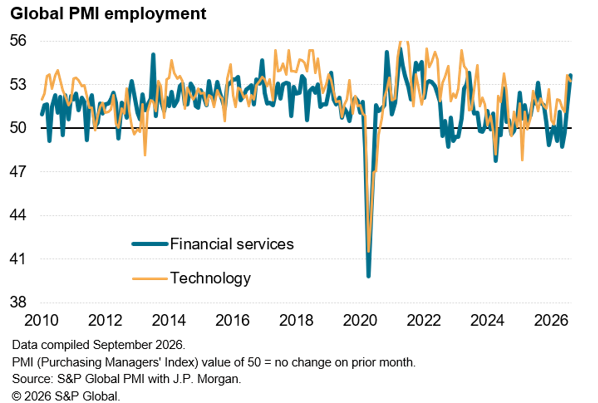
Financial services and technology lead global jobs growth
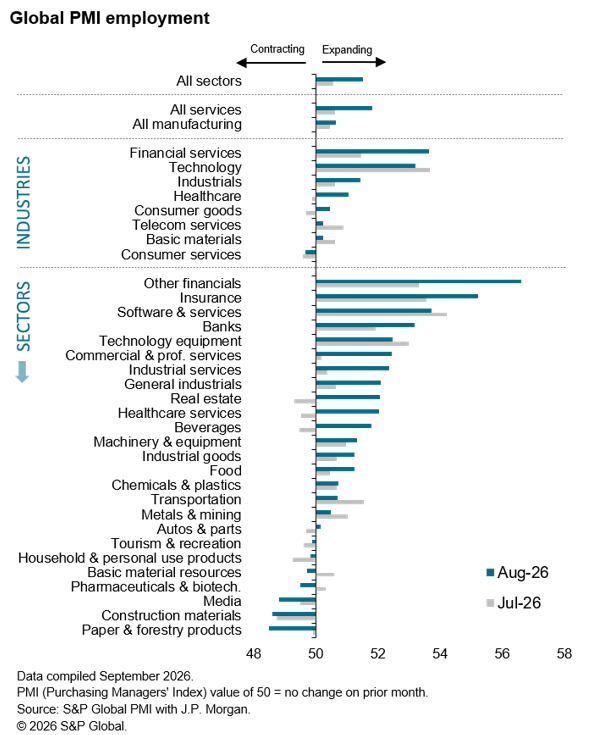
By sector, the upturn in global hiring was clearly led by the combination of financial services and technology. The former reported the largest jump in employment for 38 months. While tech firms reported a slight drop in jobs growth, it remained stronger than at any time since early 2023. Consumer services was the only broad industry to report a drop in staffing levels.
© 2026, S&P Global. All rights reserved. Reproduction in whole or in part without permission is prohibited.
Purchasing Managers' Index™ (PMI®) data are compiled by S&P Global for more than 40 economies worldwide. The monthly data are derived from surveys of senior executives at private sector companies, and are available only via subscription. The PMI dataset features a headline number, which indicates the overall health of an economy, and sub-indices, which provide insights into other key economic drivers such as GDP, inflation, exports, capacity utilization, employment and inventories. The PMI data are used by financial and corporate professionals to better understand where economies and markets are headed, and to uncover opportunities.
Read our latest PMI commentary here.
This article was published by S&P Global Market Intelligence and not by S&P Global Ratings, which is a separately managed division of S&P Global.
Theme
Location
Products & Offerings