ECONOMICS COMMENTARY — 14 Sep, 2026
Global PMI hint at stubborn inflation amid energy and supply chain pressures

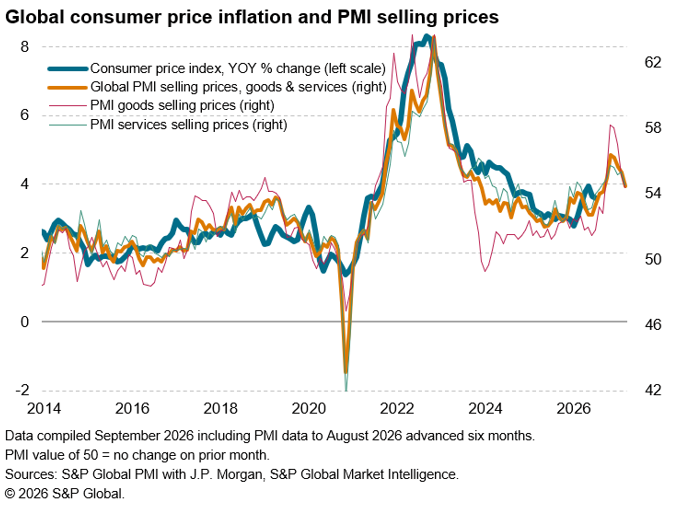
The latest official data point to global inflation cooling slightly in June and July from a recent peak in May, but the latest PMI data hint that it could rise further again in the near term. Concerns stem around renewed upward price pressures from energy and supply chains, principally linked to the ongoing war in the Middle East.
Cooling, but stubbornly high, inflation
Measured across both goods and services, average prices charged once again rose at an elevated rate by historical standards in August, according to the global PMI. Although the latest rise was the weakest recorded since February, the rate of inflation dropping for a fourth straight month, the index remains at a level indicative of higher global inflation than the 3.6% rate officially recorded for July. The leading indicator property of the PMI therefore also hints at the potential for stubbornly high inflation to run into the new year.
Rates of selling price inflation for both goods and services eased further in August, but both remained worryingly high thanks principally to the higher energy and raw material prices resulting from the war in the Middle East.
Japan reports steepest price rise of advanced economies
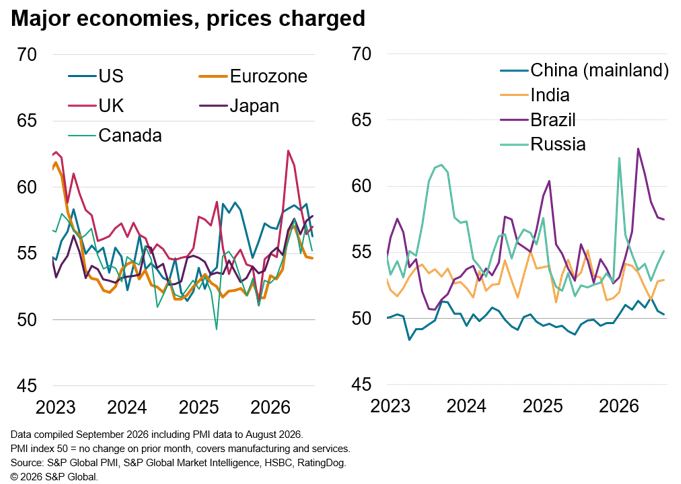
Among the major advanced economies, Japan reported the steepest rate of selling price inflation in August, the rate of increase hitting a new all-time survey high since data were first available in 2007.
The rate of increase also ticked higher in the UK, albeit below recent highs, thanks to an accelerated rate of services inflation.
In contrast, rates of inflation cooled in the US, Canada and Australia, the former notably seeing a welcome slowing of inflation after the near-four-year highs in prior months. US price growth was consequently the slowest since last November.
Eurozone selling price inflation held steady on July, running below recent peaks but – as with all other major developed economies – still elevated by historical standards in both manufacturing and services.
Of the four major emerging markets, Brazil continued to report the steepest rate of inflation, though rates accelerated in both Russia and India. In contrast, mainland China saw the weakest rise of the four economies after its rate of inflation hit a seven-month low, with prices barely rising.
Energy and supply squeeze keep inflation worries elevated
The biggest shift in the factors driving global inflation in August was a downward lurch in pressure from raw material prices. Both labor cost and energy pressures remained elevated by historical standards, albeit the latter down from recent highs. Demand-pull price pressures meanwhile continue to hover around their long-run average.
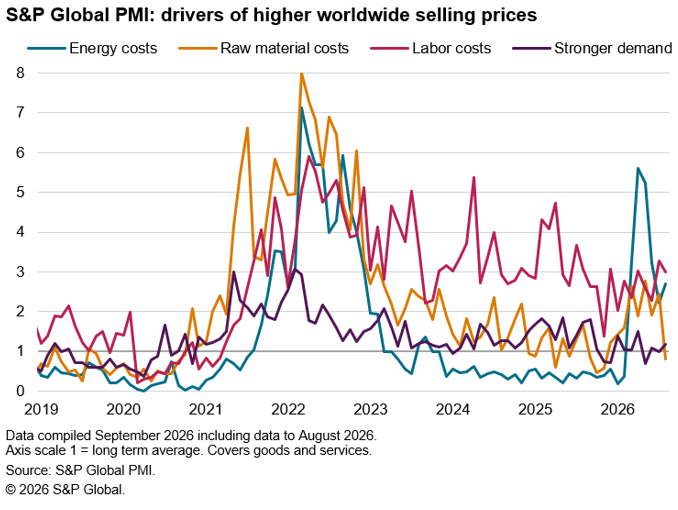
The concern is that renewed hostilities in the Middle East have pushed up energy costs again in September, which will add upward pressure to inflation again.
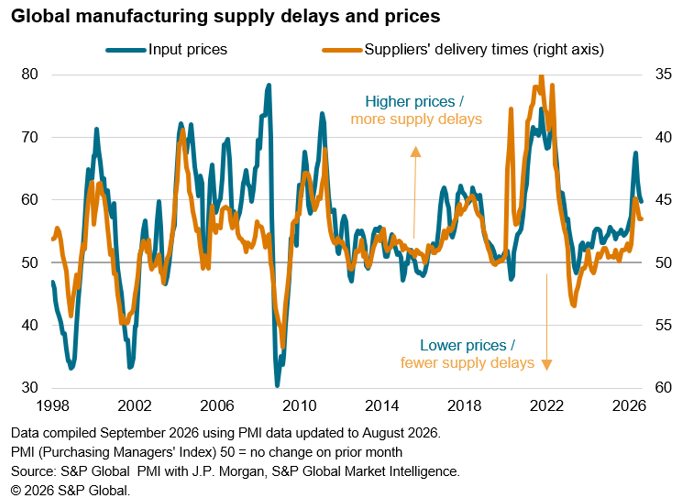
Meanwhile, the ongoing supply squeeze centred on the Middle East remains a concern for inflation. Supply chain delays continued to be widely reported in August, often linked to the drop in shipping through the Strait of Hormuz, though will additional delays coming from low water levels in other key transport routes, keeping raw material price pressures elevated and hence sending a warning signal on broader inflation trends.
Although supplier delivery times lengthened worldwide to a lesser degree than the peaks seen in April and May, the reporting of supply delays remained high by historical standards, sustaining the biggest supply shock since the pandemic.
Supply shortages combined with increased demand for raw materials, the latter in part reflecting safety/buffer stock building, put further upward pressure on manufacturing input costs. While cooling further from the peak in May, global factory input cost inflation in August remained higher than at any time since late 2022.
© 2026, S&P Global. All rights reserved. Reproduction in whole or in part without permission is prohibited.
Purchasing Managers' Index™ (PMI®) data are compiled by S&P Global for more than 40 economies worldwide. The monthly data are derived from surveys of senior executives at private sector companies, and are available only via subscription. The PMI dataset features a headline number, which indicates the overall health of an economy, and sub-indices, which provide insights into other key economic drivers such as GDP, inflation, exports, capacity utilization, employment and inventories. The PMI data are used by financial and corporate professionals to better understand where economies and markets are headed, and to uncover opportunities.
Read our latest PMI commentary here.
This article was published by S&P Global Market Intelligence and not by S&P Global Ratings, which is a separately managed division of S&P Global.
Theme
Location
Products & Offerings