ECONOMICS COMMENTARY — 17 Sep, 2026
GCC economies demonstrate resilience in August

Latest non-oil PMI data pointed to increasing signs of recovery and resilience among the economies in the Gulf Cooperation Council (GCC). Growth of output and new orders gathered pace and companies saw an improvement in lead times for the delivery of materials as they have been able to adapt their supply chains to changing circumstances. The outlook for the year ahead also brightened midway through the third quarter of the year, despite a still uncertain geopolitical backdrop.
Output growth gathers pace in August
Four of the six GCC economies are currently covered by PMI data, the exceptions being Bahrain and Oman. By aggregating the data for the economies that we have data for we can get an insight into the performance of the region as a whole. The GCC aggregate for August showed that business activity increased rapidly during the month, and at a pace that was only just shy of that seen in February, before the outbreak of war in the region. Similarly, new orders also rose sharply and business confidence hit a six-month high amid hopes among firms that they will be better able to focus on sales generation if regional tensions abate.
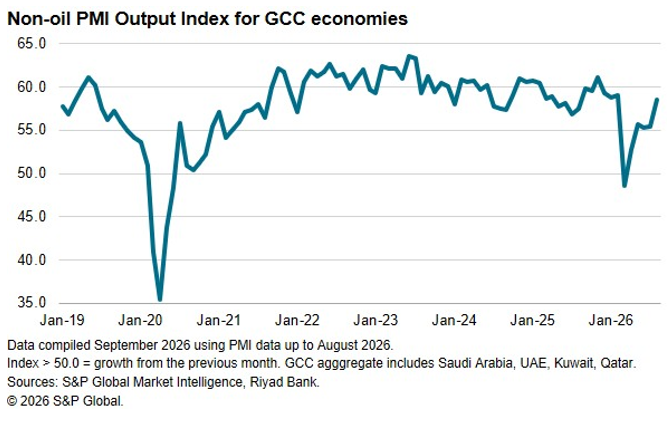
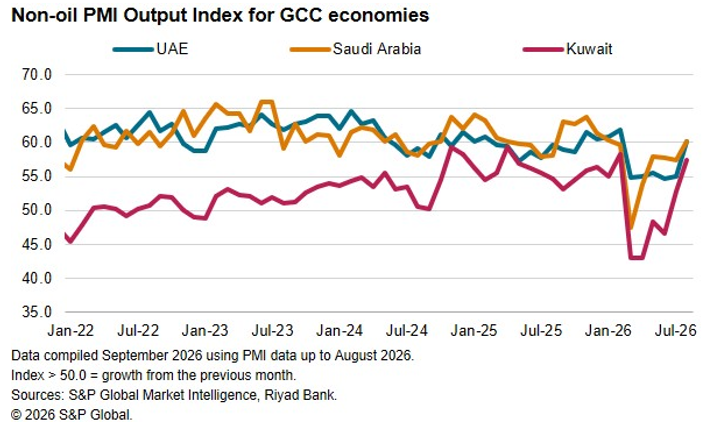
Central to the improving growth picture in the Middle East were strong increases in non-oil business activity in both the UAE and Saudi Arabia, where rates of expansion hit six- and seven-month highs respectively. Relationships between the PMI and official data in these economies suggest that we are likely to see a pick-up in GDP growth during the third quarter of the year following the disruption caused during the first half of 2026.
Overall growth was also supported by further evidence of recovery in Kuwait, where companies had faced particular challenges due to the closure of its airspace and shipping routes earlier in the year. Non-oil output in Kuwait increased for the second month running in August, and at the fastest pace since February. Less positive was a further reduction in output in Qatar amid intensifying cost pressures.
Suppliers’ delivery times shorten
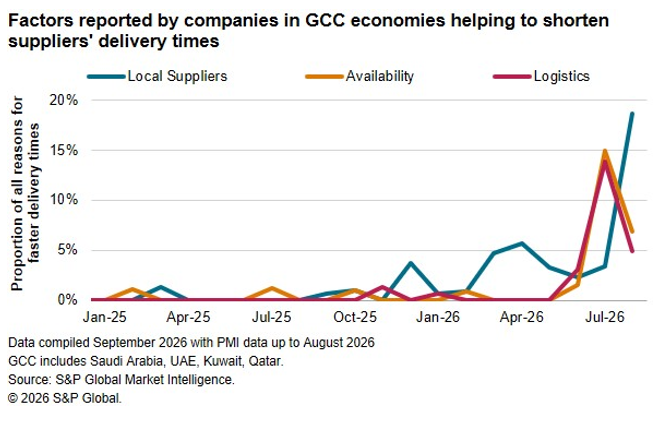
Adding to the generally positive picture in August was a fourth consecutive shortening of suppliers’ delivery times. Vendor performance improved solidly again, with quicker deliveries seen across all four GCC economies for which PMI data are available. According to respondents, the recent improvements in supply-chain conditions have been due to a range of factors as companies adapted to circumstances in order to maintain smooth operations. Better material availability and improved logistics have been widely mentioned in the past few months, while in August, the use of local suppliers in particular helped firms to secure goods more quickly.
Elevated but stable inflation
After spiking higher in April, the rate of input cost inflation across the GCC economies covered by PMI data has since remained broadly stable. As noted, Qatar posted a particularly sharp rise in input prices in August, with the latest increase the fastest in just under two years. Across the region, companies have been successful in limiting selling price inflation, which eased to a three-month low during August.
Outlook
While the picture painted by the August PMI data was generally positive, recent events have the potential to limit growth again in the months ahead. The monthly PMI data will therefore be key in monitoring the path of these economies.
© 2026, S&P Global. All rights reserved. Reproduction in whole or in part without permission is prohibited.
Purchasing Managers' Index™ (PMI®) data are compiled by S&P Global for more than 40 economies worldwide. The monthly data are derived from surveys of senior executives at private sector companies, and are available only via subscription. The PMI dataset features a headline number, which indicates the overall health of an economy, and sub-indices, which provide insights into other key economic drivers such as GDP, inflation, exports, capacity utilization, employment and inventories. The PMI data are used by financial and corporate professionals to better understand where economies and markets are headed, and to uncover opportunities.
Read our latest PMI commentary here.
This article was published by S&P Global Market Intelligence and not by S&P Global Ratings, which is a separately managed division of S&P Global.
Theme
Location
Products & Offerings