Research — Sep 18, 2026
Consensus price forecasts – Metals prices recover as rate path prospects shift

By Anna Duquiatan
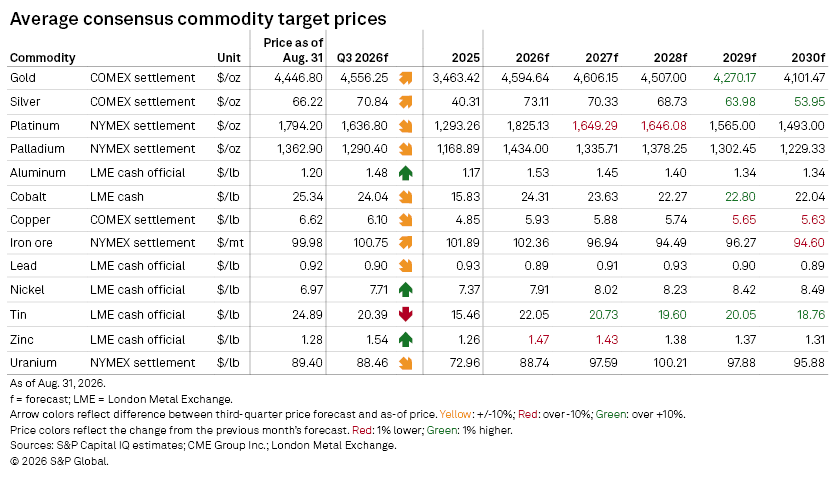
S&P Global Energy discusses consensus price forecasts for industrial and precious metals, including platinum group metals, amid broader market trends. The consensus target prices represent the average of broker estimates for each commodity for a given period, as compiled by S&P Capital IQ.
See S&P Global Energy's most recent market outlooks for aluminum, copper, gold, iron ore, lithium and cobalt, nickel and zinc.

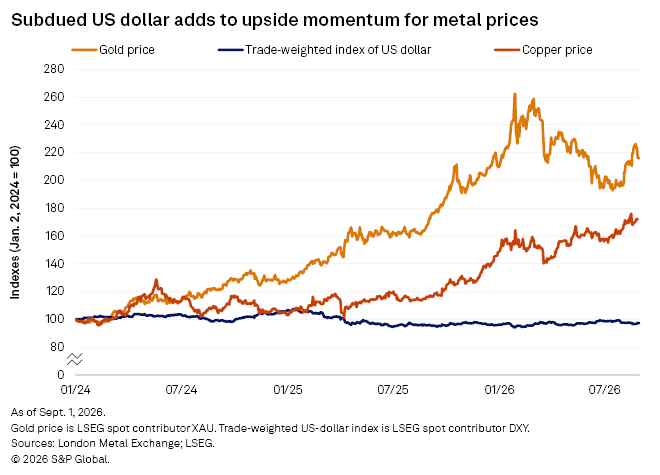
August updates to consensus price targets were mixed across metals markets. A brief softening of rate-hike expectations weighed on the US dollar, driving temporary tailwinds for metals prices. While pockets of supply constraints underpin fundamental support, concerns over Chinese demand cap upside potential. Meanwhile, shifting macroeconomic signals fueled price volatility.

Reports of a cooling US labor market tempered expectations for an upcoming Federal Reserve interest rate hike, helping metals prices recover in August. US nonfarm payrolls fell by 23,000 in July, contrary to expectations for an increase, while inflation continued to exceed the US Federal Reserve's 2% target. With a more restrictive policy path appearing less likely, the trade-weighted index of the US dollar remained below 100 throughout much of August.
A hawkish Fed stance has emerged of late, however. In an Aug. 28 speech, Fed Chair Kevin Warsh reiterated the central bank's commitment to containing inflation and emphasized that interest rates are the "predominant tool" for achieving its mandate. Odds of increased policy rates rose, with markets pricing in a 66.2% probability of a rate hike as of Sept. 2, from 36.6% a week earlier.
Complicating macroeconomic signals, the US Treasury Department announced on Aug. 19 that it would double the size of its long-dated bond buyback operations to improve market liquidity and temper rising yields. Treasury yields initially fell, pressuring the US dollar and boosting metals prices. However, yields promptly resumed an upward trajectory as fundamentals that underpin their surge remained intact; inflation worries and a growing budget deficit continue to cloud the US economic outlook. The prolonged US-Israel war with Iran has kept oil prices elevated, preserving energy-related inflationary pressures.
Although manufacturing activity across most major economies was in expansionary territory in August, accelerated inflation and the prospect of higher interest rates keep underlying demand conditions fragile. In China, a decline in real estate investment and reductions in buildings under construction compounded demand-side pressure.
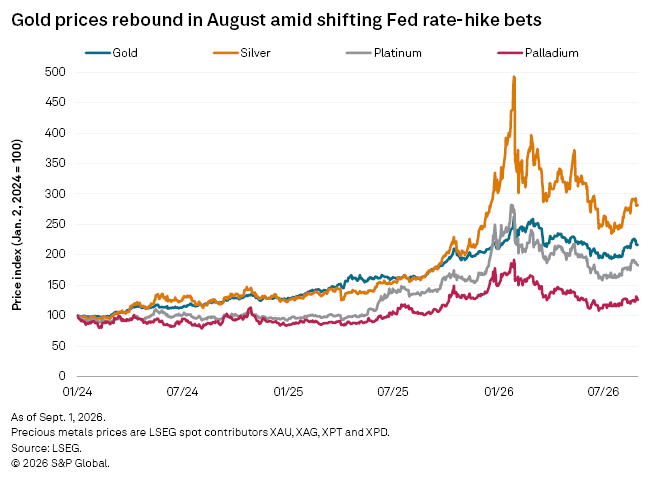
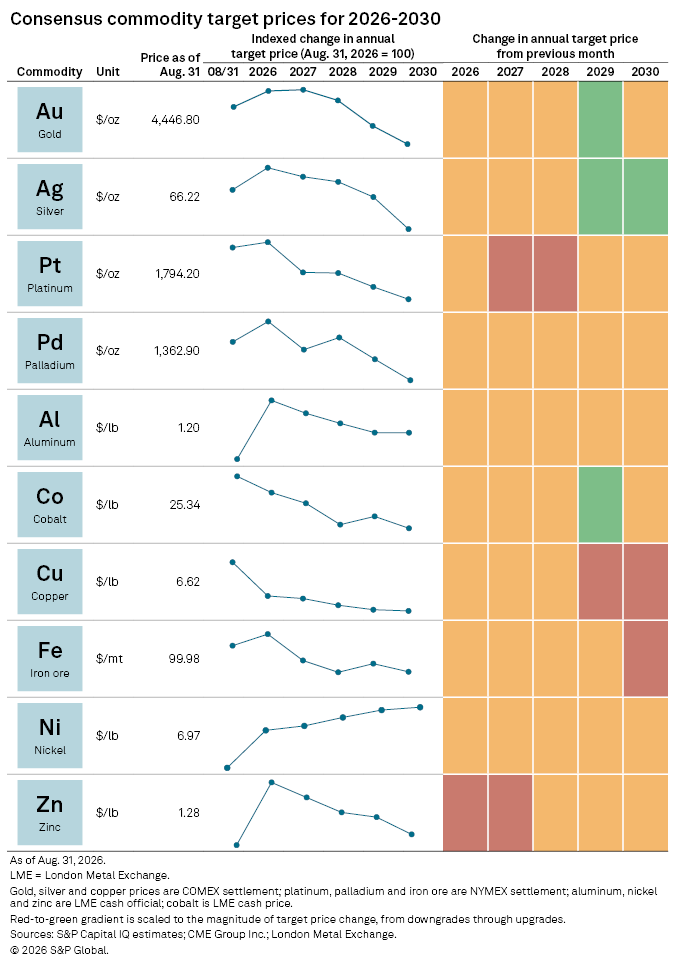
Bolstered by a subdued US dollar and renewed investor demand, the COMEX gold price rebounded to a three-month high of $4,640.8 per ounce on Aug. 24. Global physically backed exchange-traded funds (ETFs) resumed net inflows in July after two consecutive months of outflows, while official-sector demand remained supportive. However, elevated bond yields signaled an ongoing opportunity cost of holding non-yielding assets such as precious metals, limiting price gains for gold. Consensus price forecasts for gold were lowered by an average of 0.3% across 2026-28 but upgraded 0.8% across 2029-30.
The COMEX silver price rose 11.3% month over month to average $65.3/oz in August, joining the recovery across the precious metals space. Global silver ETF holdings increased by 7.6 million oz in July after six consecutive monthly declines. Expectations of a prolonged structural deficit despite weakening industrial demand continued to drive fundamental support. Still, elevated Treasury yields and shifting expectations for US monetary policy remain downside risks. Silver consensus price outlooks were lowered 0.2% on average across 2026-28 and raised 4.5% across 2029-30.
Price recovery extended to platinum group metals, with NYMEX platinum and palladium prices climbing to above $1,800/oz and $1,300/oz, respectively, during August. ETF holdings for both metals increased in July, although higher bond yields could dampen investment appeal. Fundamentals continue to diverge, with platinum expected to remain in deficit through 2030 while palladium moves toward surplus. Consensus price forecasts were lowered by 1.6% on average across 2026-28 for platinum but remain almost unchanged for palladium.
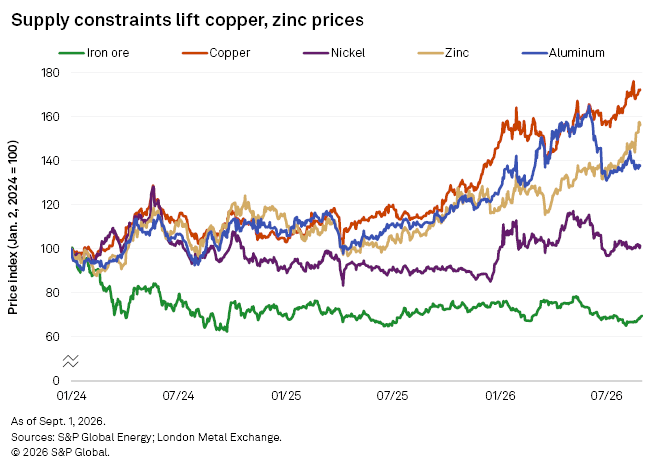
At the copper market, tariff uncertainty compounded structural supply challenges, propelling the London Metal Exchange three-month (LME 3M) copper price to a new all-time high of $14,349.5 per metric ton on Aug. 25. Uncertainty over potential US tariffs on refined copper continued to draw material into COMEX, where inventories as of Aug. 20 reached 241% of combined LME and Shanghai Futures Exchange stockpiles. During the month, LME inventories fell to their lowest level since February, driving the cash-to-3M spread to a multiyear-high backwardation. A sustained concentrate shortfall, resource nationalism, and recent mine and smelter disruptions could further constrain refined copper availability. Already, steep metal prices have begun to weigh on downstream consumption in China. Although tariff-related premiums could unwind once the tariff policy becomes clearer, tight supply conditions will continue to support copper's upside potential. Consensus price forecasts for copper were upgraded 0.5% on average across 2026-27 but lowered 1.0% across 2028-30.
The LME 3M zinc price rallied in August to approach $3,900/mt toward month-end, with supply constraints also a dominant theme in the market. Both imported and domestic concentrate treatment charges fell further into negative territory, as smelter restarts following maintenance and weather-related mine disruptions exacerbated the concentrate supply squeeze. Substantial withdrawals from LME warehouses reduced visible inventories, widening cash-to-3M backwardation. However, lower crude steel output amid industry reforms and a stagnant construction sector in China continue to dim demand prospects. Zinc consensus price outlooks were downgraded 1.3% on average across 2026-28 and lifted 0.2% across 2029-30.
Historically low LME stockpiles propped up the LME 3M aluminum price to above $3,300/mt briefly in mid-August, but improving supply availability and China demand concerns prevented a sustained rally. China's exports of semifabricated aluminum products rose 19.4% year over year in January-July, helping to mitigate acute supply tightness stemming from the Middle East war. Smelter restarts in the Middle East and capacity expansions in Southeast Asia are expected to boost global primary aluminum output, helping to narrow projected market deficits through 2028. Regional premiums pulled back from recent highs amid muted demand in Japan and tariff uncertainty in the US. Negotiations to reduce the US' Section 232 tariffs on Canadian aluminum exports broke down on Aug. 21, reigniting trade tensions between the two countries. In China, sluggishness in the property sector continues to dampen demand sentiment. Consensus price targets for aluminum were nearly unchanged across the five-year forecast horizon.
The LME 3M nickel price was rangebound between $16,750/mt and $17,200/mt in August, as uncertainty over Indonesian mining policy prevailed. Reports that Weda Bay had received an additional mining quota — after it exhausted its original allocation — heightened oversupply concerns, although a government official later refuted the news. The country's trade flows were also disrupted by confusion surrounding Indonesia's rare earth elements (REE) export rules, as differing interpretations temporarily delayed export clearances and stranded shipments of nickel-containing products. A subsequent rule clarification that limited an export ban to pure REE products later eased bottlenecks. Feeding downside pressure, declining uptake of nickel-intensive batteries continues to temper demand sentiments. Nickel consensus price expectations were lowered an average of 0.2% across 2026-30. Future price discovery may be influenced by Indonesia's plan to launch its own mineral exchange, which would allow the country to move beyond being a commodity producer toward becoming a price setter.
The Platts IODEX 61% Fe iron ore price stabilized at just above $95.0/dmt over Aug. 6-21, before closing in on $100.0/dmt at the end of the month. Platts is part of S&P Global Energy. Stockpiling and buying at low prices drove China's imports of iron ore to a record 736.8 million mt in the January-July period, pushing port inventories to historic highs. Exports from Australia and Brazil rose in the first half of the year, with further upside likely, as shipments typically pick up pace in the second half. Sintering restrictions in China and constrained domestic concentrate supply bolstered lump and pellet premiums, although weakening steel mill profitability caps support. China's steel mills have begun to face negative margins, as domestic coking coal and coke price hikes due to tight availability accompanied subdued steel prices. While Chinese imports are expected to remain resilient through 2030, declining domestic steel demand and growing global seaborne trade surplus continue to present downside risks. Consensus price forecasts for iron ore were raised 0.4% on average across 2026-29 but downgraded 1.1% for 2030.
The Platts-assessed ex-warehouse Shanghai cobalt metal price unraveled in August to reach a monthly low of 290,000 yuan/mt on Aug. 20, as meaningful cobalt shipments from the Democratic Republic of Congo arrived in China. Imports of DRC cobalt into China surged more than fivefold month over month in June to more than 3,000 mt, marking the highest monthly arrivals since July 2025 and signaling a path for shipments to normalize to 9,000-10,000 mt/month. Easing supply tightness coincided with sluggish demand, as electric vehicle sales softened amid a seasonal slowdown, and cobalt-containing batteries continued to lose market share to alternative chemistries in traction battery production. Consumer electronics production also remained constrained by semiconductor and memory chip shortages. Normalizing DRC export flows and increasing production from secondary sources and emerging producers is expected to drag on prices, although rising resource nationalism could make access to supply a longer-term challenge. Cobalt consensus price outlooks were lifted an average of 0.6% across 2026-30.
For questions or more information, please contact:
Anna Duquiatan, Principal Analyst, Metals and Mining Research, anna.duquiatan@spglobal.com
S&P Global Energy produces content for distribution on S&P Capital IQ Pro.
This article was published by S&P Global Market Intelligence and not by S&P Global Ratings, which is a separately managed division of S&P Global.