Research — Aug 06, 2026
REITs increasingly favoring at-the-market offerings when issuing equity

By Chris Hudgins
With low valuations for the sector overall, follow-on common equity offerings for US real estate investment trusts have declined significantly in recent years. That being said, REITs continue to utilize at-the-market offering programs as a form of raising capital.

➤ US equity REITs have increasingly preferred at-the-market programs for issuing common stock as opposed to more traditional follow-on equity offerings. Follow-on common equity offerings have largely declined since the latter half of 2022 as valuations for the sector declined; however, common stock issuance through at-the-market programs has remained high over the time period.
➤ At-the-market offering programs typically include lower commission spreads for sales agents, making them a cheaper option for common stock issuance.
➤ The number of sales agents underwriting REIT at-the-market offerings has grown significantly in recent years, with 52 different sales agents associated with ATM programs utilized by REITs to raise capital during the first quarter of 2026.

At-the-market offerings outpace follow-on stock offerings
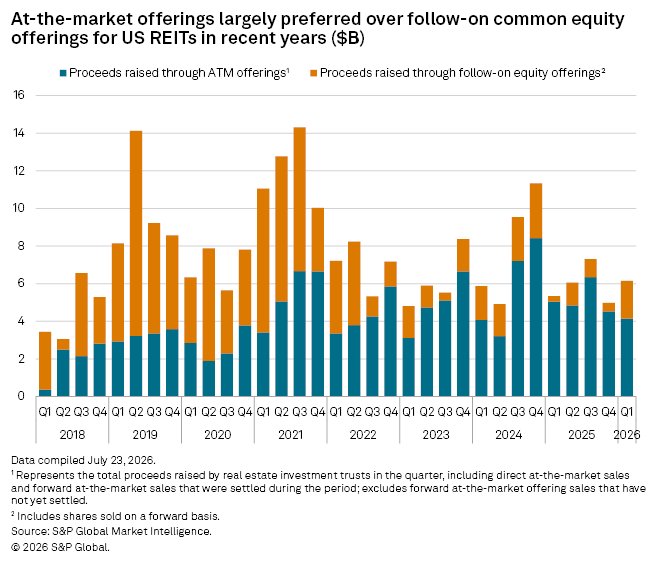
US equity REITs have largely preferred issuing common stock through at-the-market offering programs as opposed to more standard follow-on equity offerings in recent years.
Follow-on common equity offerings have largely declined since the latter half of 2022 as valuations for the sector fell, and common stock issuance through at-the-market programs has remained high over the time period.
US REITs raised $77.58 billion through common stock sold under their ATM programs between July 1, 2022, and March 31, 2026, almost four times the $21.03 billion raised through follow-on common equity offerings. When looking at prior years, follow-on common equity offerings outpaced proceeds raised through ATM programs between Jan. 1, 2018, and June 30, 2022, with $88.91 billion raised compared to $60.74 billion.
Due to US REITs being required to pay at least 90% of their taxable income in the form of dividends to their shareholders, REITs typically carry lower cash on their books as compared to other industry types. ATM offering programs have proved beneficial to US REITs in particular, allowing them to sell additional shares of common stock and raise capital as needed to fund corporate expenses such as developing or acquiring real estate properties or paying down other forms of debt.
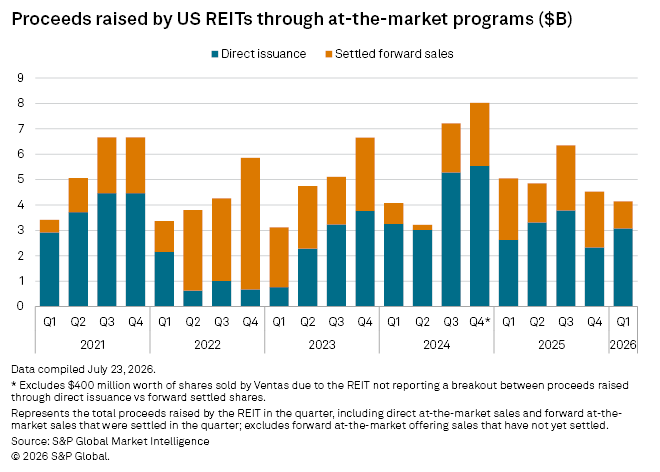
US REITs have also ramped up their usage of forward sale agreements within their ATM programs during recent years, which provides an avenue to issue common stock and collect the associated proceeds at a future date while locking in current share prices.
At-the-market programs carry lower underwriter spreads
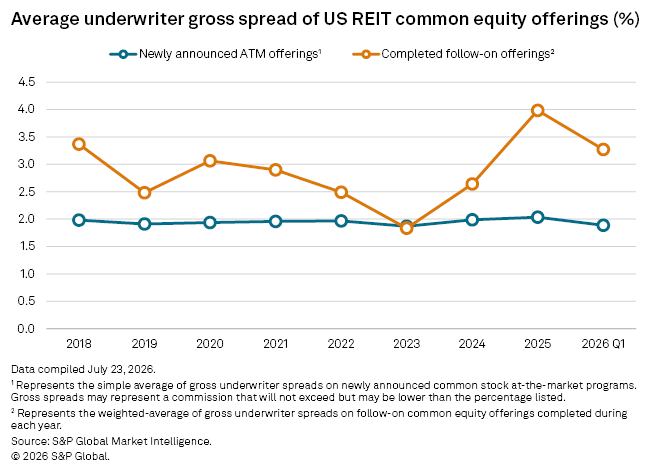
Looking at fees paid to selling agents associated with REIT common stock offerings, ATM programs typically carry lower fees as compared to more traditional follow-on equity offerings.
The vast majority of REIT ATM programs include gross underwriter spreads of no more than 2%. Of the 352 REIT ATM program announcements since 2018, only 11 included rates higher than 2%.
Follow-on common equity offerings for the sector, however, typically carry higher commission spreads. Follow-on offerings completed in the first quarter of 2026 carried a weighted-average gross underwriter spread of 3.3%, while the weighted-average gross underwriter spread on follow-on offerings completed in 2025 stood at 4.0%.
Correlating with the increase in usage of ATM programs by US REITs, the number of selling agents associated with those programs has also risen in recent years.
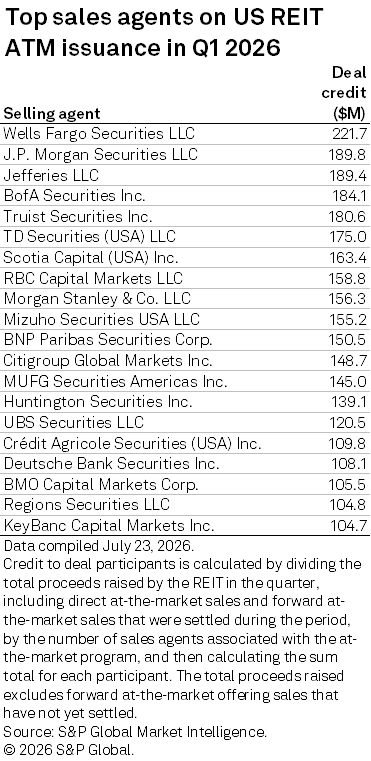
Fifty-two different sales agents were associated with ATM programs utilized by REITs during the first quarter of 2026. Wells Fargo Securities LLC ranked as the top sales agent for REIT ATM programs utilized during the first quarter with $221.7 million in deal credit, followed by J.P. Morgan Securities LLC and Jefferies LLC with $189.8 million and $189.4 million of deal credit, respectively. BofA Securities Inc. and Truist Securities Inc. rounded out the top five sales agents during the first quarter with deal credit of $184.1 million and $180.6 million, respectively.
Credit to deal sales agents was calculated by dividing the total proceeds raised by the REIT in the quarter through its ATM program, including direct ATM sales and forward ATM sales that were settled during the period, by the number of sales agents associated with the ATM program, and then calculating the sum total for each participant. The total proceeds raised exclude forward at-the-market offering sales that have not yet settled.
REITs trading at discounts to net asset value
While valuations for US equity REITs improved significantly during the second quarter of 2026, the majority of REIT property sectors continue to trade at discounts to their net asset value (NAV) estimates.
The US REIT sector closed the second quarter at a median 8.7% discount to NAV. Timber, farmland and communication REITs traded at the largest median discounts to their NAV estimates as of June 30, while the healthcare REIT sector, largely driven by REIT focused on senior housing properties, traded at the largest premium to NAV on a median basis.
Issuing common stock is typically less attractive for REITs trading at low valuations.
This article was published by S&P Global Market Intelligence and not by S&P Global Ratings, which is a separately managed division of S&P Global.