Research — Aug 06, 2026
NYISO transmission growth surges for utilities, falls for New York Transco, NYPA

By Jim O'Reilly
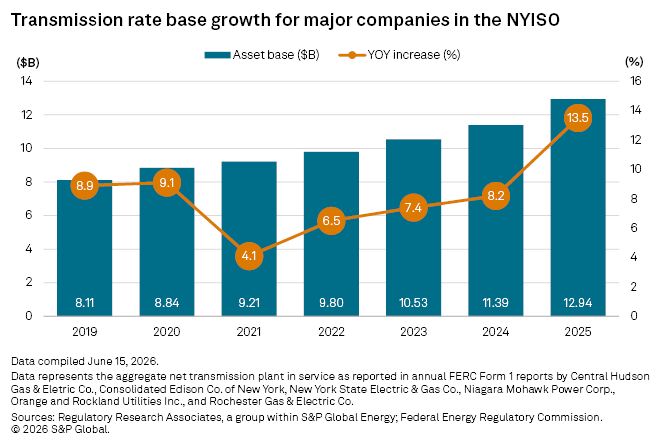
The combined aggregate transmission asset base for six major utilities in the New York Independent System Operator rose to $12.94 billion in 2025 from $11.39 billion in 2024, or 13.5%, the fourth consecutive year of accelerating growth for the companies and the highest annual growth rate in at least seven years. Separately, annual transmission rate base growth for New York Transco LLC and the New York Power Authority (NYPA) declined from the previous year.
|
NYISO Transmission 2026 Update
|


➤ The aggregate transmission asset base for six major utilities in the NYISO showed strong growth of 13.5% year over year in 2025, the fourth consecutive year of accelerating growth for the companies. The growth was led by the two largest companies in NYISO, which together accounted for more than 72% of the six-company total.
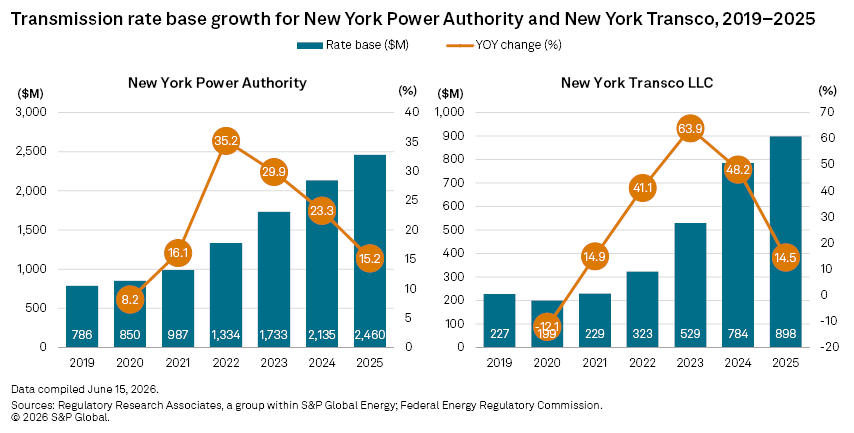
➤ Transmission rate base growth for New York Transco and NYPA had been very strong for both companies, with year-over-year growth of 63.9% in 2023 for New York Transco and 35.2% in 2022 for NYPA, but their year-over-year growth fell to approximately 15% in 2025. Despite the slowdown, both companies have seen extraordinary growth since 2020, resulting in NYPA's rate base more than tripling and New York Transco's rate base increasing by more than four times.
➤ The base return on equity (ROE) for both New York Transco and NYPA was recently modified after both companies sought significant increases at the commission. Settlements in each proceeding resulted in a base ROE of 9.99% for New York Transco and a base ROE of 9.75% for NYPA.

Overview
Regulatory Research Associates annually publishes a series of transmission ratemaking analyses covering the six regional transmission organizations and independent system operators in the US, in addition to a report covering 14 utilities in the West and Southeast regions of the US that are not members of an RTO/ISO. RRA also compiles the seven regional reports annually into one national report that analyzes a total of nearly 100 companies.
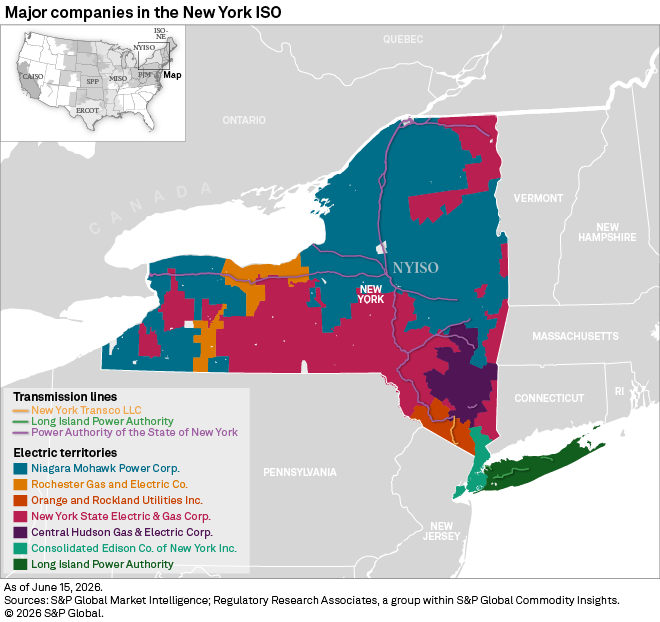
The eight companies in this NYISO analysis include six vertically integrated utilities, a transmission-only company (transco) and NYPA, a political subdivision of the State of New York. The six integrated utilities are subsidiaries of four parent companies, Consolidated Edison Inc., National Grid USA, Avangrid Inc. and Fortis Inc. The transco, New York Transco, is a joint venture of subsidiaries of those same four parent companies.
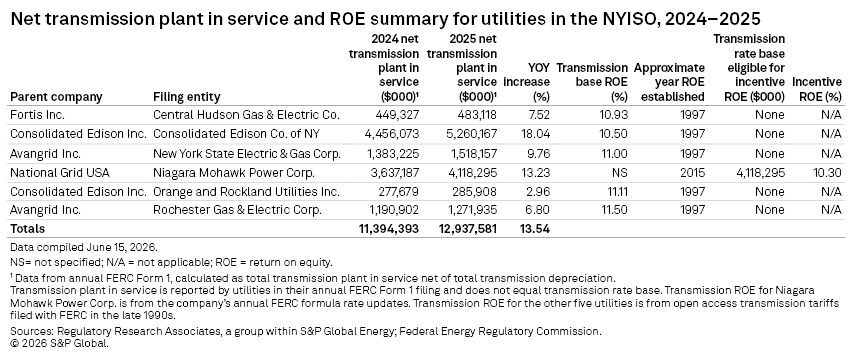
The accompanying table highlights the six integrated utilities covered in this analysis, their reported net transmission plant in service for 2024 and 2025, their base ROE, and any additional ROE incentive adders where applicable.
NYISO growth
The 13.5% year-over-year growth in aggregate transmission plant in service for the six utilities in the NYISO marked the fourth consecutive year of accelerating growth for the companies since 2021 and the highest growth rate since at least 2018. The six utilities have added more than $3 billion in transmission assets during the four years of accelerating growth, and more than $1.5 billion in just the latest year of available data.
The NYISO is currently engaged in a statewide 2026 Reliability Needs Assessment (RNA) process, a biennial study that evaluates long-term New York State transmission system reliability needs using a base case scenario. If reliability needs are found, NYISO issues a competitive solicitation for market-based and alternative regulated solutions. The affected transmission system owners are required to propose regulated fixes to meet the reliability needs.
Companies in the state have continued to build out new transmission infrastructure and announce new transmission investments during the RNA process. Consolidated Edison Co. of New York Inc. (Con Ed) announced it is investing $3.9 billion in its electric delivery system across New York City and Westchester County. The company's investments include 88 new underground transformers, 142 new overhead transformers and 123 spans of underground and aerial cable.
National Grid announced a multiyear Upstate Upgrade project that includes investing more than $4 billion in 70 projects through 2030 to "transform its energy delivery system."
After years of planning, developers of the $3.2 Propel NY Energy Project are poised to begin construction later this year. The project is being undertaken by New York Transco and NYPA and includes underground and submarine electric transmission projects to improve grid reliability and deliver clean energy across Long Island, New York City, and Westchester County. The project includes approximately 90 miles of new underground and submarine cables, including nine miles under the Long Island Sound.
Individual company growth
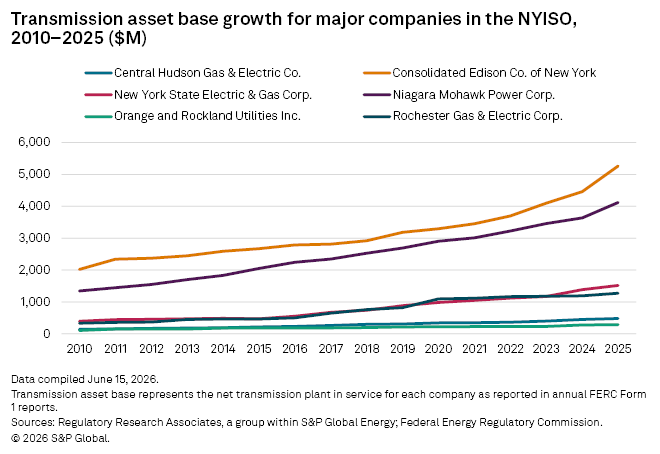
The strong combined year-over-year growth of 13.5% for the six companies was led by Con Ed's very strong 18% growth. The company's reported net transmission plant in service of $5.26 billion represents 40.7% of the transmission plant for all six companies combined.
Apart from the very strong 18% growth in 2025, Con Ed has shown moderate yet steady growth over time, likely due in part to its vast network of underground transmission lines in New York City and Westchester County and the increased costs associated with maintaining and replacing underground infrastructure. Con Ed estimates approximately 70% of the company's transmission infrastructure is underground.
Niagara Mohawk Power Corp.'s $4.12 billion in transmission plant is second only to Con Ed, and the company also recorded strong year-over-year growth of 13.2%. Niagara Mohawk's transmission plant represents another 31.8% of the combined transmission plant for the six companies. Niagara Mohawk utilizes formula rates for transmission, and data from its annual formula rate updates is included separately.
The other four companies recorded slow to moderate growth year over year, from Orange and Rockland Utilities Inc.'s (O&R's) 3.0% to New York State Electric & Gas Corp.'s (NYSEG's) 9.8%.
During the four years of accelerating growth from 2021 through 2025, the six companies added $3.73 billion in net transmission plant, a more than 40% increase.
NYPA and New York Transco also utilize transmission formula rates and report their calculations of rate base, revenue requirement and other ratemaking parameters in annual formula rate updates filed with FERC and posted on RTO/ISO websites. Rate base growth recorded by the two companies, while still strong, declined significantly year over year.
NYPA's annual growth rate has declined in three consecutive years, while New York Transco's annual growth rate declined for the second consecutive year. Both companies have recorded sharp declines in annual rate base growth since NYPA recorded extraordinary growth of 35.2% in 2022 and New York Transco recroded 63.9% growth in 2023.
Despite NYPA's declining growth over the last three years, the company's transmission rate base has more than tripled since 2020, due in part to the $1.1 billion Smart Path Connect project in northern New York. NYPA began construction in December 2022 on the project in partnership with Niagara Mohawk, with an expected in-service date in late 2025. NYPA and LS Power Grid New York Corp. also completed the 93-mile, $600 million Central East Energy Connect transmission project in late 2023.
During the same time frame of 2020 through 2025, and despite New York Transco's declining growth over the last two years, the company's rate base soared from $199 million to $898 million, or more than 300%.
Return on equity in NYISO
Base ROEs and any additional ROE incentives for NYISO transmission owners have been authorized by FERC on a company-by-company basis. Transmission ROEs for the six utilities were established when FERC approved open access transmission tariffs filed by the companies in the late 1990s.
Niagara Mohawk filed an open access transmission tariff in the late 1990s, but the company subsequently received FERC approval to transition from a stated transmission rate to a formula-based rate in 2009. At that time, FERC authorized the company an 11.50% ROE, inclusive of a 50-basis-point ROE incentive adder for participation in the NYISO. A 2015 settlement of a complaint filed by the New York Association of Public Power and the Municipal Electric Utilities Association subsequently reduced the company's ROE to 10.30% "inclusive of any incentive adders."
NYSEG, Con Ed, Rochester Gas and Electric Corp. and Central Hudson Gas & Electric Corp. have received FERC authorization to establish targeted transmission formula rates and associated protocols for recovering the costs of certain eligible transmission upgrades determined by the New York Public Service Commission (NYSPSC) to be necessary to meet New York state climate and renewable energy goals.
NYPA received FERC approval to implement a formula-based rate for transmission in 2017 that incorporated a base ROE of 8.95%, plus the 50-basis-point ROE adder for NYPA's participation in the NYISO. In 2022, FERC granted NYPA a 50-basis-point incentive ROE adder and a performance-based ROE incentive linked to a cost-containment mechanism to reflect the risks and challenges associated with NYPA's investment in the Smart Path Connect project.
On July 11, 2024, FERC approved a 75-basis-point incentive adder to NYPA's authorized ROE for the investment in the Propel NY project, which will also serve offshore wind facilities in New York. NYPA stated that it is jointly developing the Propel NY project with New York Transco and that NYPA's financial share will be between 15% and 30% of the total cost. NYPA explained that it is responsible for development of the land portions of the Propel NY Project while New York Transco will focus on developing the underwater transmission lines.
Most recently, on Oct. 24, 2024, NYPA asked FERC to approve a revised base ROE of 10.98% to be incorporated in NYPA's transmission formula rate, a significant increase from NYPA's then-current base ROE of 8.95%. NYPA argued that the current economic and capital market conditions affecting NYPA's cost of equity are far different than those that applied when NYPA's 8.95% ROE was approved in 2017. On Dec. 29, 2025, FERC approved a settlement in the proceeding that incorporates a base ROE of 9.75% for NYPA.
New York Transco received FERC approval to implement a formula-based rate for transmission in 2016 in a partial settlement that established a 9.50% ROE for the company, plus a 50-basis-point incentive ROE adder for the company's investment in certain transmission projects known as the Transmission Owner Transmission Solutions. In 2017, FERC approved a separate settlement that established a 9.65% base ROE and a 100-basis-point incentive ROE adder for New York Transco's investment in certain transmission lines known as the Alternating Current Transmission Projects.
On Oct. 2, 2025, New York Transco submitted a proposed settlement of the company's request to modify its formula transmission rate and establish a new companywide base ROE for transmission investments other than the Propel NY project. On Dec. 22, 2025, FERC approved the settlement in the New York Transco proceeding that incorporates a base ROE of 9.99% for all of the company's transmission investments except the Propel NY project.
Separately, on Dec. 19, 2024, FERC authorized New York Transco a base ROE of 10.30%, a 75-basis-point "risks and challenges" ROE adder and a 25-basis-point "grid enhancement" ROE adder for a portion of the Propel NY project, which are intended to reflect the project's reliability and congestion relief benefits.
RRA's analyses and the NYISO companies
Of the six integrated utilities in this analysis, only Niagara Mohawk uses FERC-approved formula rates for transmission and reports transmission rate base in annual updates filed with FERC. Current and historical ratemaking data from Niagara Mohawk's annual formula rate updates are included in this analysis where indicated. New York Transco and NYPA also use FERC-approved formula rates for transmission, and current and historical ratemaking data from their annual transmission formula rate updates are detailed in the linked data tables.
In lieu of reported transmission rate base for all six integrated utilities in annual formula rate updates filed with FERC, transmission asset base for those utilities was calculated as net transmission plant in service, or gross transmission plant in service minus total transmission depreciation, based on data reported in the companies' annual FERC Form 1 filings.
The Form 1 is filed by major electric utilities in April each year with the previous year's data. Three of the companies in this analysis use formula transmission rates and report transmission rate base in annual updates filed with FERC.
Regulatory Research Associates is a group within S&P Global Energy.
S&P Global Energy produces content for distribution on S&P Capital IQ Pro.
For a complete, searchable listing of RRA's in-depth research and analysis, please go to the S&P Capital IQ Pro Energy Research Library.
This article was published by S&P Global Market Intelligence and not by S&P Global Ratings, which is a separately managed division of S&P Global.