ECONOMICS COMMENTARY — 06 Aug, 2026
Middle East economic growth in lower gear amid ongoing conflict

Middle East PMIs show uneven economic effects from regional conflict in 2026. Non-oil economic growth has recovered on average from the lows seen in March, when activity weakened sharply following the initial US attacks on Iran, but momentum remains below pre-conflict levels. Since March, Saudi Arabia has led the recovery, UAE growth has steadied in a lower gear, Lebanon has stabilised, but Kuwait and Qatar have continued to struggle.
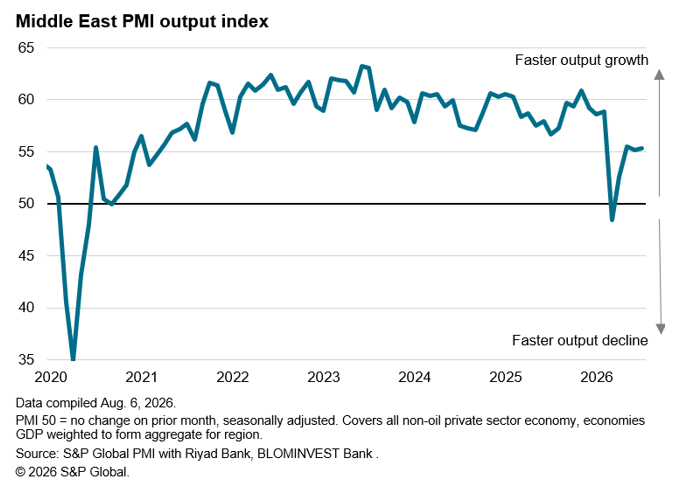
Middle East growth revives from March low
S&P Global’s PMI surveys cover a range of key Middle East economies, allowing an assessment of the impact of the conflict in the region in 2026 so far.
By way of background, the Middle East PMIs cover all private sector business activity excluding the oil economy. This encompasses manufacturing, traded services, construction, retail and wholesale. The data therefore provide a valuable advance guide to non-oil gross domestic product.
The data generally show that growth rates have rebounded from the lows seen early in the conflict, but that growth remains weaker than before the initial US attacks on Iran on 28 February.
A headline PMI output index for the Middle East, derived by weighting individual survey data by each economy’s non-oil GDP, sank from 58.9 in February to 48.5 in March, indicating the first contraction of output across the region for nearly six years. However, the index has since recovered to a level of 55.4 in July, broadly unchanged on the resilient readings seen in May and June, though well below the average of 58.9 seen in the three months prior to the conflict.
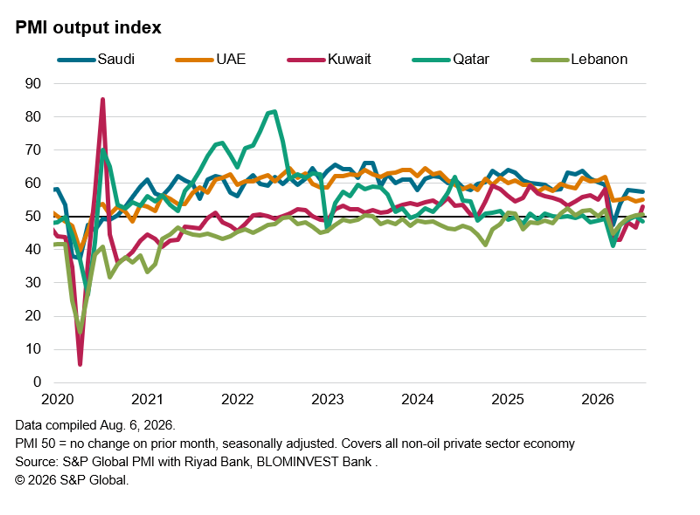
Saudi Arabia and UAE led growth ahead of conflict
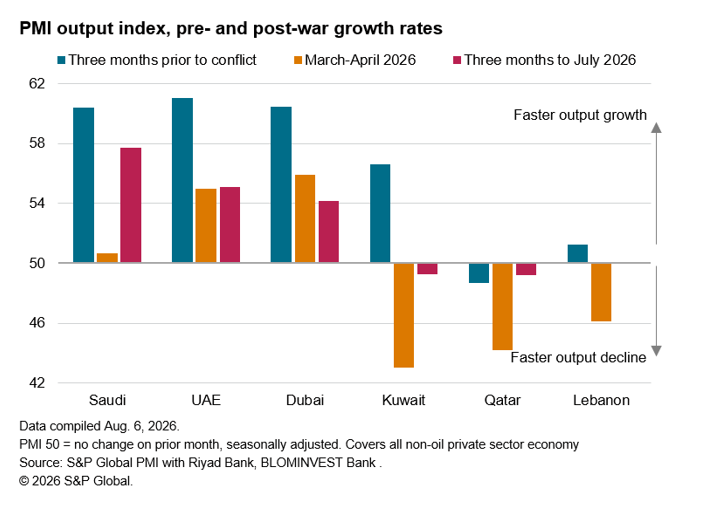
In the lead-up to the war, especially robust growth rates were recorded in Saudi Arabia and the United Arab Emirates. More modest but still robust growth was meanwhile seen in Kuwait and Lebanon, but business activity had reportedly fallen in Qatar in the lead-up to the conflict.
March saw business activity fall in Saudi Arabia for the first time since August 2020, during the COVID-19 pandemic, with output also down in Kuwait for the first time since early 2023 and lower in Lebanon for the first time in eight months. Growth meanwhile slowed sharply in the UAE, including in Dubai, while the downturn deepened in Qatar.
March was consequently a low point for the region, but since then growth has on average resumed and accelerated into July.
Mixed recoveries
However, trends have varied since March.
The strongest growth of output in the three months to July has been recorded in Saudi Arabia, albeit remaining below the pace seen in the lead-up to the conflict. In the UAE, growth held broadly steady on average at the slower rate seen in March and April. Output has meanwhile steadied on average over the past three months in Lebanon.
However, the past three months have seen output fall on average in Kuwait and Qatar. Encouragingly, Kuwait returned to growth in July for the first time since February.
© 2026, S&P Global. All rights reserved. Reproduction in whole or in part without permission is prohibited.
Purchasing Managers' Index™ (PMI®) data are compiled by S&P Global for more than 40 economies worldwide. The monthly data are derived from surveys of senior executives at private sector companies, and are available only via subscription. The PMI dataset features a headline number, which indicates the overall health of an economy, and sub-indices, which provide insights into other key economic drivers such as GDP, inflation, exports, capacity utilization, employment and inventories. The PMI data are used by financial and corporate professionals to better understand where economies and markets are headed, and to uncover opportunities.
Read our latest PMI commentary here.
This article was published by S&P Global Market Intelligence and not by S&P Global Ratings, which is a separately managed division of S&P Global.
Theme
Location
Products & Offerings