Research — Aug 28, 2026
How Lead, Silver and Copper Credits Are Reshaping Zinc Mine Profitability
By Jason Holden and Monica Ramirez
How are by-product credits impacting zinc mine profitability?
By-product credits from associated metals like lead, silver and copper are now the primary driver of cost competitiveness for primary zinc mines. S&P Global Market Intelligence analysis shows that the value of these by-products has a greater influence on reported all-in sustaining costs (AISC) than operational performance improvements. Projections for 2026 indicate that strong by-product credits will be the main factor behind a 6.4% decline in global zinc AISC, fundamentally altering how zinc assets are valued.
Key Takeaways
By-product credits drive cost competitiveness
➤ By-product credits now drive zinc cost competitiveness. By-product credits rather than reductions in mine-site costs drive the projected 2026 AISC decline.
Silver's impact on revenue volatility
➤ At many polymetallic zinc operations, silver is the largest source of by-product revenue volatility. At a $40.31/oz average in 2025, silver can move a mine on the cost curve to the March quarter from the September quarter, with no change in operational performance.
Decomposing cost reporting
➤ Standard cost reporting obscures the real picture. AISC must be decomposed and stress-tested under multiple by-product price scenarios.
Valuation of polymetallic assets
➤ Zinc mines are polymetallic businesses, while Red Dog, Mt Isa Zinc and Rampura Agucha are multi-commodity operations, and valuation frameworks need to reflect this.
What is driving the forecast decline in zinc mining costs for 2026?
Zinc has long been the primary metal that covers the cost of mining. The lead, silver, copper and germanium come along as a bonus, by-products that reduce unit costs but do not fundamentally alter the operational economics.
That is changing. With silver forecast to average US$73.35 per ounce in 2026 and lead holding close to US$2,000 per metric ton, by-product credits have become one of the most important drivers of zinc mine cost competitiveness. For many operations, the credits now have a greater influence on reported costs than improvements in mining performance. S&P Global Market intelligence's latest projections for 2026 indicate that global zinc all-in sustaining costs (AISC) for primary zinc mines will decline 6.4% in 2026, to 85.17 cents per pound from 91.01 cents/lb in 2025, under coproduct costing, driven primarily by strong by-product credits and shifting treatment charge dynamics rather than by broad-based improvements in mining productivity. This shift has material implications — for how we value zinc assets, assess cost-curve positioning and gauge the risk profile of an industry whose fortunes are increasingly determined by the prices of metals that are nominally not its primary product.
The polymetallic reality of zinc mining
Zinc deposits are overwhelmingly polymetallic. The geological processes that concentrate zinc — particularly sedimentary exhalative (SEDEX) and volcanic-hosted massive sulfide (VHMS) mineralization — almost invariably concentrate lead, silver and often copper alongside it. As a result, many of the world's largest zinc mines derive a significant share of their value from by-products, with payable lead, silver and copper revenues materially reducing the effective cost of zinc production.
Case study: Teck Resources' Red Dog mine
Teck Resources Inc.'s Red Dog mine in Alaska, US — the world's largest zinc mine — produced about 424,500 mt of payable zinc in 2025, representing about 6% of global zinc mine production. The operation also produced about 96,900 mt of payable lead, equivalent to about 3.8% of global lead mine production. In addition, Red Dog is an important source of silver and contributes to the supply of germanium, a critical technology metal recovered from Red Dog concentrate processed at Teck Resources' Trail operations in British Columbia.
Case study: Glencore's Mount Isa complex
Glencore PLC Mount Isa complex in Queensland, Australia, has historically been a significant producer of zinc, lead and silver. In 2025, the mines yielded 288,200 mt zinc, 90,700 mt lead and about 3.59 million oz of silver, with the cash cost after by-product credits falling to just 29 cents/lb of zinc. At that cost level, the lead and silver credits were not supplementary; they were the difference between a competitive operation and a marginal one.
This polymetallic character is the norm. Any analysis of zinc mine economics that treats by-product credits as incidental noise rather than as a structural determinant of profitability is analytically incomplete.
How by-product credits reshape the zinc cost curve
The standard by-product methodology for reporting zinc mine costs — whether total cash cost (TCC) or AISC — deducts by-product revenue from the cost base and expresses the residual as a cost per unit of the primary metal. This is analytically convenient and commercially standard, but it creates a reporting framework in which by-product prices can move a mine's position on the global cost curve by hundreds of positions without any change in its actual operational performance.
Hypothetical impact of price changes
Consider a hypothetical zinc mine annually producing 100,000 mt zinc, along with 30,000 mt lead and 2 million oz silver, with total site costs of $200 million. At a lead price of $2,050/mt and a silver price of $40.31/oz for 2025, the by-product credits total $142 million, reducing the net zinc cost to $57 million, or approximately 26 cents/lb of zinc.
If silver rises to $73.35/oz (per the consensus price forecast for 2026) and lead holds steady, total by-product credits would increase to approximately $208 million, exceeding the mine's total site costs. As a result, the operation would report a negative net zinc cost of approximately 3.7 cents/lb. The mine's operational performance has not changed, but its position on the zinc cost curve has improved significantly due to stronger by-product revenue.
This example illustrates a broader feature of zinc mining economics. Under the standard by-product costing methodology, changes in silver and lead prices can have a larger effect on reported costs than changes in mining performance itself. As by-product credits rise, mines move down the cost curve, even though their underlying operating costs remain unchanged.
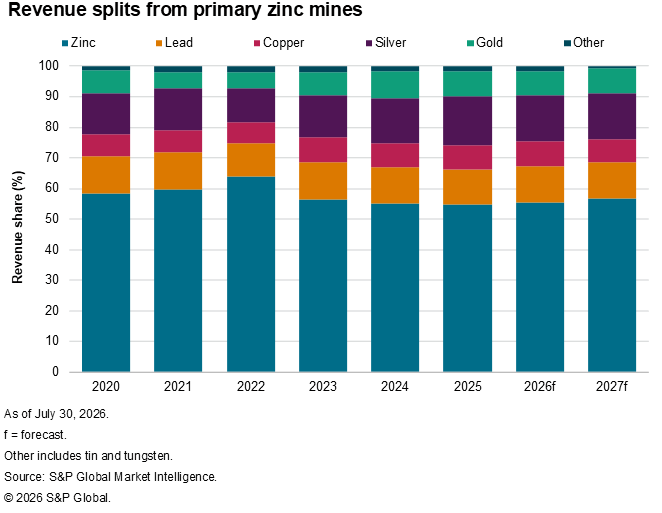
What are the revenue shifts toward by-products of zinc?
Zinc's share of total mine revenue has declined to about 55% by 2024-2026 from a peak of 63.9% in 2022. The decrease is not because zinc revenue collapsed, but because silver and gold by-products are capturing a growing slice, rising to nearly 25% combined from 21%. Silver has stood out, climbing to 16.1% from 11.2% of revenue by 2025, as elevated prices and tightening physical markets make silver credits increasingly critical to mine-level profitability. At the same time, the operating mine count has contracted 18% to a projected 115 by 2027 from 141 in 2020, yet total sector revenue remains elevated, indicating consolidation around fewer, larger and more by-product-rich assets.
The potential for negative reported costs
At current by-product prices, lead and silver credits can be large enough to offset an operation's entire cost base, resulting in negative reported zinc costs under the standard by-product accounting methodology.
This is not merely hypothetical. Silvercorp Metals (China) Inc., which operates polymetallic silver-lead-zinc mines in China's Henan and Guangdong provinces, reported a cash cost per ounce of silver — net of by-product credits from lead and zinc — of negative 54 cents/oz for fiscal year 2025. The by-product credits were so large that they more than fully offset the direct costs of mining and processing the ore. Silver was, in a narrow accounting sense, produced at a negative cash cost after by-product credits.
Silver prices have nearly doubled in 2023-25, driven by strong industrial demand (particularly from photovoltaics), monetary hedging and constrained supply from primary silver mines.
The disproportionate effect of silver
The scale of the silver effect is disproportionate to the tonnage involved. A zinc mine with an output of 100,000 mt zinc is producing about 62 metric tons of silver (2 million oz), which is less than 0.1% of total ore throughput by weight. Yet at $73.35/oz, those 62 metric tons generate $146.7 million in revenue, equivalent to 43.8% of the projected zinc revenue based on the 2026 price forecast of $3,349/mt.
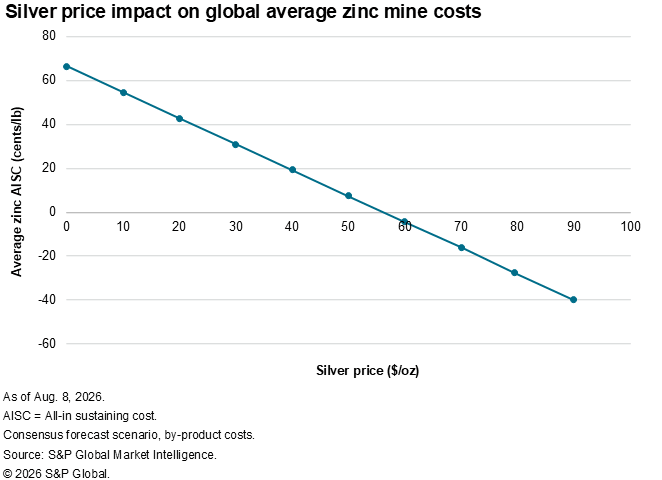
Silver's inverse impact on costs
Silver has an inverse impact on the zinc primary mine AISC through by-product credits. As the silver price rises, the value of silver by-product credits increases, which reduces the reported AISC.
Silver by-product credits act as a powerful cost differentiator across the global zinc mining sector, with the most silver-intensive operations — Cerro de Pasco, Yauliyacu and Yubang — consistently occupying the lowest-cost quartile. The relationship is geographically concentrated: Peru, Mexico and Bolivia host the most silver-rich polymetallic zinc deposits, giving Latin American operations a cost advantage over their peers. In contrast, China leads in mine count but relies on low labor and energy costs rather than by-product credits, representing a different economic model. Notably, 38% of zinc mines produce no silver, leaving them fully exposed to zinc price cyclicality without the cushion of precious-metal revenue.
Lead: The underappreciated companion
Lead receives less attention than silver, as it is neither as glamorous nor as volatile. But for many zinc operations, lead is the more reliable and voluminous by-product credit. The geological co-occurrence of zinc and lead in SEDEX and Mississippi Valley-type (MVT) deposits means that most major zinc mines produce substantial lead tonnages. At Red Dog, the lead-to-zinc production ratio is about 1-5 by weight, while it has historically been closer to 1-1.8 at Mount Isa.
Stable demand for lead
Lead demand is largely driven by lead-acid batteries, a mature but large and stable end-use that provides a floor under lead prices. With the global vehicle fleet continuing to grow and lead-acid technology retaining a significant role in hybrid and start-stop automotive applications despite the rapid growth of lithium-ion batteries, lead-acid batteries continue to dominate starter-battery applications and remain the largest source of global lead demand.
For zinc mines, lead's contribution is particularly valuable because it is recovered at low incremental cost, liberated during the same milling and flotation process that produces zinc concentrate and sold as a separate concentrate stream. The incremental processing cost is a fraction of the cost of producing either metal in isolation, indicating that the lead credit flows almost entirely to the bottom line.
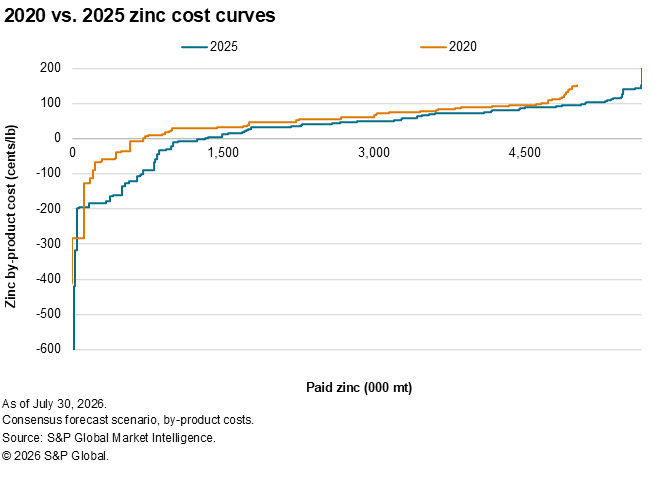
Transformation of zinc mine economics
By-product credits have transformed zinc mine economics over 2020-25, with the industry's weighted-average TCC falling 26 cents/lb as silver and gold prices surged. The share of mines where by-product revenue fully offset cash costs has more than doubled — to 28% in 2025 from 11% in 2020 — improving the sector's cost resilience. China, Canada and Australia have been the primary beneficiaries, with operations such as Lalor Lake and Wuji swinging into deeply negative TCC positions on the back of precious-metal credits. However, the mine count has contracted to 126 from 160 over the period, showing the cost improvement is concentrated among fewer, more by-product-rich survivors.
Copper, germanium and the long tail of value
Beyond lead and silver, some zinc deposits contain meaningful copper mineralization — typically as chalcopyrite intergrown with sphalerite — and a suite of minor and trace metals that can be recovered during smelting and refining. Copper credits are particularly significant at VHMS-type deposits, where the polymetallic character of the ore often includes a copper-rich zone that can be selectively mined or processed.
Germanium is recovered as a by-product of zinc smelting and is classified as a critical mineral in most countries. Red Dog's zinc concentrate, when processed at Teck Resources' Trail smelter, yields germanium that enters the supply chain for fiber optics, infrared optics and solar cells. Its value is not typically disclosed separately in mine-level cost reporting. Still, it can be meaningful and adds a strategic dimension to zinc mine valuation that extends beyond commodity pricing.
Indium, gallium and cadmium are also recovered from zinc smelter residues at various operations globally.
By-product credits are no longer a secondary consideration in the economics of zinc mines and are the primary driver of cost competitiveness across the global zinc industry. Silver at $73.35/oz transforms the cost curve, lead at $1,962/mt sustains the base, while copper, germanium and minor metals add incremental value and strategic relevance.
The zinc mine of today is not a monoculture. It is a polymetallic enterprise whose economic viability is jointly determined by the prices of zinc, lead, silver and a suite of critical and precious metals that share the same orebody.
This article was published by S&P Global Market Intelligence and not by S&P Global Ratings, which is a separately managed division of S&P Global.
How does S&P Capital IQ Pro support the analysis of zinc mine costs?
The Metals and Mining data and research on Capital IQ Pro provide granular, asset-level information to analyze the complex economics of polymetallic zinc mines. Our platform allows users to deconstruct reported costs by accessing detailed production data for primary and by-product metals, mine-level cost metrics such as AISC and TCC, and comprehensive commodity price forecasts via the Mine Economics solution. Our users can stress-test asset valuations under multiple by-product price scenarios, identify which operations are most sensitive to fluctuations in silver and lead prices, and build a more accurate picture of cost-curve positioning, thereby addressing the analytical challenges highlighted in this research.
Frequently Asked Questions About By-Products in Zinc Mining
What is the impact of silver prices on zinc mine costs?
Silver prices have a significant inverse impact on the reported costs of zinc mines through by-product credits. As the price of silver rises, the revenue generated from silver produced alongside zinc increases, which is then deducted from the mine's operating expenses under standard cost accounting. This can substantially lower the reported AISC per pound of zinc, to the extent that some mines can report a negative net by-product cost, meaning by-product revenue exceeds total site costs.
Which regions benefit most from silver by-product credits?
Latin American operations derive a significant cost advantage from silver by-product credits, as the region hosts many of the world's most silver-rich polymetallic zinc deposits. Countries such as Peru, Mexico and Bolivia are home to mines like Cerro de Pasco, Yauliyacu and Yubang, which consistently rank in the lowest quartile of the global cost curve due to their high silver output.
Why is lead an important by-product of zinc mines?
Lead is an important by-product for zinc mines because it is a reliable, high-volume source of revenue that provides a stable cost credit. Most major zinc deposits also contain substantial lead mineralization, and demand for lead is anchored by the large, mature market for lead-acid batteries. Because lead is recovered at a low cost using the same processes as for zinc, its revenue flows almost directly to the bottom line, enhancing mine profitability.
What does it mean for a mine to have a 'negative cost'?
A mine has a "negative cost" when its revenue from by-products (such as lead, silver or gold) is greater than its total on-site operating costs for a given period. Under the standard by-product costing methodology, these credits are subtracted from gross costs. If the credits exceed the costs, the resulting net cost per unit of the primary metal (e.g., zinc or silver) is negative, even though the mine still incurred positive operating expenses.
S&P Global uses generative AI to create FAQ content in accordance with our Terms of Use
Content Type
Location
Products & Offerings
Segment
Language
